But First a Stop in Fiji!
Rebecca’s text in italics and Woody’s in regular… For readers new to our blog, click here…
For those of you that are reading one of our blogs for the first time, the blog is called “Fridaes’ Adventures,” obvious enough, but we added an explanatory subtitle of “People First.” This calls out our tendency to be more interested in the people we meet than the places we go. We try to get to know the people first and let them teach us about the landmarks, the food, and the culture. The magic is hardly ever planned, but for us it unfolds usually when we find something or meet someone unexpected: serendipity. A great day is one in which we had nothing planned, or when we abandon a plan because somebody tells us about a more interesting place to see or an activity to do, and it often turns out better than anything we could have planned.
We travel primarily using Airbnb. One reason is that there is a simple tool you can use on the website to communicate with your hosts before you make an arrangement to stay. (Some people might call this a “hack,” but it’s just a friendly way to talk with your potential hosts before you agree to rent.) We often tell our hosts that we keep a blog and would like to get to know them as a part of our stay. Some hosts are very willing but some tell us that they’re busy, don’t have the time, or maybe that it’s just a business and that they don’t even live onsite. That is fine for us if we’re not interested in writing about that town or place. But often, we want to investigate a place, and they’re is no better place to start learning than with your host. And when a host is interested in us, and willing to open up, that makes for a brilliant start! In this blog, we dived right in and met a host who was very willing to share generously!
Rebecca’s writing is entered in italics and mine is in normal text like this. She usually does the hard work of remembering people and place names, and she often records the food we eat. For my part, I often try to research the place a bit and throw in some history and analysis. We record them this way so you get a bit of our unique voices. Also, our trips are recorded here newest at the top. So if you’re following longer, multi-part story, you might need to scroll down to find the beginning of it. Happy reading. We love to hear from our readers in the comment section below. Tell us if any of this is interesting or if you’ve had similar experiences. And please subscribe and share on social media. If you subscribe you’ll receive an email when we post a new blog, and that’s only a few times a year, at best. Thanks for coming along!

Travel is about being open to new ideas, and I am struck by how quickly this one begins in teaching us new things. When we were booking this trip, we noticed that there was a stopover in Fiji. So we thought, “why not stop over in Fiji? But became something much bigger. Forgive the detail we get into, and feel free to skip ahead if you want. But for us, it was compelling. Little did we know that this first episode would prove to be the most profound experience of all, perhaps. Stay with us to see why.
Leaving out of SFO…
We were somewhat worried that we had not been able to check in online, so we got there a bit early… three hours early! “Oh, we just wanted to see your passports,” Kelli said, our American Airline agent, told us.
Once past the TSA and the anxiety associated with pre-travel preparations, we walked around the corner from the inspection station and who should we see. facing us? It was California icons San Francisco Mayor London Breed and Harvey Milk. Their larger-than-life images meet us as we round the corner into the terminal. This is also what arrivals to SFO see as they walk off the planes–first impression of the Golden State.
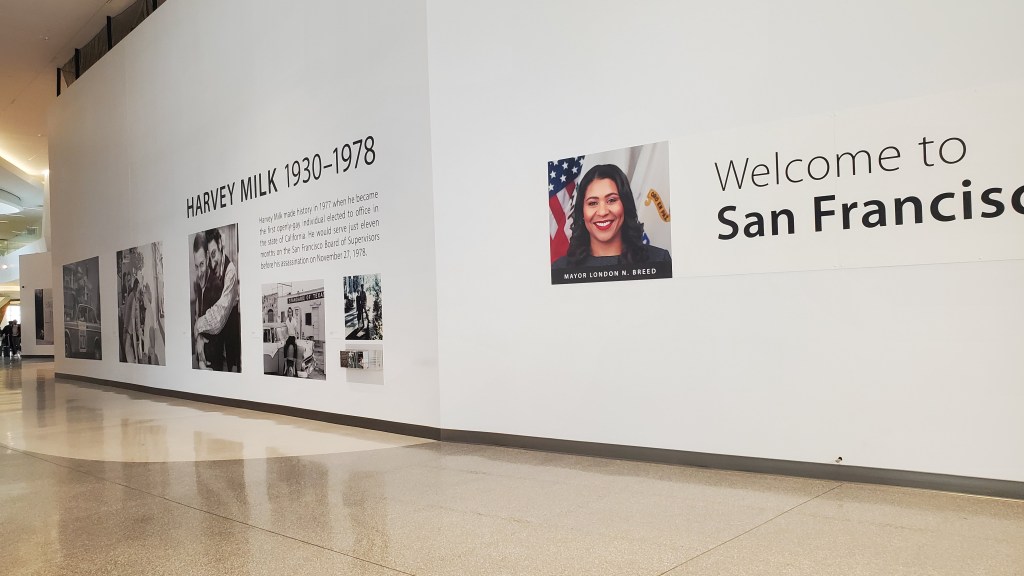
London Breed and Harey Milk greet incoming passengers at SFO.
Click to read more about Breed and Milk.
Harvey Milk, inventor of the Rainbow flag, never seemed to give up his high ideals. He is known as the first openly gay man to be elected to public office in California when he won a position to the San Francisco Board of Supervisors in 1977. Milk crafted the first pro-gay bill prohibiting discrimination in employment and housing. He was assassinated by Dan White who was the one dissenting vote against his bill. His short political career tragically ended, arguably, because it was too liberal.
Unlike Milk, Breed contrasts sharply Milk. Breed is the queen of seconds: just elected to her second term already, second black mayor, and the second woman to serve as San Francisco’s mayor. Despite headlines blaming the homeless problem on Mayor Breed, she has nearly doubled the capacity of programs to get people experiencing homelessness shelter and a path to move off the street. ”But not without accountability,” she said recently, an effort to force intervention. But San Franciscans are not giving her much slack, I read, while waiting for our plane to arrive. Breed has turned more conservative in her second term, as conservative as a Democrat can get and still hold office here. If she loses her next election, it seems, it will be because she’s too conservative.
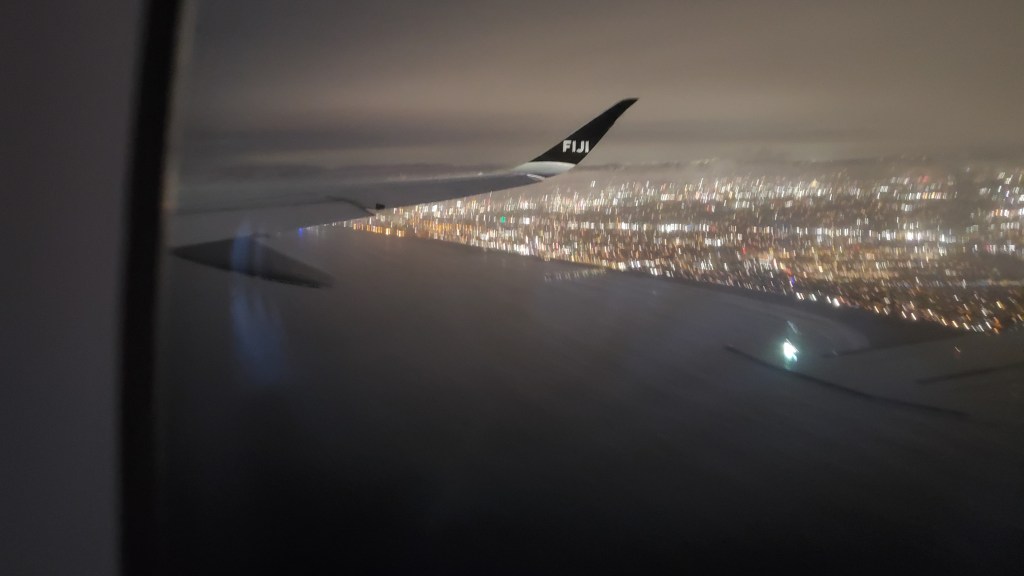
Once onboard the overnight flight to Fiji, things went smoothly. On the flight, I read some articles about Fiji, trying to learn a bit the history of the island. Later, I actually slept a bit, unusual for me, making me ignore the fact that we move back four hours, and forward a day.
A brief, and perhaps not entirely accurate historical background of Fiji: I guess I had always thought of Fiji as a single, purebred bloodline and culture. But the more I learn, it is anything but. Even before the European “first landing” in the 17th century, groups of settlers from Austronesians, Lapita, and Polynesians visited, then moved on to Samoa, Tonga, and Hawaii. These islanders had been island-hopping and swapping DNA for 25 centuries before the westerners even saw the place. Click for more history…
Then there was another 2500 years to go before Captain Cook ever saw the island. This blending of cultures was just getting started.
Obviously, these Pacific Islanders had become very adept at sailing stretches of 500 miles or more at a time. It was even proven by Thor Heyerdahl long after anthropologists had proclaimed that the these islanders were cut off from the “New World” that even a Norwegian academic could construct a raft (he called the Kontiki) and sail from Peru and reach Polynesia without the skill of a sailing culture of millennia behind him. Since then, genetic proof has been discovered that verifies that the Pacific Islanders have traces of South American DNA.
Trade routes established in the 1800’s were far more important than the brief visits of Captains Cook (1774) and Bligh (1789). Sandalwood and “beche-de-mer” (sea cucumber) were so desired that traders kept coming back to the islands for more. I wonder just how you would fill a ship with the giant sea worms. But apparently, they were and still are so highly prized that today they sell for upwards of $100 a pound!
And then there is religion. In the 1830’s, missionaries from England began to arrive and settle in Fiji (as well as in other Southwest Pacific islands) to preach the Gospel. The local chiefs tolerated these intrusions to their culture as a “mixed blessing,” but not perhaps in the sense that the Bible uses the word “blessing.” On one hand, the chiefs considered these settlements a boon to the trade that they wanted to encourage. But on the other hand, the teachings of the missionaries began a gradual destruction of tribal customs and cohesiveness, eventually leading to tribal war among the tribes and against the missionaries. So they allowed the missonaries to stay but hated the cultural damage they saw beginning to unfold.
In 1871, in an effort to compete on a more global scale, an administrative government was set up with representatives from all the major tribal chiefs. They copied the British form of government with a constitutional monarchy. The “Paramount Chief” was Seru Epenisa Cacobau, and he assumed the role of the King of Fiji, but that didn’t last long. Because he was faced with mounting debts of running the infant country, he ended up ceding the country to England to cover those debts, and the soon the island became an English Colony.

Fiji’s history was checkered, and that’s putting it mildly. An early Christian missionary, Thomas Baker, had an unfortunate end to his proselytization. In 1868, he and seven of his Christian initiates were killed and eaten when they entered an inland village of Nabutatau. But there was an official apology issued when the descendants of the clan performed a ceremonial “reconciliation,” a over a century later in 2003.
Slavery was practiced in Fiji for a time. It became a location where cotton was grown to take up the slack in supply in the mid 1800’s when the US was busy with a civil war. They followed the US style of plantations, complete with slave quarters and overseers. But the British tried to normalize it by saying that it was just “indentured servitude,” a sort of a willing bargain to work for a time expecting a reward in the end. They failed to mention the fact that the living conditions, beatings, and rape were just as bad as what was going on with US slavery. And the freedom did not come quickly, either.
And all this bring us to the 1879 when the British decided to move Indians (from India) en masse from one colony (India) to Fiji to work in the sugar cane fields. This of course caused lots of disruption to the social fabric of both India and Fiji. Not the least of which was upsetting the labor market with the native Fijians. Suddenly the Indians were inserted into this caste system somewhere in the middle while the westerners were on the top of the ladder, and the Fijians were subjugated to the bottom rung.
Various religions have flourish on Fiji, falling along ethnic lines. Nowadays nearly 32% are Methodist, 28% are Hindu, 9% are Catholic, and 6% are Muslim. While social and racial lines were rarely crossed in the past, it seems that these divisions are beginning to blur nowadays.
Recent laws have been enacted to make education and medical care more egalitarian. Women are beginning to gain some control over issues, especially in local government, but domestic violence remains a difficult current issue. There have been four coups in the last 40 years, mostly arising from tension from the Fijian majority and the more powerful Indian minority. Despite all these issues, Fijians are probably some of the nicest people that you will ever meet. They are welcoming, polite, and generous to a fault.
Landing in Fiji
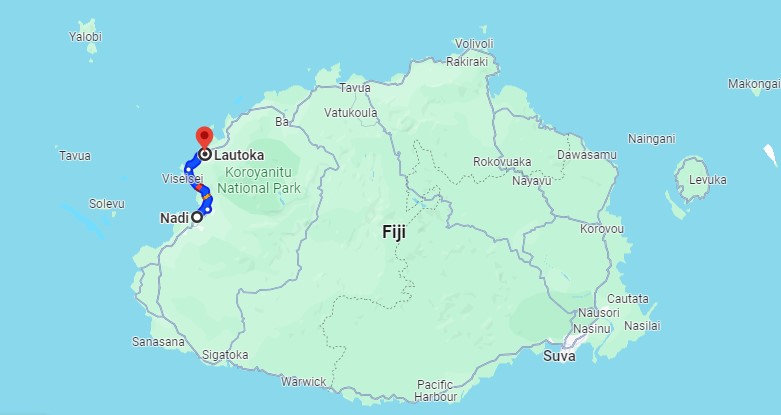
We landed at 5:30 am at Nadi International Airport. Even in the cool air of the dawn, the heat and humidity crept under my clothing. I immediately shed the light jacket I had on and still I could feel the sweat start to trickle down my back.
I had been communicating with our Airbnb host by text. She told us that she would send her taxi driver/husband, Kelechi, come fetch us. Soon he greeted us with a big smile and somewhat silent disposition. Her husband is from Nigeria. He makes his living here as a taxi driver, but he also is a auto and motorcycle mechanic. Later he told us in more detail that he worked as a young man in Norway and Belgium by buying old cars and bicycles, sending them in shipping crates to Nigeria, then fixing them up for resale. His business grew until he hired someone to receive the crates and reassemble and repair the bikes and cars he sent. That way he became a full time buyer. In this way, he recycled old cars, motorcycles and bicycles from Europe to Nigeria. It amazed me that he was able to learn various languages, travel to Europe, start his business, and make such a success of himself. We heard about all this during the 30 minute drive in the early morning from the airport to their home. Their beachfront home is just about 25 kilometers north, near the third largest city and former capital of Fiji, Lautoka.
Our Airbnb host, Priscilla, had told us that her husband could pick us up at the airport. Kelechi found us at the airport and drove us out of Nadi–-the second largest town on the island–north, up the western coast. The lush growth all around reminded me of Indonesia. A high rocky range rose to the north covered in dense jungle growth but we drove through flat land filled with mimosa, mango, and banana trees, and bougainvillea vines in hues of reds and pinks.
Brahman cows and skinny horses were staked on long ropes along the way–behind them were low concrete house with corrugated tin roofs. Some were brightly painted. The two lane highway had speed bumps to slow traffic down, but between these, the cars seemed to speed up again.
There were lots of businesses along the way–car repair, stores selling appliances, and make-shift fruit stands with people selling watermelons and coconuts. In the distance we could see the blue Pacific.
Kelechi turned the car onto a nondescript driveway under some big, big acacia trees and down, close to the ocean. The recent rains made the dirt driveway muddy and the grass puddled with soggy patches.’
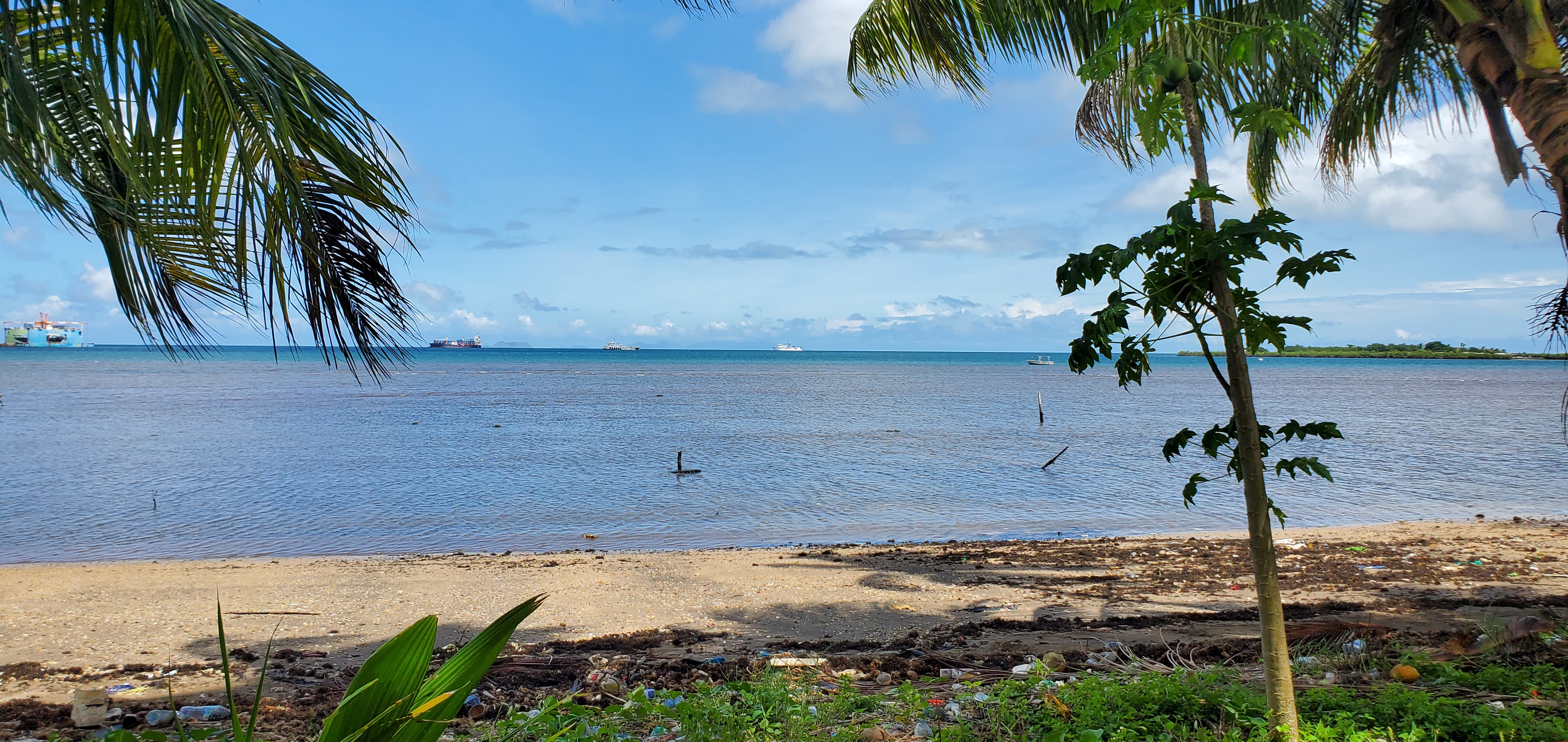
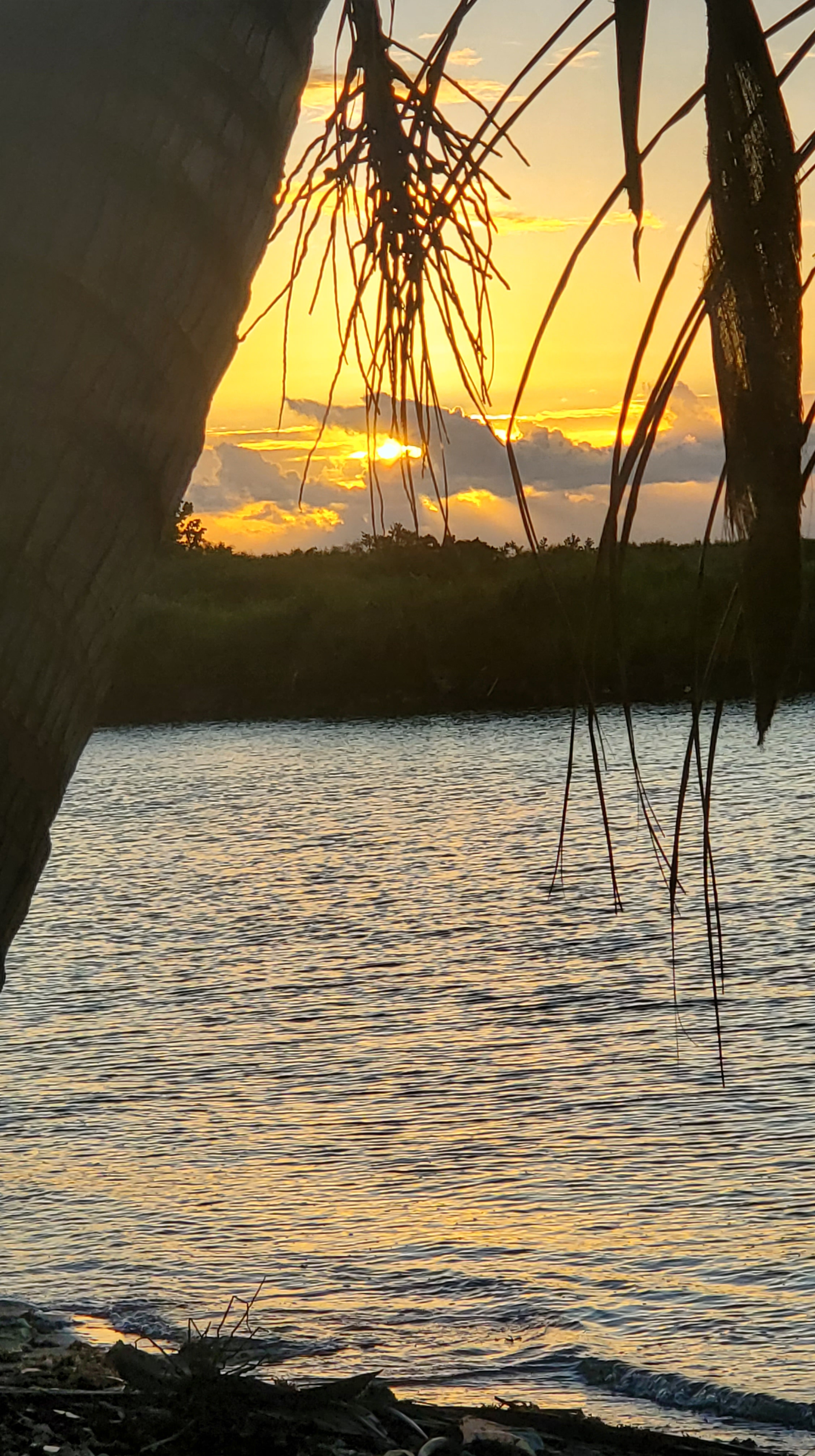
The house where we are staying is wood with a tin roof and a wide veranda. It overlooked a mowed yard, lots of trees (mostly coconut trees) and the water that was about 70 yards away.

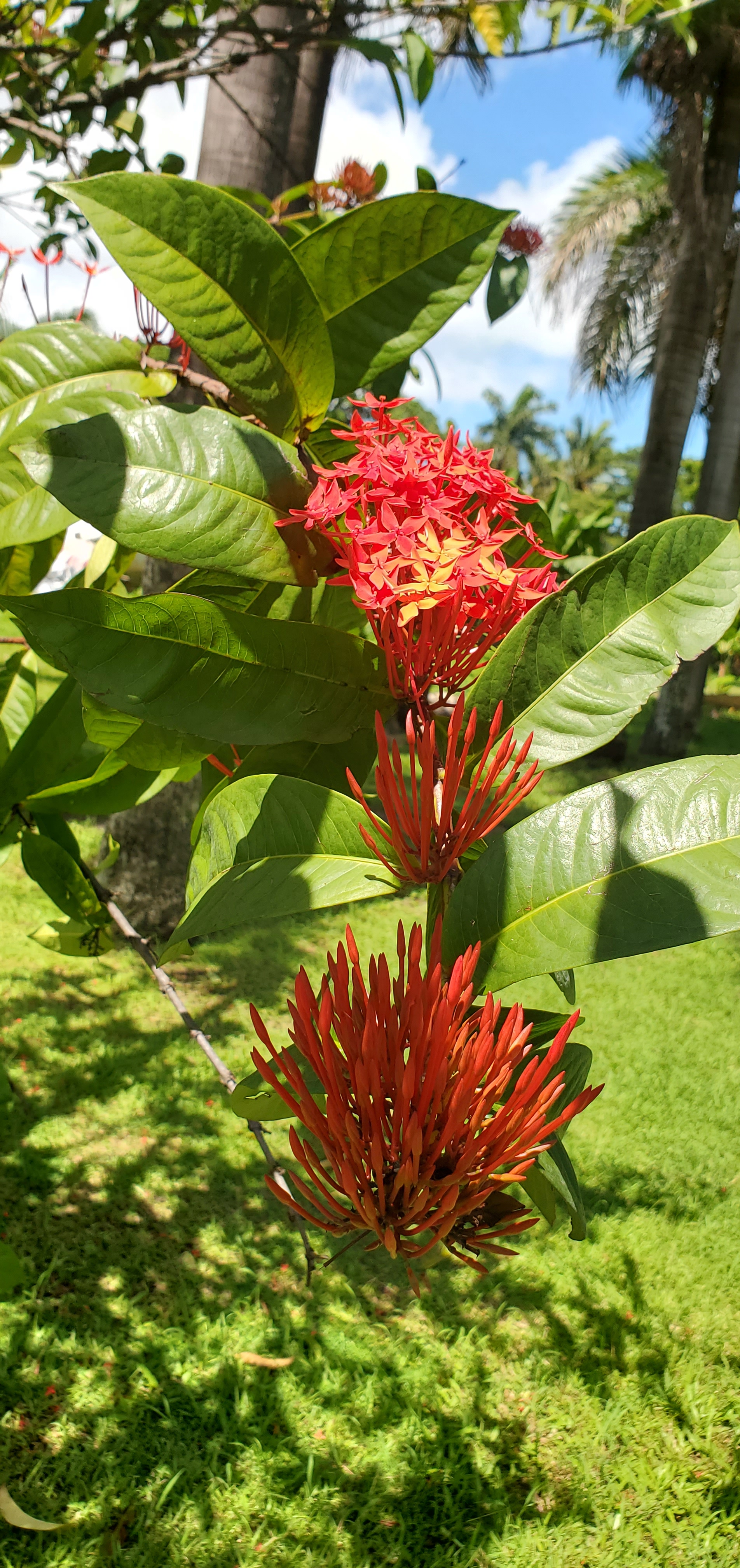
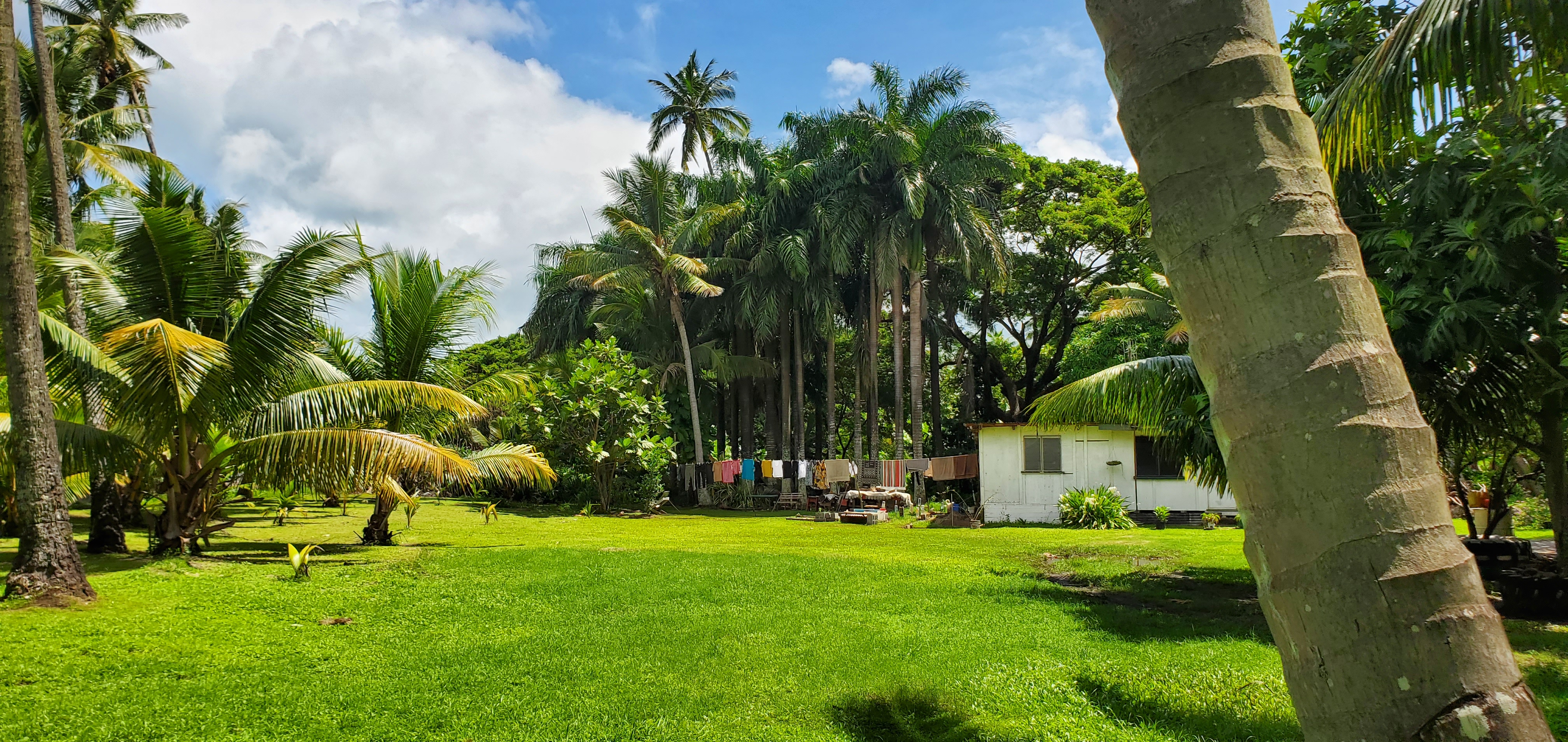
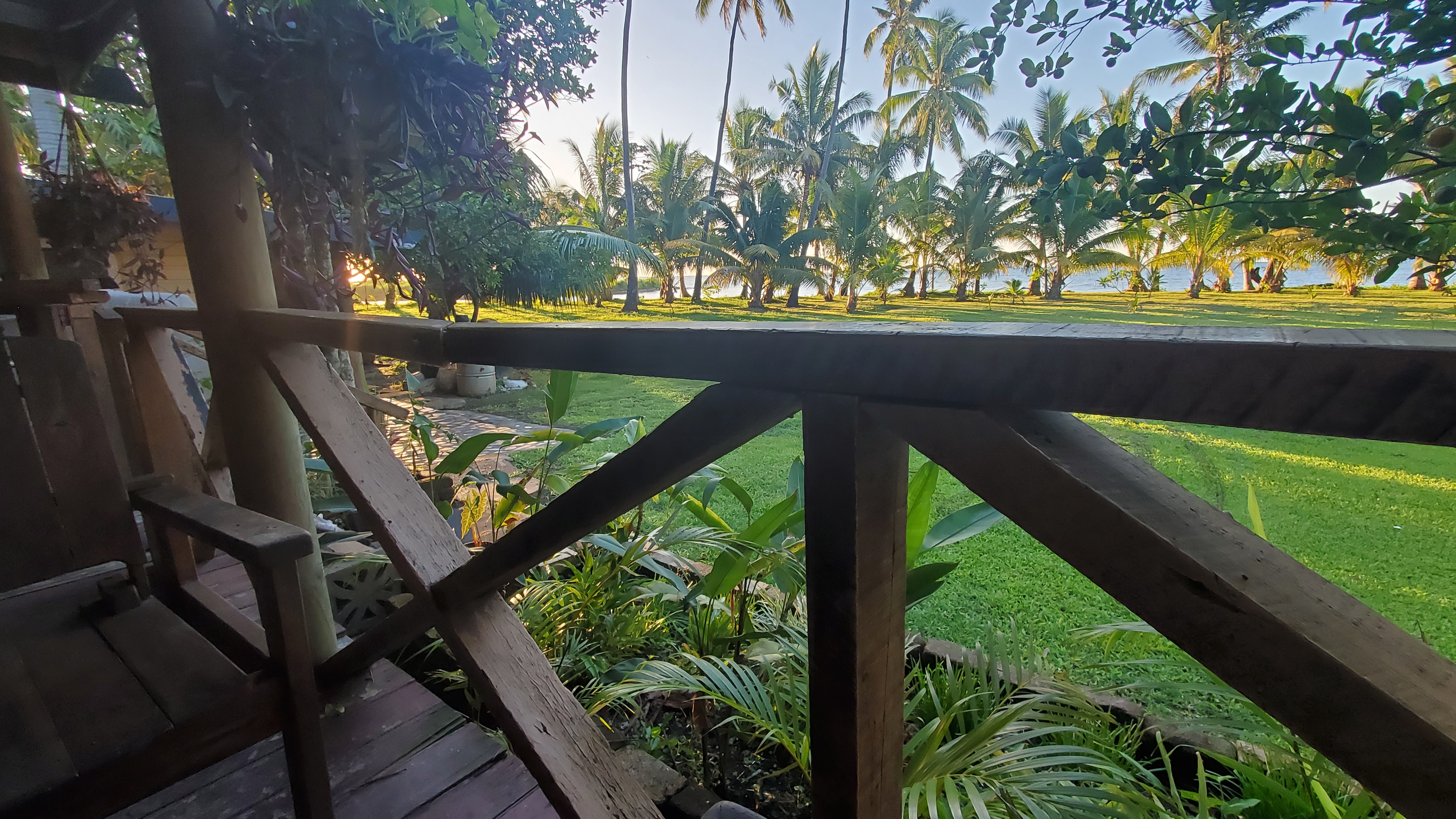
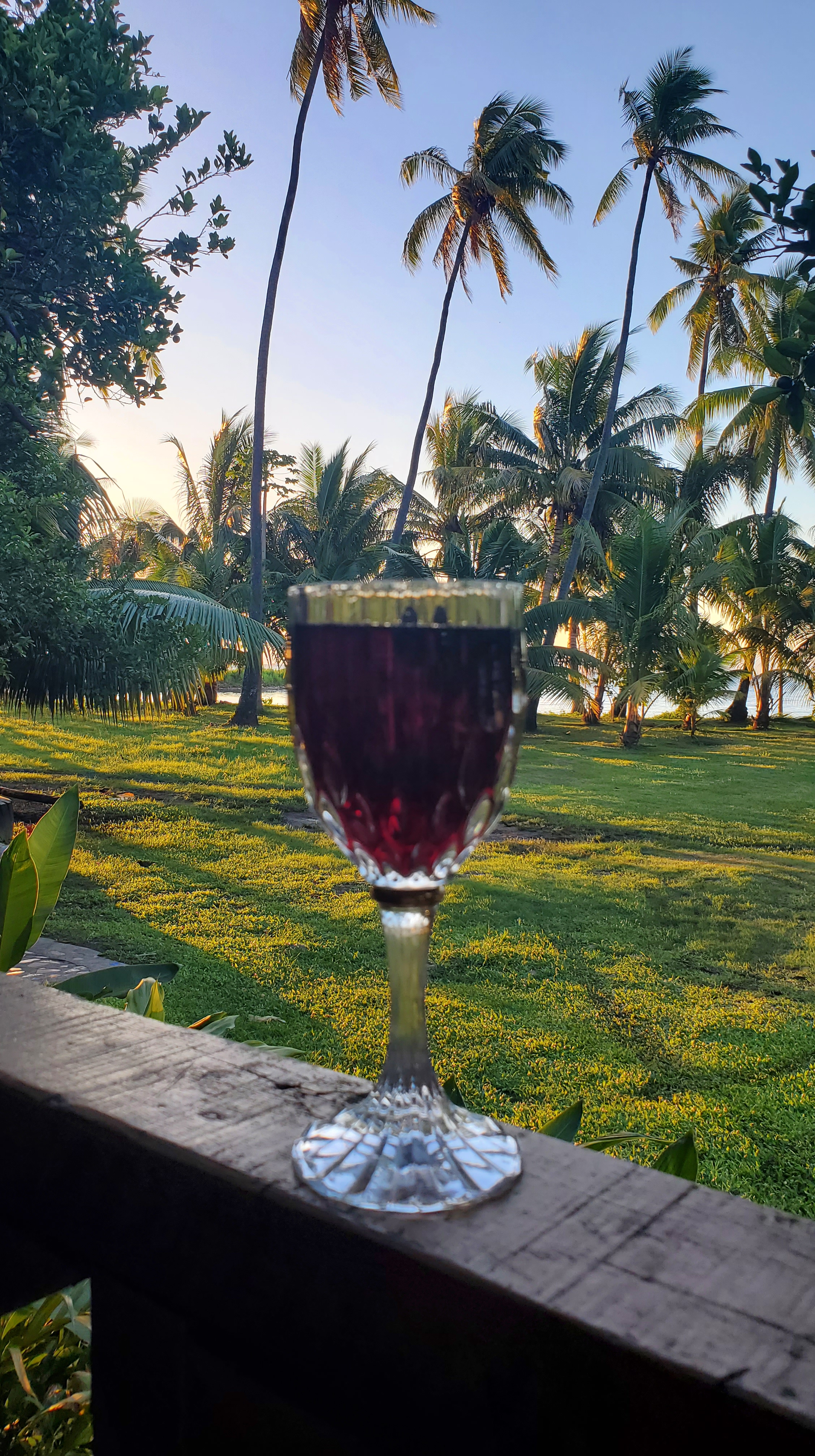
Pricilla is an interesting woman, a native Fijian with historical roots that go back generations–English, French, German, and Chinese all mixed with Fijian. Quite international.
Priscilla Lewgor
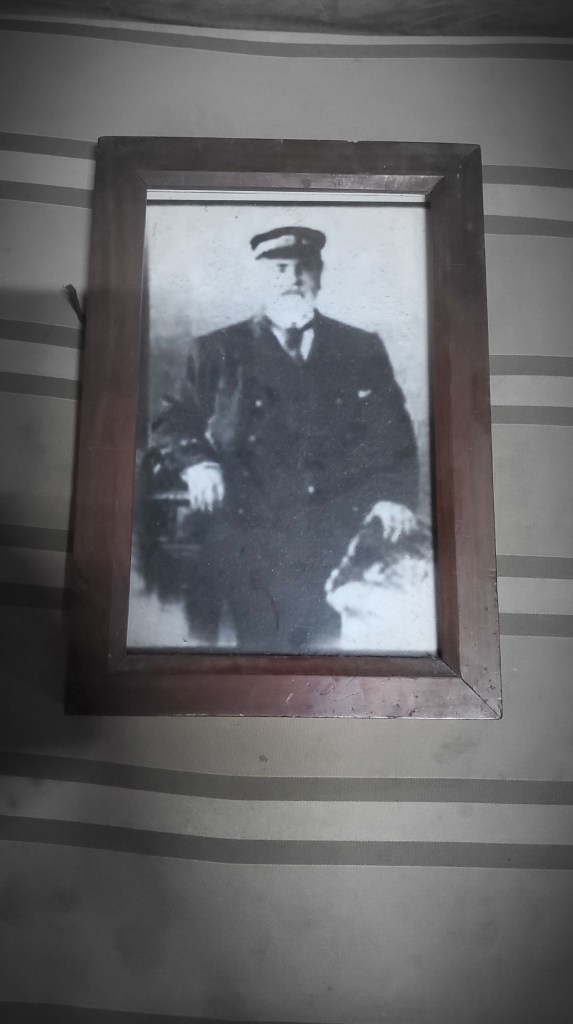
The house was originally built in the 1800’s by Priscilla’s great-great grandfather who was an English captain names Robert Noall. They had to rebuild it after a cyclone so it isn’t original but much of the wood was reused.
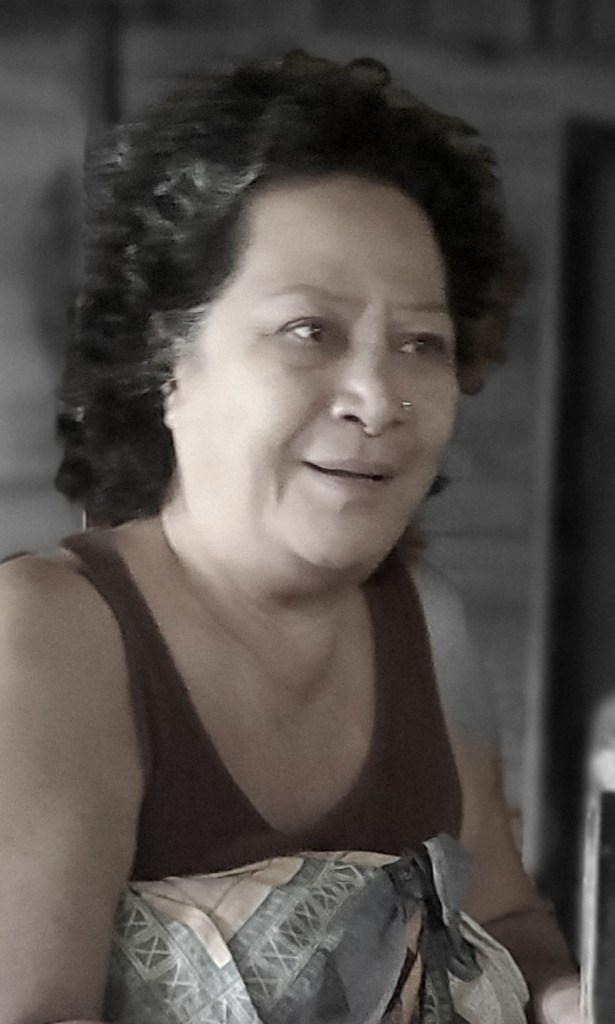
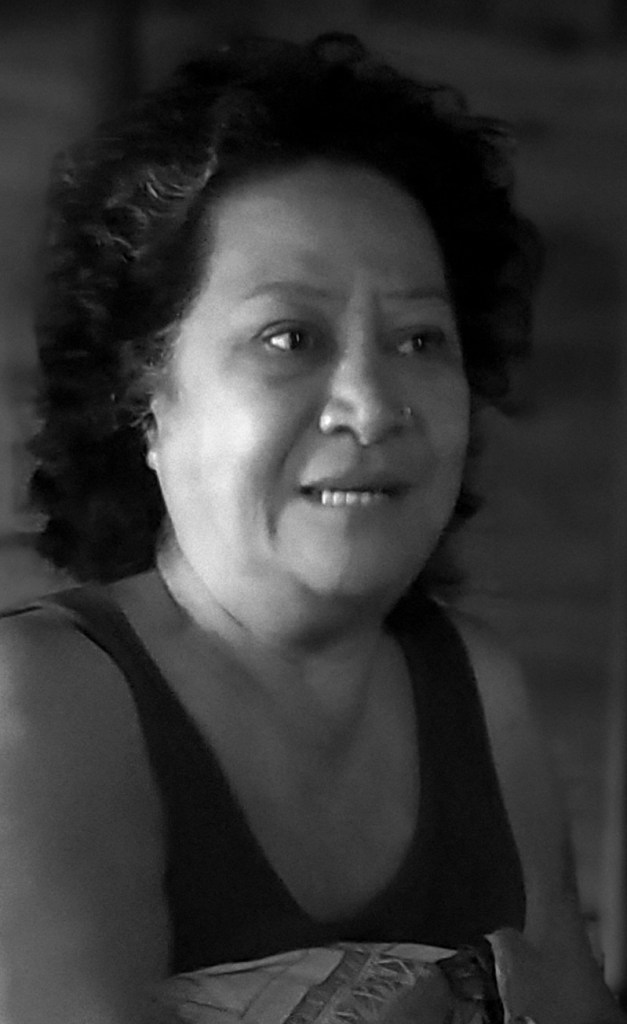
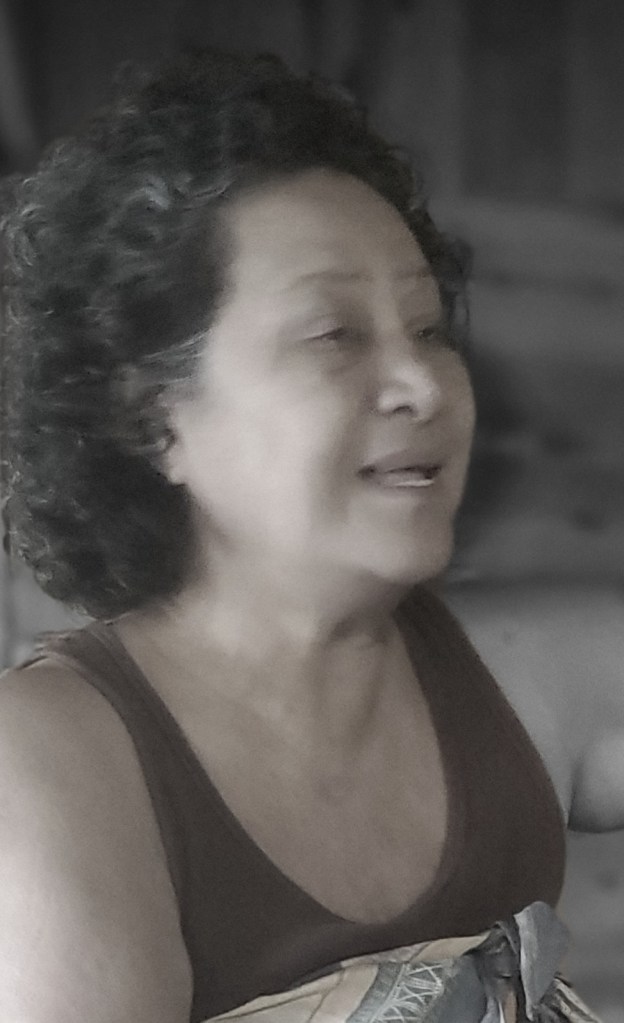
At breakfast, Priscilla told us about her family. Her great grandfather was Captain Richard Noall is known by Noalls in Michigan in the US, Noalls in England and some in France. Noall is a French name going all the way back to the Normans. We wondered how Captain Noall’s early enterprises connected with the Fijian history. We wanted to learn more. Over morning coffee, Priscilla generously shared her family story.
Priscilla is a 5th generation Fijian. Her mother was of French, English, German, and Samoan bloodlines. Her great-great grandfather was Captain Richard Noall of St. Ives,Cornwall, England. HIs ancestors were from Normandy, France. They are the De Noailles who crossed the English Channel with William of Normandy, defeated the English at the Battle of Hastings in the 1066. They then anglicized their name from de Noailles to Noall to protect their French interests. Captain Richard Noall married Meipo Soisoi in Samoa then moved to Fiji to work in the Sugar industry as a ship captain. Priscilla did some research on the Soisoi name and found that it originates in Peru. Captain Richard Noalls’ eldest daughter Emmaline is Priscilla’s maternal great grandmother. Emmaline married Seflin Matthias who was German. Around the turn of the 1900s there were a lot of Germans settled in the Samoan Islands. Priscilla’s grandfather Vincent Matthias married a Samoan woman named Meleaga Masaga. From that marriage was born Priscilla’s mother, Mary, the youngest of 4 siblings who was .
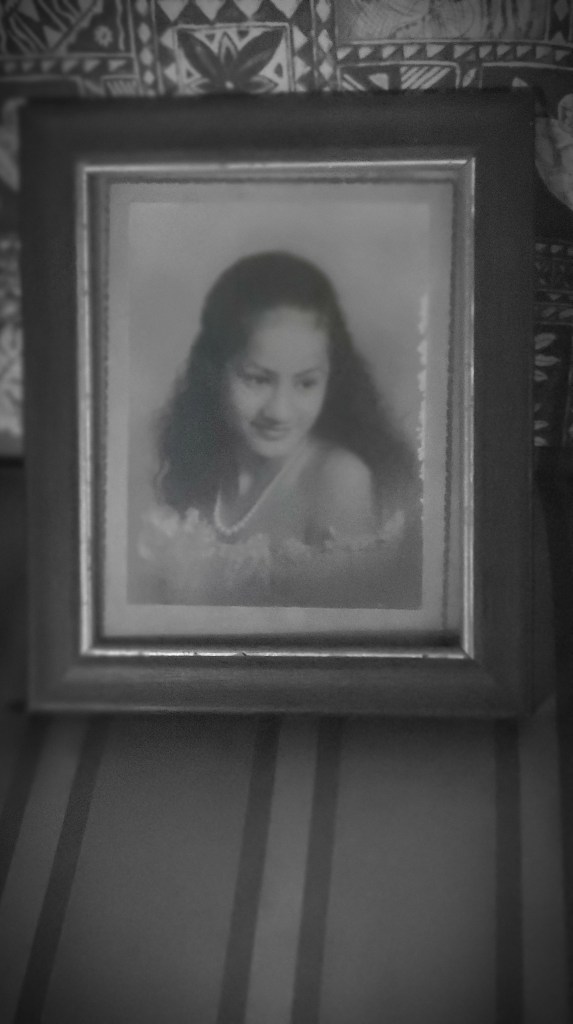
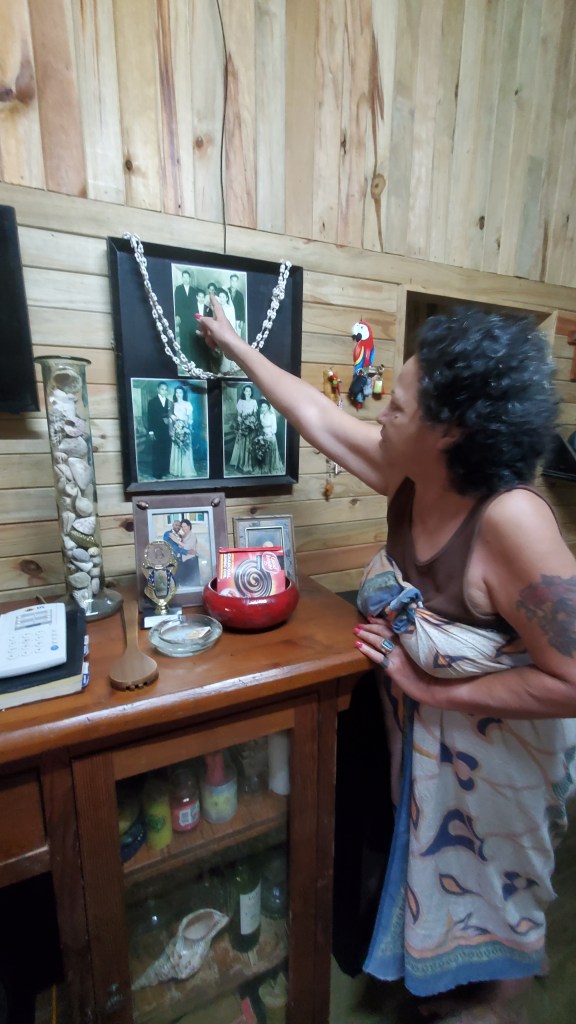
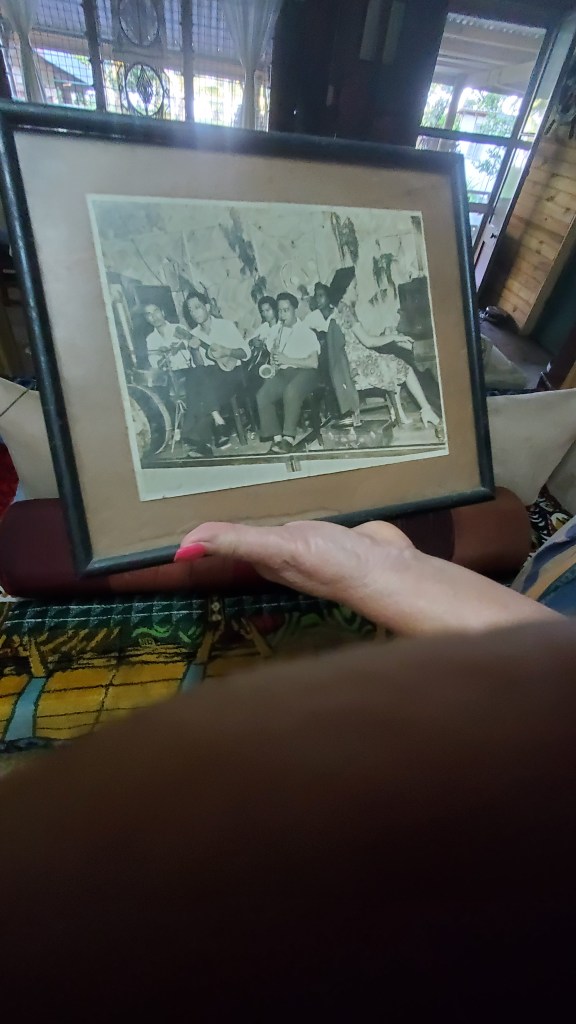
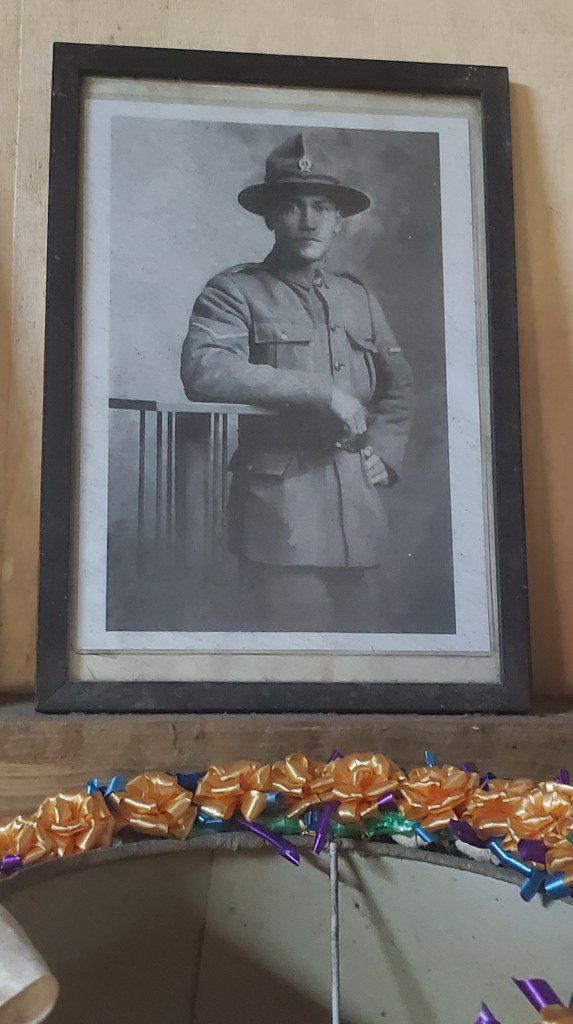
Her dad’s side of the family is half Chinese and half Fijian. Her Chinese grandfather is from Taishan-China.vHe left China with the advent of Communism. He ended up in Hong Kong and sailed to Australia to work in the gold mines. Somehow, things didn’t turn out as planned so he and his male Chinese cousins sailed to Fiji. This is where he met Priscilla’s Fijian grandmother. They are in the wedding photo of her parents that she showed us.
Priscilla told us that when she was growing up, the Indian culture had taken over much of the trades and businesses, and subjugated most of the Pacific Islanders. There were Muslim, Indian, Chinese, Japanese, and Fijian schools, all of which were quite segregated. The only school that would let her mixed race family attend was the Catholic schools. Later, she said, they after the revolution of 1977, the schools had all become public, so now everyone can go to all the schools.
Her great grandfather was the one who originally obtained this lovely acre lot, about 100 by 100 meters square, maybe a little narrower at the ocean. It’s the typical wood framed house on stilts sitting about a meter off the ground, and open, vaulted tin roofs to deprive bugs any place to hide. It was almost completely destroyed in a cyclone when Priscilla was a child. Almost all the wood was recovered and reused when the house was rebuilt.
Our room was dark with one fluorescent light overhead, and two single beds–no bedside tables or lamps and no air conditioning, but it was charming in its worn and well-loved look and antique furnishing.
She cooked us a good breakfast, porridge and toast. I spread Vegemite on my toast. We talked for quite a while learning the history of her family and the history of the island.
I walked around the grounds and down the beach–I heard two coconuts fall from the trees so I kept a wary eye out.
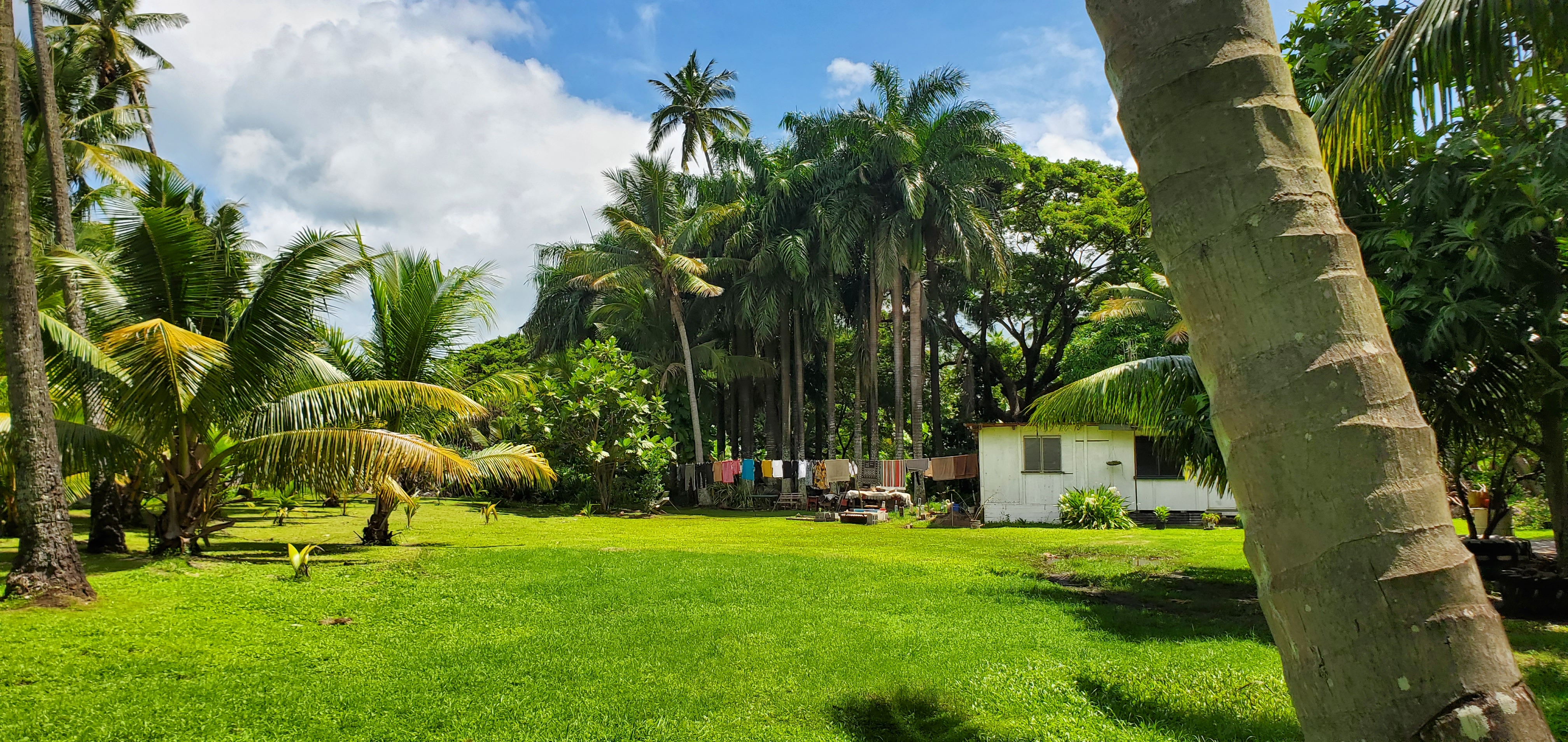

The beach was narrow and, I bet, at high tide, nonexistent. The difficulty was that after the storms or strong currents, pieces of plastic and other trash wash up along this shore–it’s too much for them to keep up with so they don’t. It’s not their plastic, it comes from China and across the planet like that Great Pacific Garbage Gyre.
There are three houses on the property, her nephew’s and a niece’s, I think. Besides the coconut trees that line the water, there is a huge tree that Pricilla told me is a Polynesian rambutan–it is so big, they can’t harvest them, they just wait until they fall off the tree. But they don’t get many because the bats get to them first. She says her great grandfather planted it and it’s the oldest and biggest on the island. Also, there are two kumquat trees planted by the back porch.
Bula Bula!
Later, that first morning, we went out for a walk, I was somewhat confused as carloads of kids would shout out, “Bula, bula!” Soon, we realized that it was “Hello.” Later, when we crossed paths with others on the road, we saw them up close. The shouts of “Bula!” were accompanied by wide grins and genuine smiles, emphasized by the dazzling white teeth contrasted with the dark faces. It is almost as if the national pastime is to drive around and greet the tourists.
After a short rest, we decided to walk into to town, up the road to get our bearings. Priscilla told us it would take us about 30 minutes.
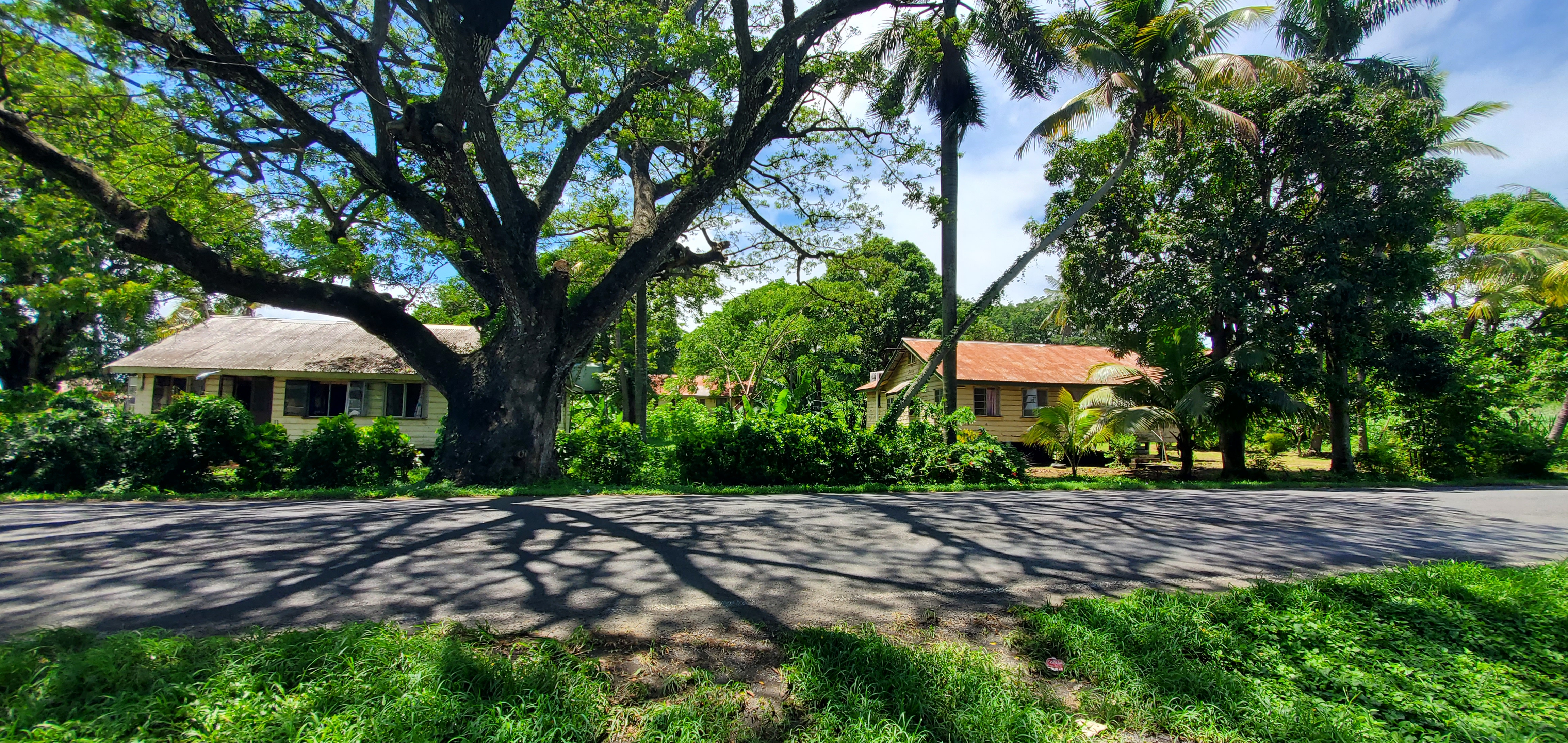
It was hot and sticky as we headed out along the Queen’s Highway to Lautoka. Along the way the trees planted along the road gave great shade. The trunks were huge, and the leaves looked like mimosa trees, but I’m not sure. I believe they were planted by the British over a hundred years ago.
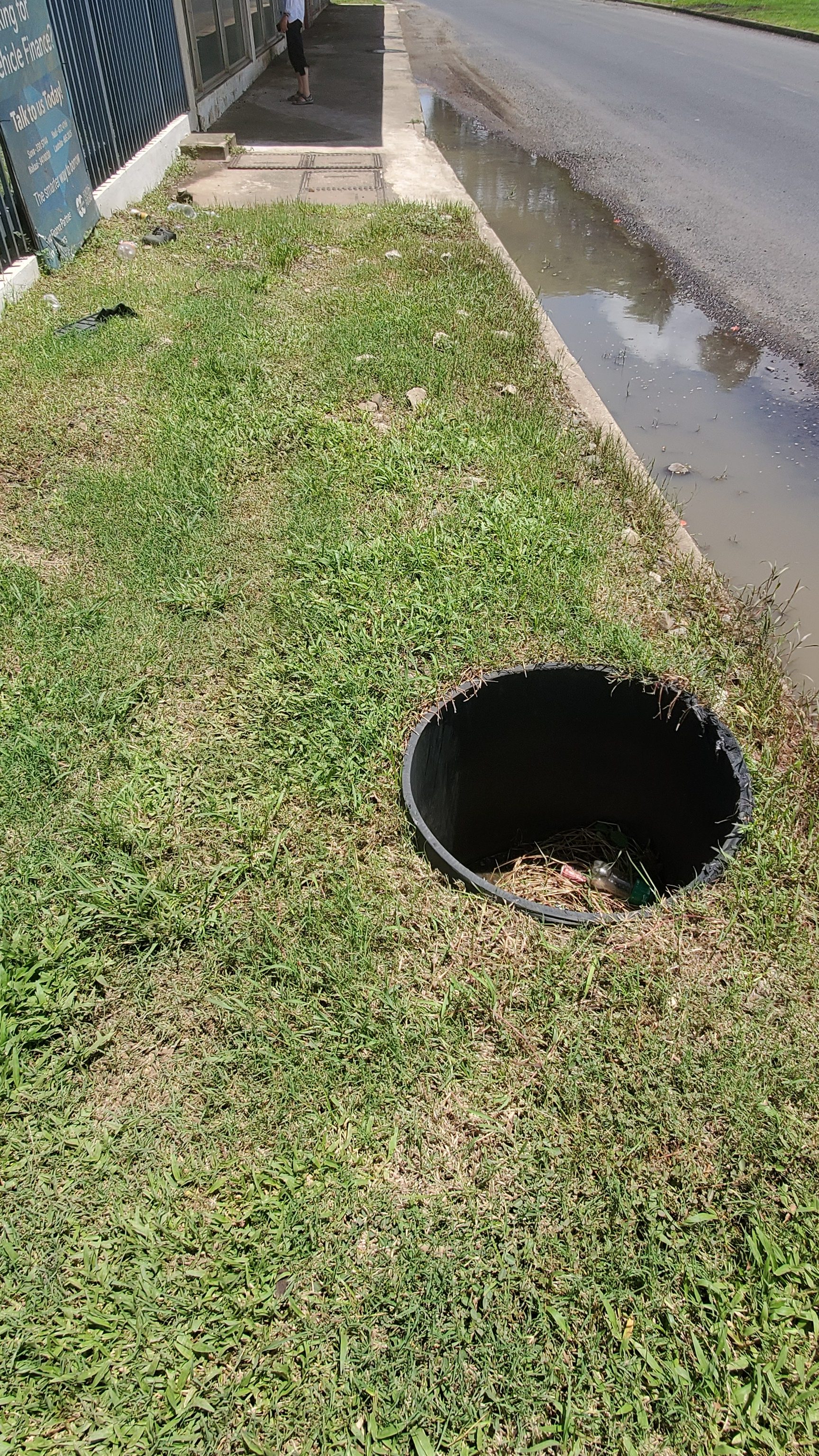
There were many dangers along the way–open holes in the ground, broken culverts, and roots to trip over. It reminded of the “Gringo traps” in Mazatlán.

The houses along the route were a mix of old wooden structures that had more charm than comfort, concrete houses painted bright colors, and fancier houses higher up, usually painted white. Many yards had clotheslines full of colorful clothes in geometric patterns flapping in the wind–bright red, bold green, and dark blue. It was a fun walk.
Coming into town was ugly. There were factories and shops that fixed things. We came into the center of town where we stopped at a McDonalds just to see what a Fijian McDonald’s looked like and decided to share a milkshake and enjoyed a welcome airconditioned break.
We found an open-air market and took pictures of fruits and vegetables of many kinds, but didn’t buy anything. (Later, Pricilla said that most–80-90% of the vegetables are imported from China). We found an ATM and got Fiji dollars because most places want cash only. We found a place for lunch called the Aroma Tiger Cafe. The waitress was very sweet and helpful. I had a veggie wrap and Woody had a chicken burger.
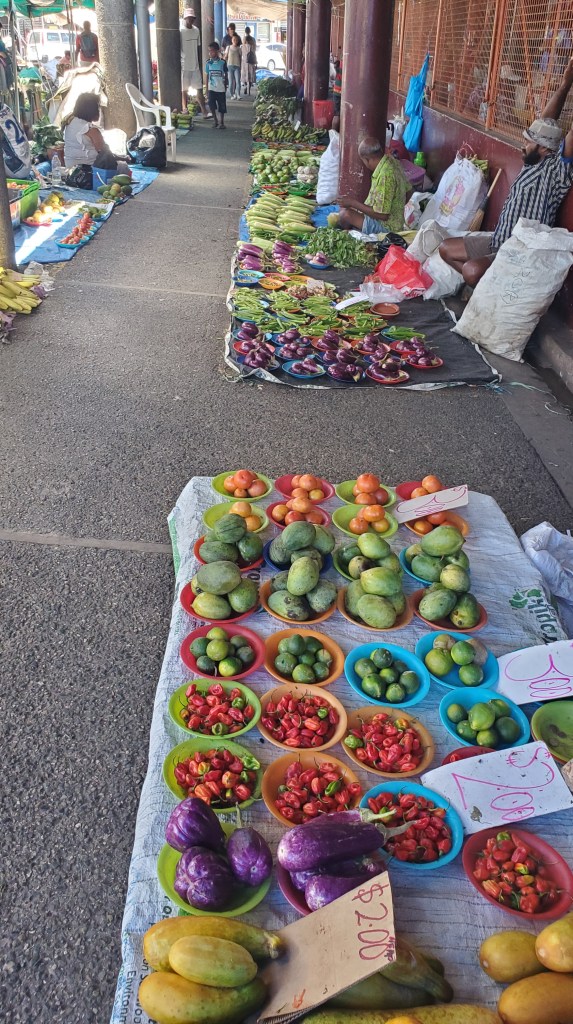

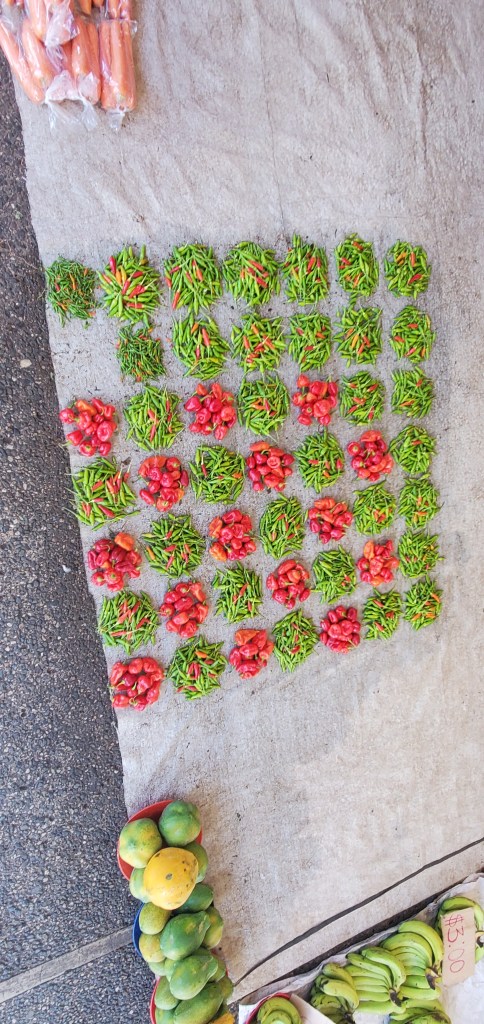
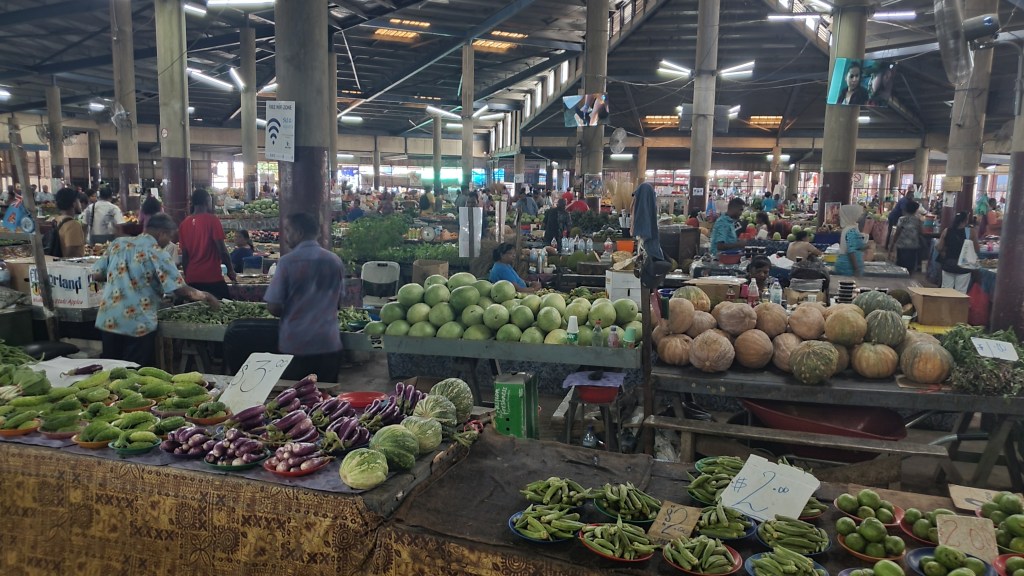
We took a bus to get home, and a kind woman helped us get to the right bus. We climbed on and rode home. Once on the bus, we decided to take it all the way to Nadi and wander around there. It was a crowded bus, but we had fun people-watching. As we passed our place, we noted the surroundings carefully so we would know where to ring the bell and get off in time on our way back.
The countryside is lovely and lush and green, but they need to do something about the trash. The bus took a smaller road off the main road through a charming neighborhood called Vuda and a new land development called “First Landing.” It seemed cleaner there and well tended.
In town we found a Polynesian clothing store that I wanted to check out. I had mentioned to Woody that he might want a Fijian shirt because the shirts he has are all polyester and it might be nice to have a cotton one that breathes better. He saw one he liked in the store and bought it just like that. He never does that. I was proud of him. It’s a reddish brown print and looks good on him.
We found the bus stop to go back home. Woody looked the wrong way stepping off the curb, and I saved him from a truck coming from the right. I pulled him back. Now we’re even because he saved me earlier in the day.
Saturday, January 27th–It is odd when you cross the International Date line. I can’t keep my days straight.
Today I woke up at 4am Fiji time but I managed to go back to sleep. We have single beds here, so I don’t sleep as well. Just before 6am I was awakened by birdsongs. What a lovely wakeup call.
This old wood house has lots of windows with screens and glass louvers. The door to each room has screens to let air flow through the house. It is all well screened to keep bugs out but let the air in. The morning air is lovely–velvety soft and smelling of flowers.
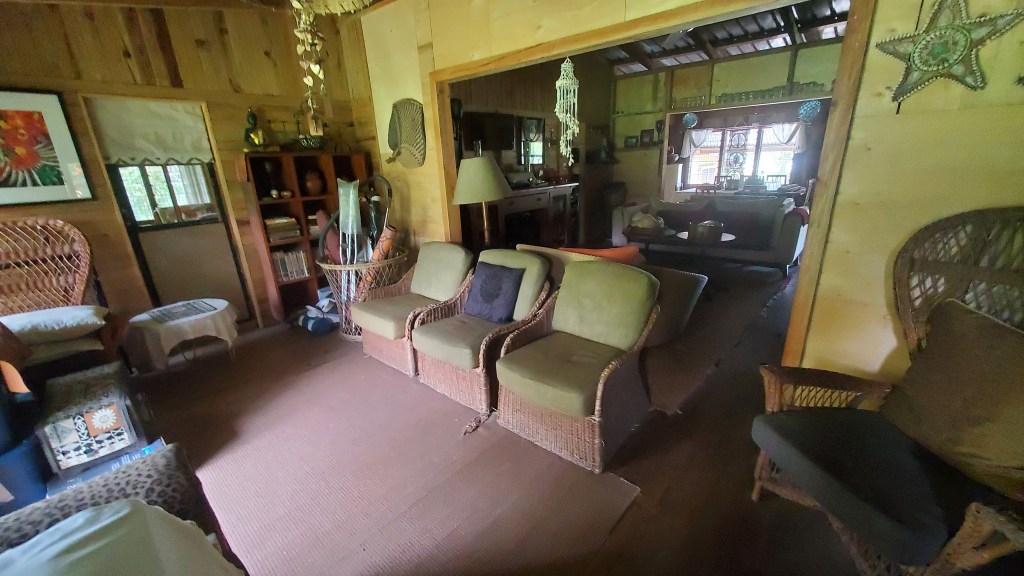

The Sleeping Giant Orchid Grove
We took the bus toward Nadi and got off at the junction of the Sleeping Giant Road. We walked up a gravelly road for about two miles to the Orchid Plantation. It was originally built by Raymond Burr of Perry Mason fame. He was an orchid lover and had a house in Fiji for many years.
Along the way, we met several people walking to the highway. They were all extremely friendly and would call out “Bula” (hello) and smile big smiles to show they were glad to see us. Some even waved.
Along the way, we met a family of five, all carrying colorful umbrellas. They all greeted us with smiles and waves.
“That’s a great idea to carry those beautiful umbrellas for the sun,” I said.
“Oh, yes, it works very well,” the father said. “Do you want to take this one?” holding out his umbrella to me.
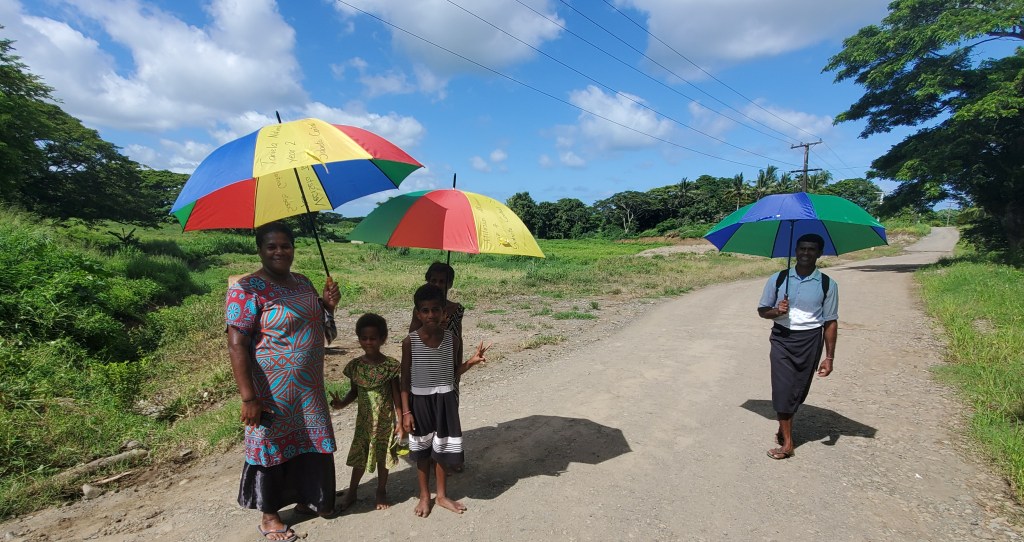
“Oh no, thank you,” I said, somewhat embarrassed that he perhaps he thought I was asking for his. It is amazing that these folks are so generous with words and deeds. That walk out to the orchid farm was about three kilometers. I think we saw at least a dozen groups of people on our way and not one failed to greet us with a “Bula!”
We also passed two cows (or they passed us) walking along with no one leading them. One had a rope trailing along behind her on the ground.

The reception building is an old large wooden structure with a bar and dozens of low tables and rattan furniture. We paid our $25 Fiji (about $12 US) and followed the path to the garden.
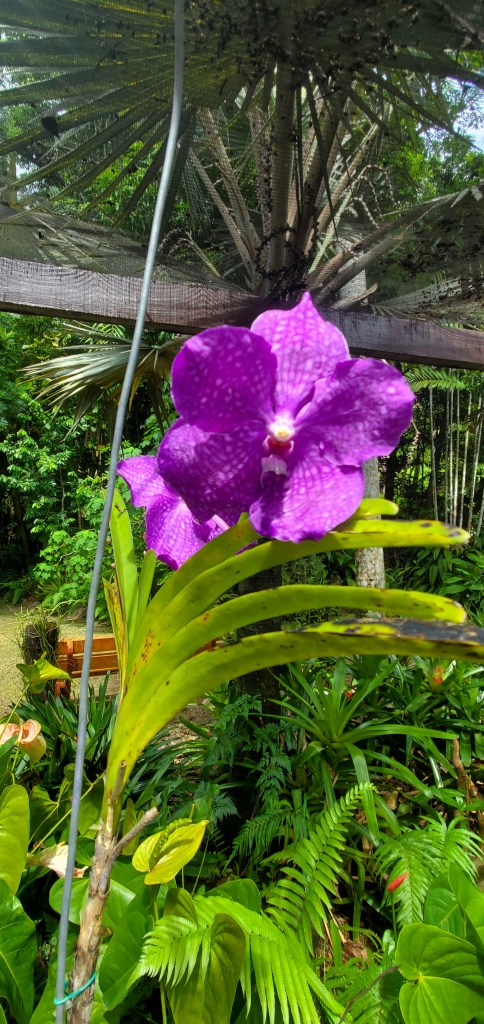
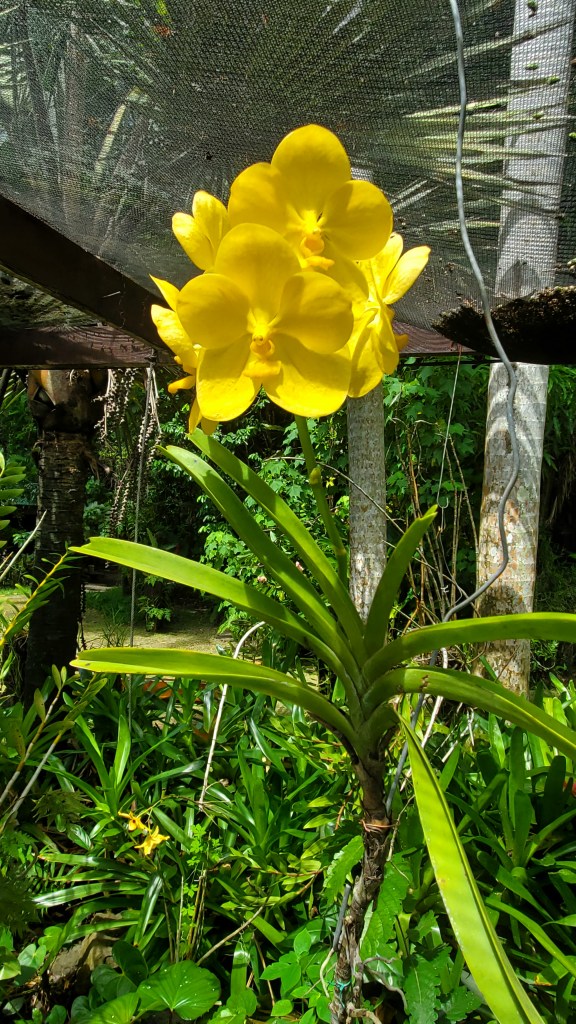

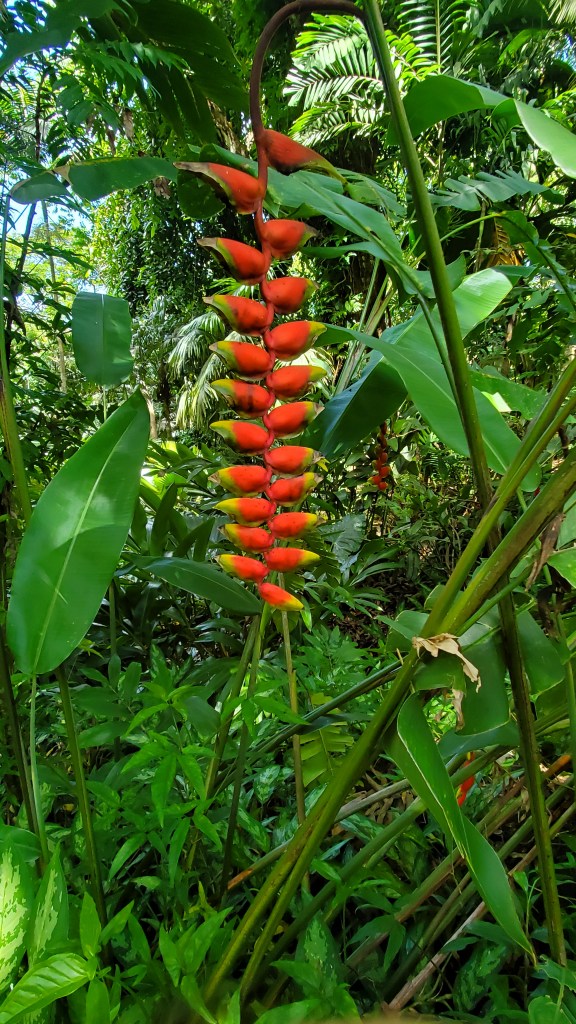
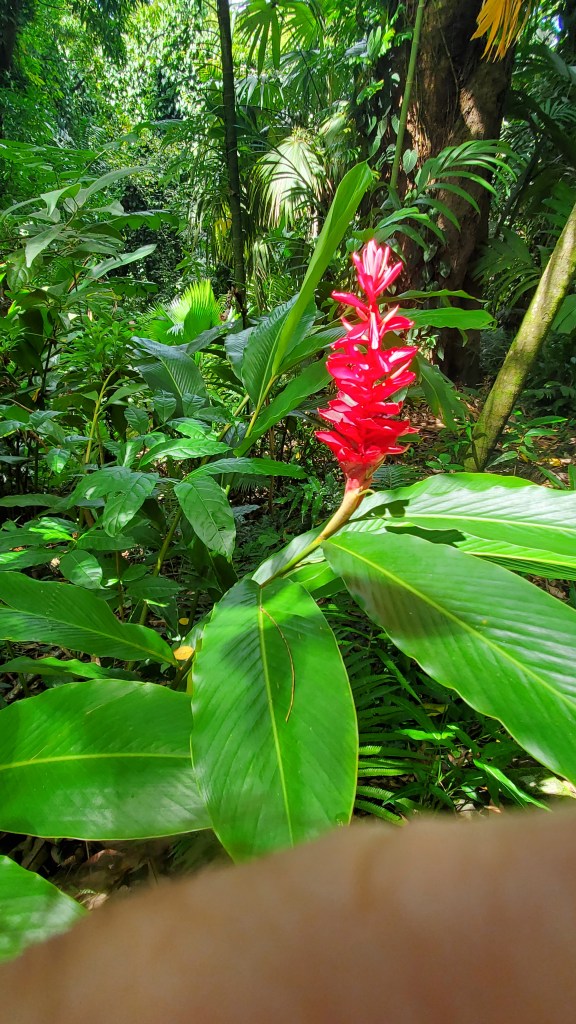
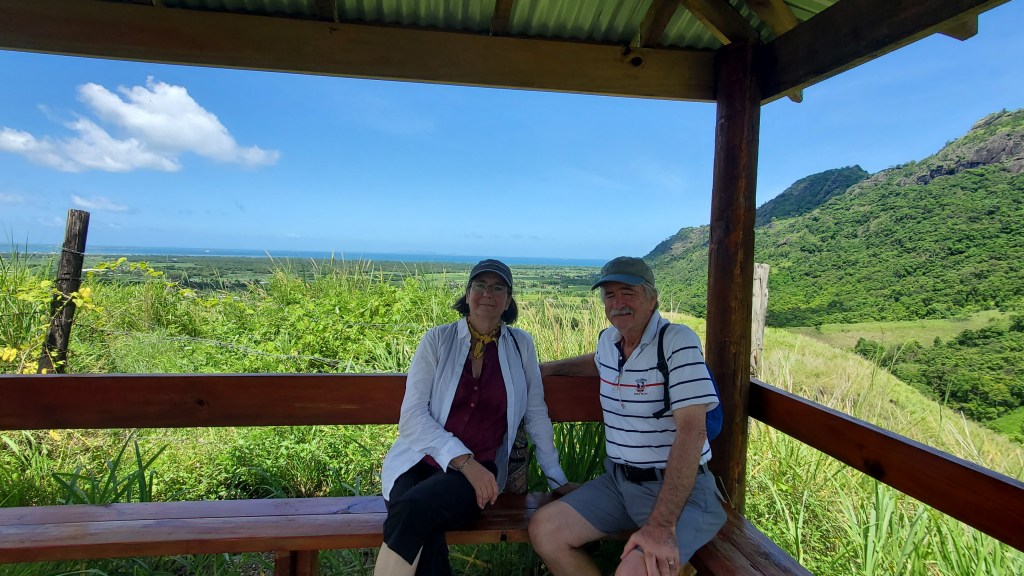

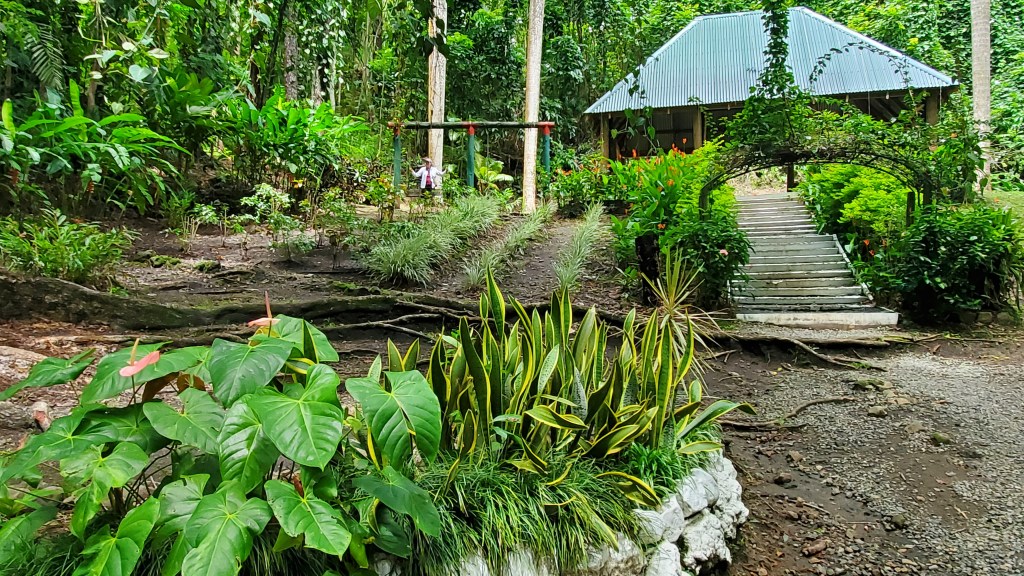

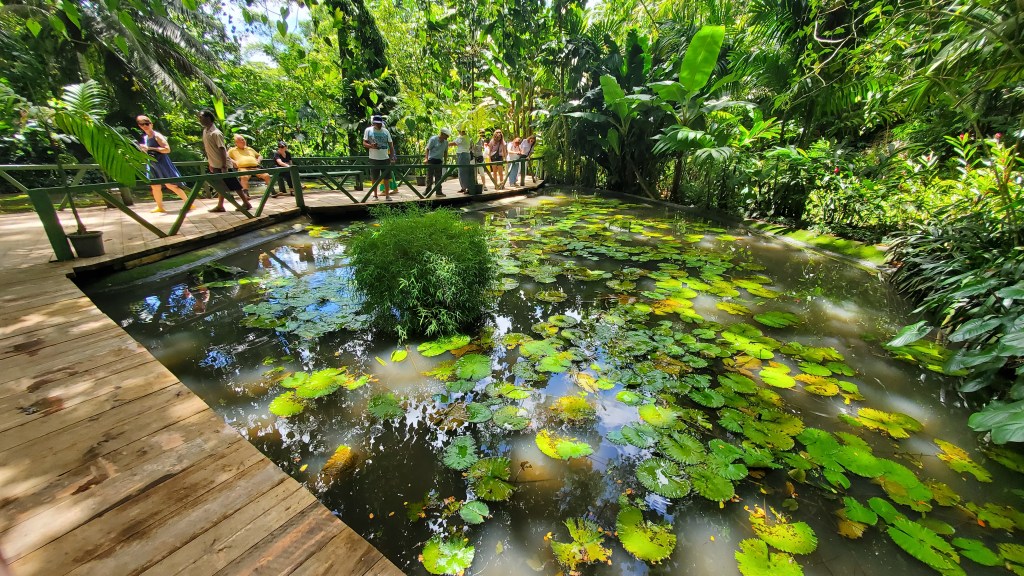
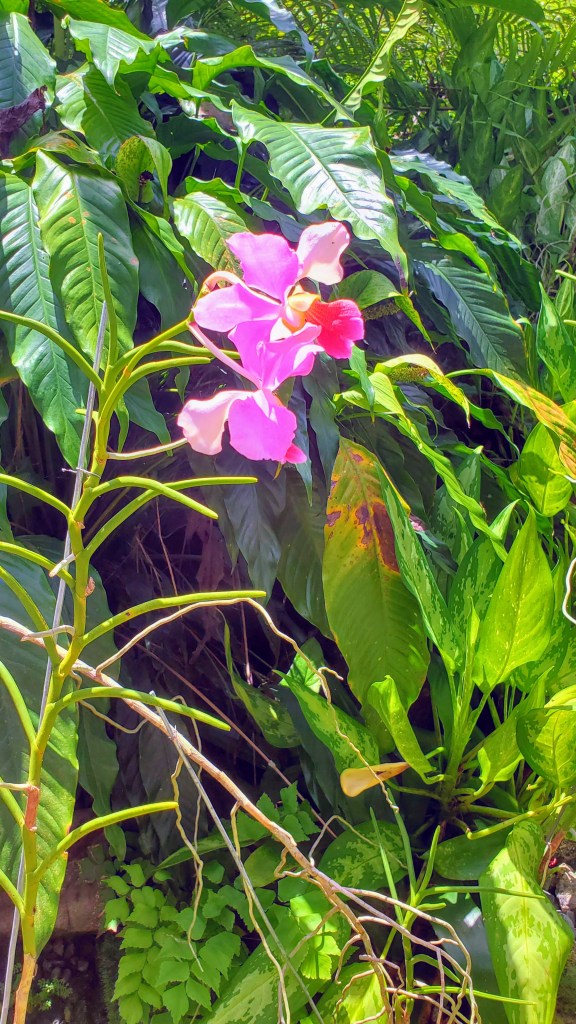
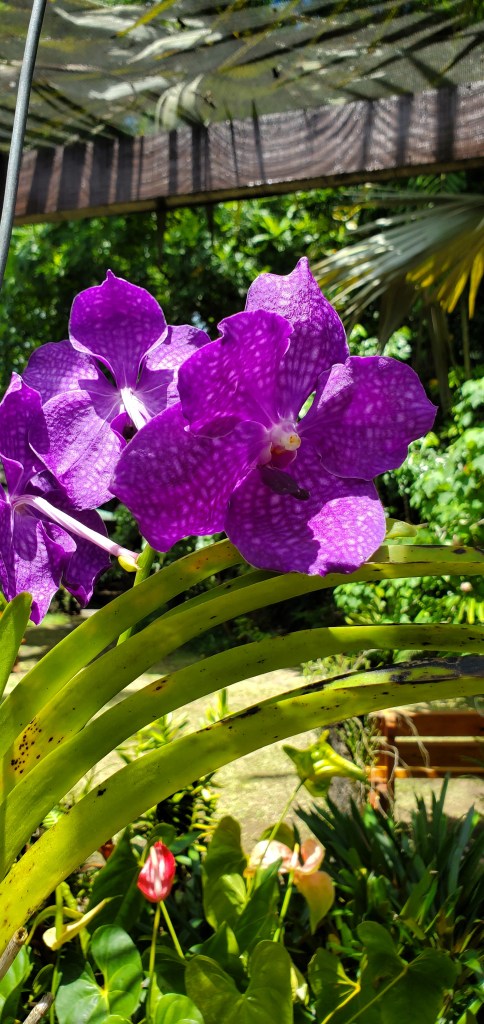
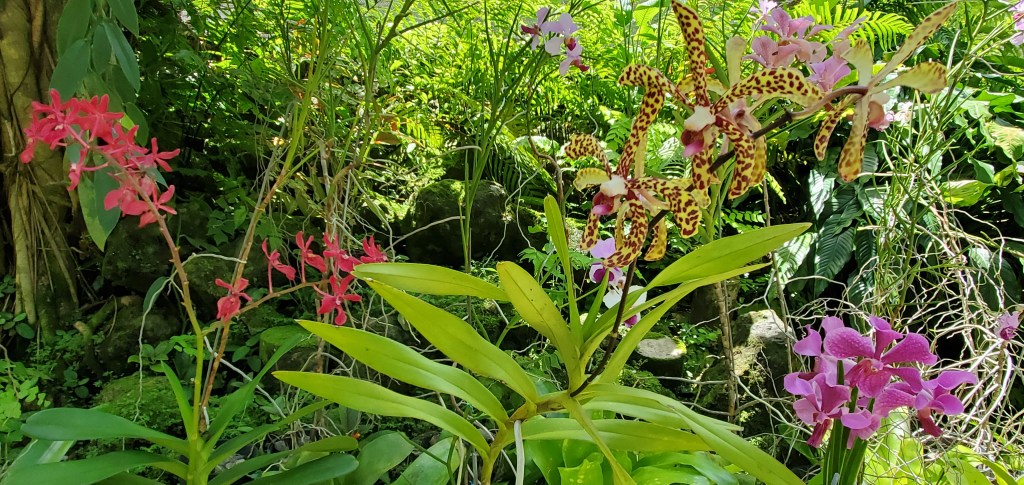
Dozens and dozens of potted orchids lined the first part of the path. Many were in bloom and there were lots of colors, sizes, and shapes. The path led across a lily pond where no lilies were in bloom, but plenty of fish circled in the depths. Then the path led uphill and we climbed up to the viewpoint. After that first path of orchids there were no more–but the forest hike was still worth while. Huge trees with trailing philodendrons covered the hillside. Smaller green bushes and trees and ferns filled in the rest of the space. So much garden to manage, I wondered how many people it takes to keep this section going.
We met a woman on the trail who asked us if we wanted to share her taxi back to Nadi. So we accepted, and ended up having lunch in at her luxury hotel, the Hilton. It was an opportunity to see the resort area called Denaru Island. It’s really an estuary that had been full of mangroves that was filled in to gain oceanfront real estate. There are about a dozen high-end resorts, a port for connections to other islands, and a golf course, all connected by a shady, modern roadway and a little tourist bus. The Hilton had a swim-up bar and several restaurants around the pool. We splurged and had a nice lunch there, then took the bus back into town.
From there, we walked down to the Denaru port, a very touristy place, looking at short day trips we might take to another island. All of them ranged from about $150 to $300 per person, way over our budget. We later took the local bus back into Nadi where we found a woman who runs a locally owned tour agency, and she arranged a nice day trip for us on Monday.
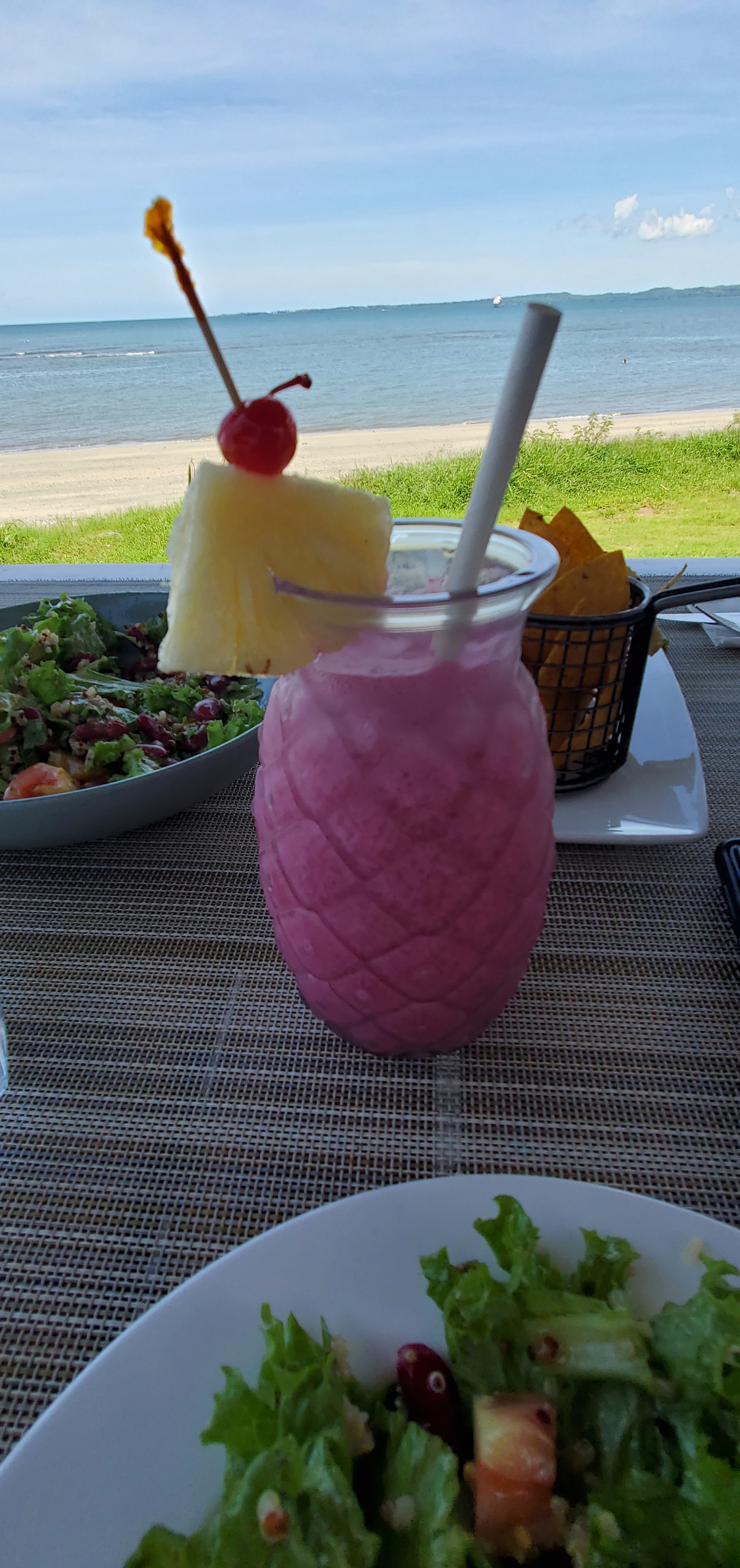


The Hilton was luxurious and designed for the tropics with lots of open air spaces. There were several pools, two with swim-up bars, a couple of restaurants and a white sand beach. We decided to eat lunch there over-looking the ocean. I had a quinoa salad and Woody had tacos. We watched a group of people learning how to use jet skis and saw very few people on the beach. This beach is much cleaner than ours. I wonder whether people clean it daily. There were lots of shells and sand dollars. I picked up a few. Later we walked to the port and looked up what it would cost to take an outer island trip. All these islands are private resorts and the boats take you out and feed you and bring you back and offer lots of activities. It was all too expensive and not the thing we wanted to do, so we headed back to home.
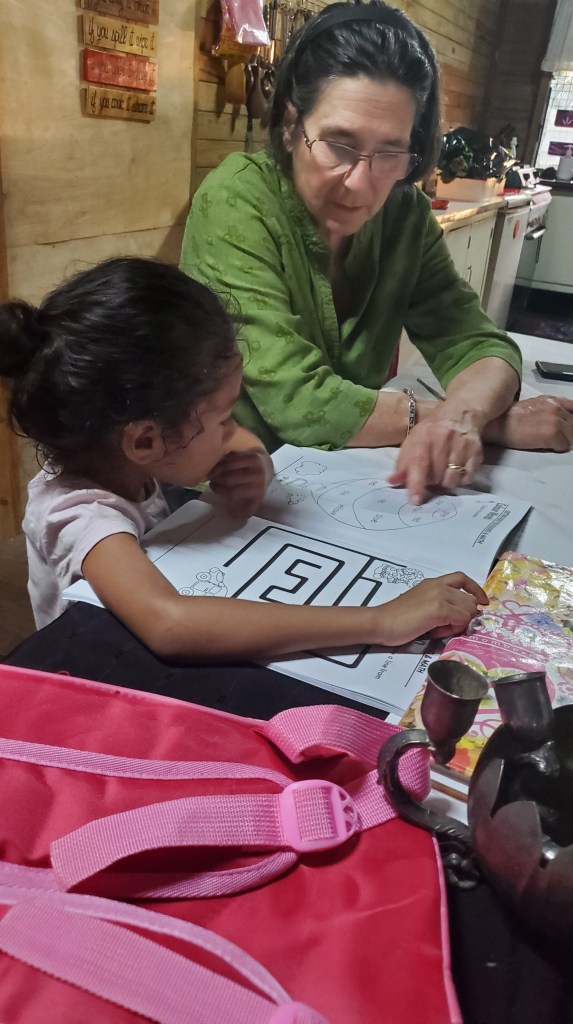
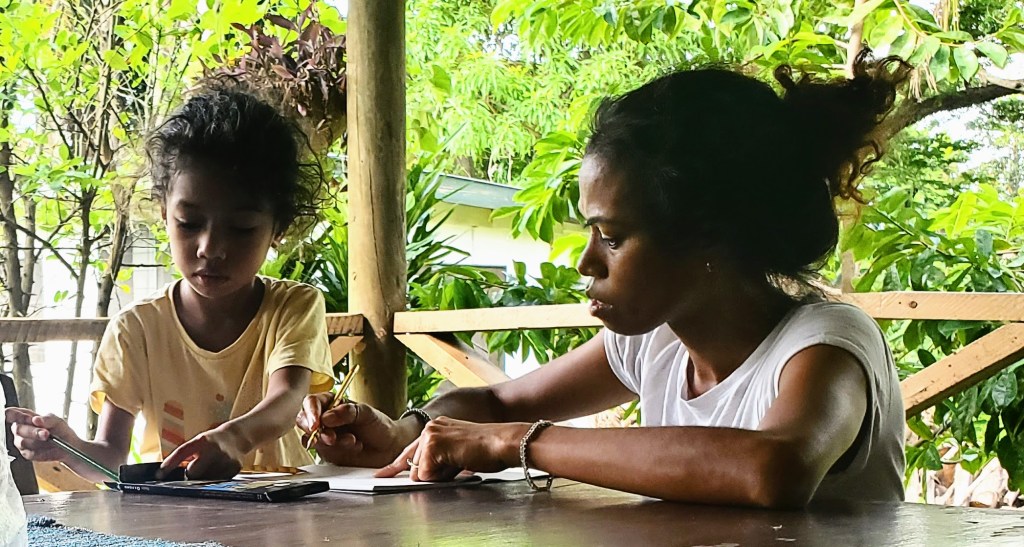
That evening, we enjoyed spending more time with Pricella and her family, Her son Germaine and his wife Ilisapeci,(shortened to Ili) and their daughter, Pricilla’s granddaughter, Eliziana, (shortened to Eli). Eli was getting ready for her first day of school ever, entering kindergarten in a couple days. Rebecca worked with Eli on some puzzle books.
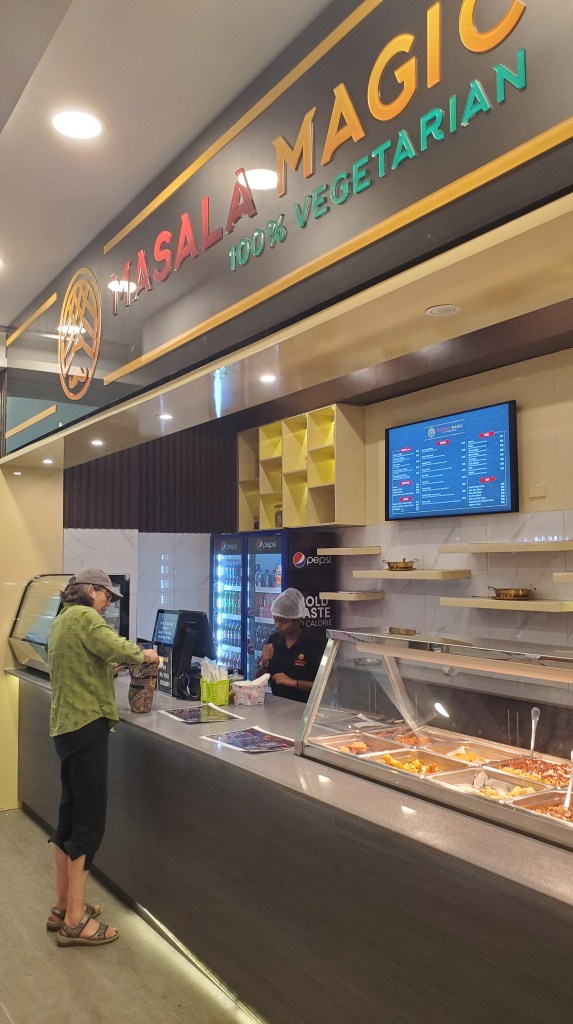
The next day was Sunday, and Pricilla told us that most of the stores would be closed. We spent the morning catching up on writing and doing some laundry. Later, we went into town to have lunch at the only place that was open, a mall with the entire upper floor devoted to a sort of food court. Rebecca found two vegetarian places among the dozen or so there. Back at the house, we continued writing. It was too hot to stay inside, so we went outside to work. I was feeling the bites, but I tried to ignore them for a while, maybe too long. Between the heat and the mosquitos, it got to be too much me. Fortunately, the hand sanitizer that Rebecca brought gave a little relief from the itching. That night was a difficult one for me.
The Water Falls
Monday the 29th… We had organized a tour today through a friend. A driver, Sam, picked us up at the house early, about 7:45am. Sam drove us past Nadi to a small village where we started a hike for a waterfall. We think it’s called Biausevu, but no one called anything but “the waterfall.”
The drive south of Nadi was more wild than it was closer to home. There seemed to be less European influence–no tree-lined roads planted by the British–but lots of papaya, banana, and other trees along the way. The houses looked a bit more primitive–many concrete block houses with open windows. It felt much more wild.
Farther south there were some older resorts that looked like they were a bit past their prime. I am sure the newer one on the island of Denaru where we visited the Hilton have hurt the businesses here. But to my mind, these look much more inviting.
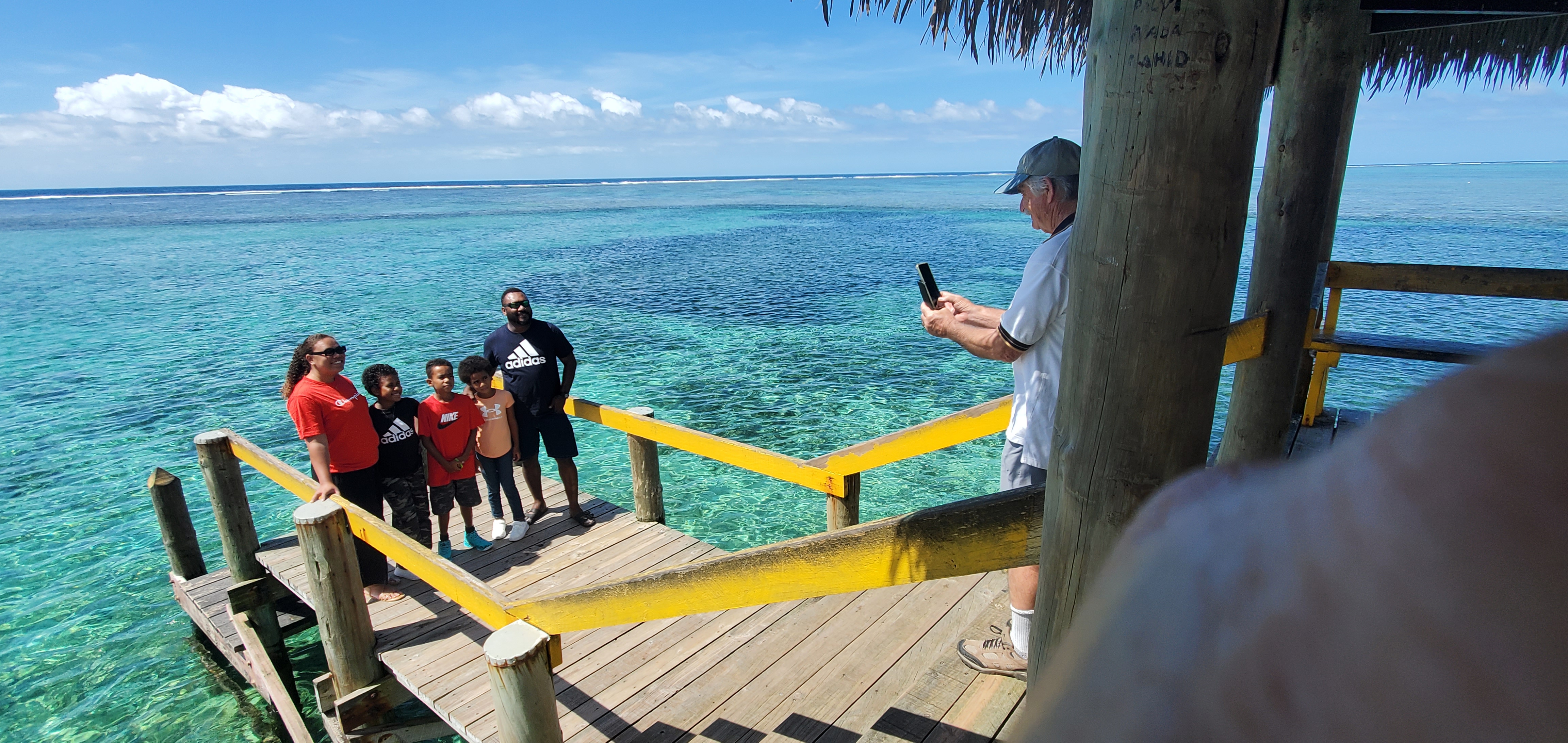
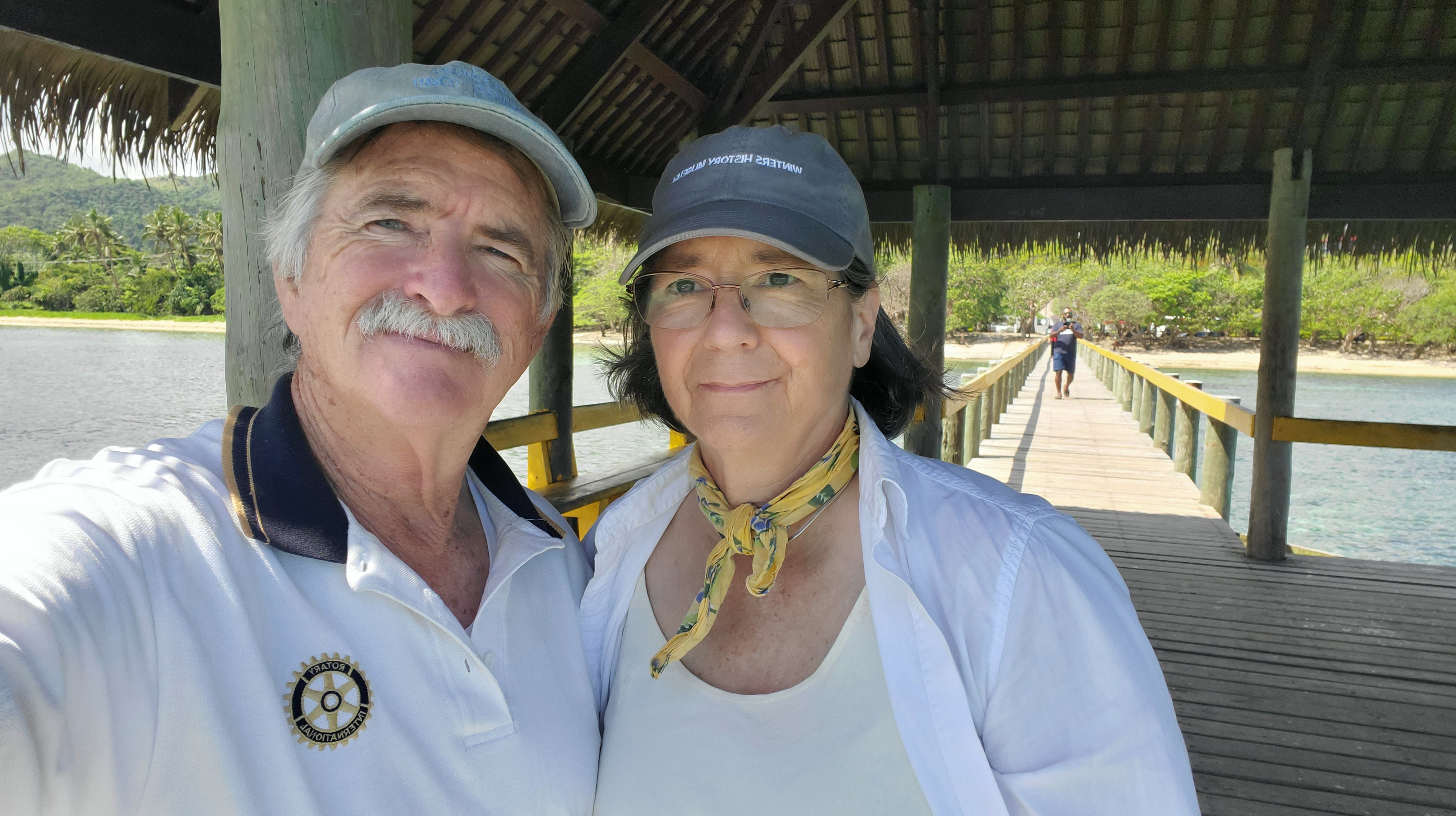
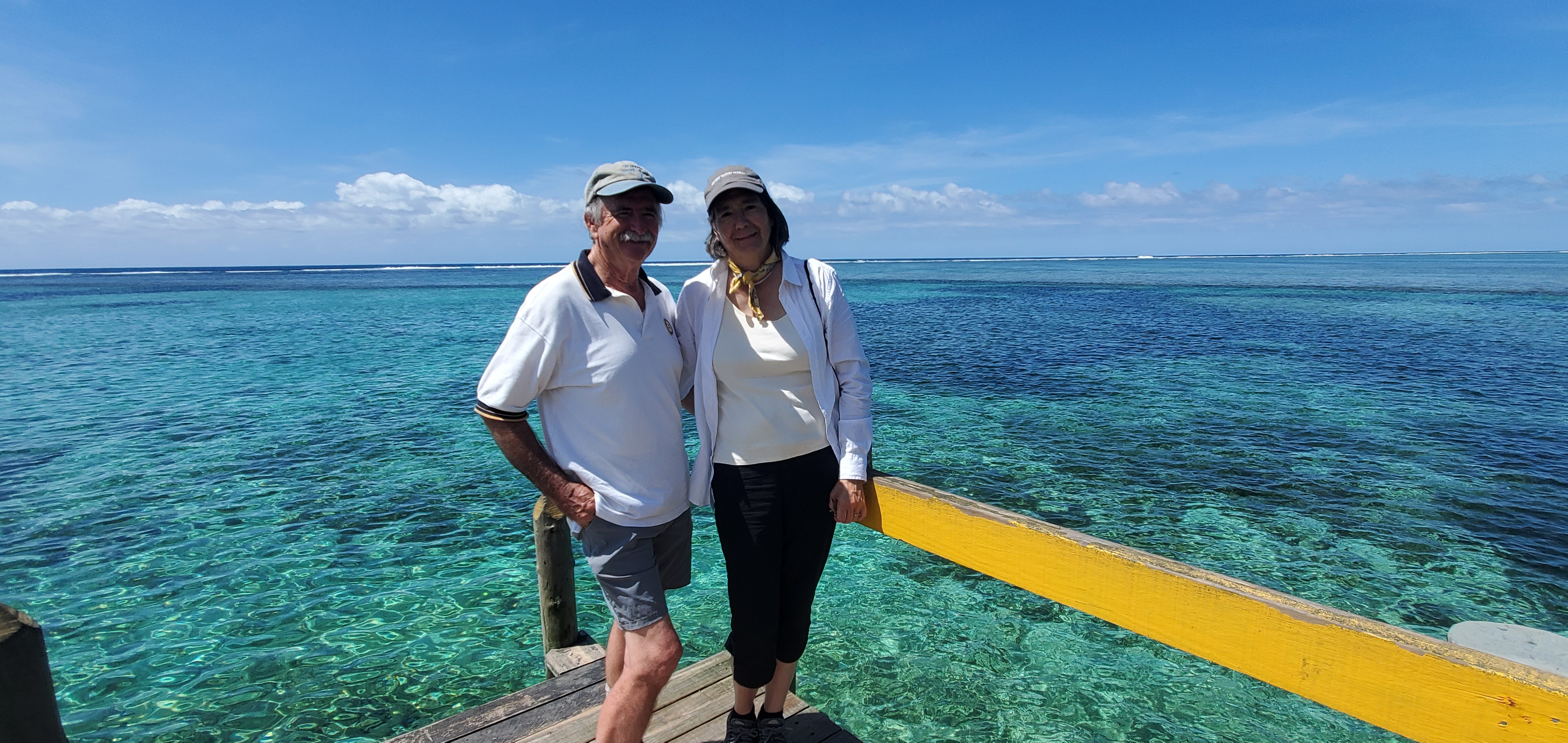
We stopped for a break at a seaside park where we walked out on a dock that went out a 100 yards or so to the ocean. What a lovely blue it was. We met a family on vacation from Suva, the capital. They asked Woody to take a family photo, and we was glad to do it.
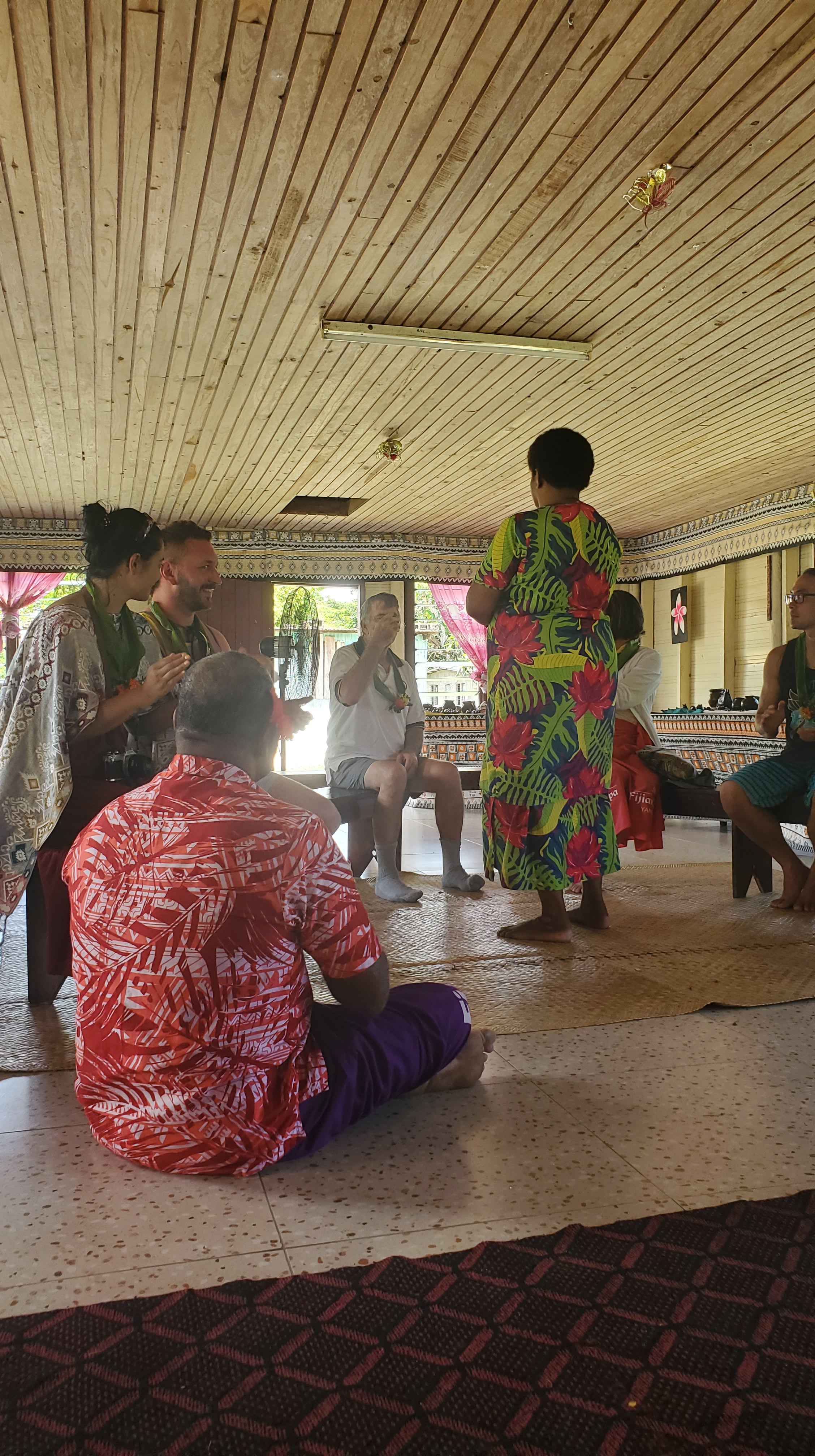
After another hour of winding roads up the hill, we finally arrived at the starting point of the hike up the mountain to the waterfall. There they welcomed us to the “community” by performing a ceremony. People were sitting on grass mats and they invited us to join them. They welcomed us with song and a kava drink. We were to clap once, take the drink, (which tasted a bit like a slightly bitter tea, but not bad) and then clap three times and say “Vitaka,” as a thank you afterwards. Sam, Rebecca and I went through this ceremony, then they invited us to view the hand-made crafts to buy.
We met our waterfall guide, Beno, who was large and dark and barefoot. A rugby player, he told us, from one of the small islands of the north.
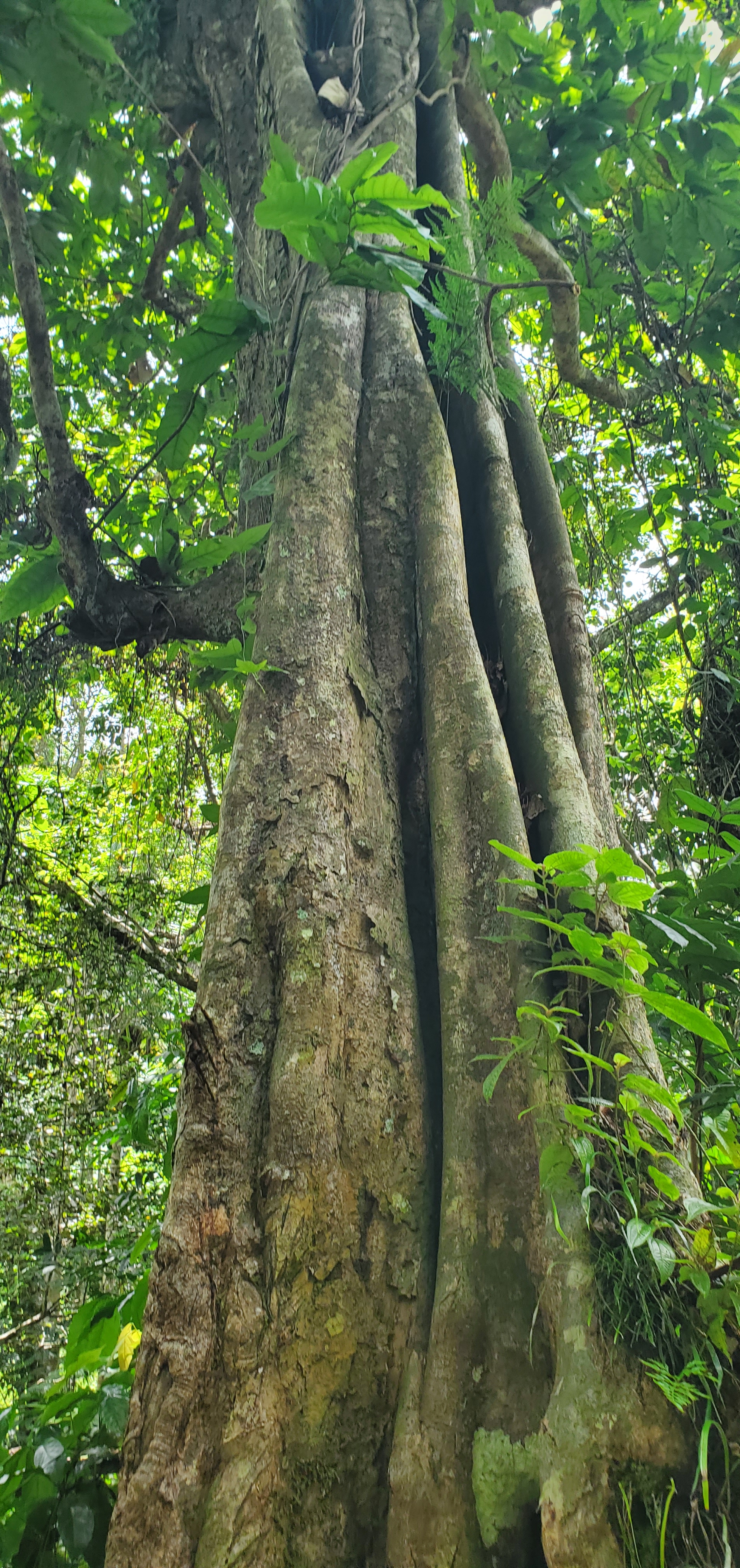
We walked up the concrete track through a dense jungle. The forest was full of different shades of green and spots of other color–purple snake weed, yellow irises, and bright crotons (that only grow as house plants back home). Beno pointed out mahogany trees, flame trees, Polynesian tulip trees, and four kinds of ferns. Vines draped down from the trees. Much of these plants are not native here, but have grown like weeds. Pricilla had told us later that you just stick things in the ground and they grow.
Walking along this raised path through the jungle we startled a number of butterflies among the snake weed. It reminded me of the story by Ray Bradbury, The Sound of Thunder about people that traveled back in time to the dinosaur age to hunt and one man steps off the path, crushing a butterfly only to come back to the present in a world void of color. I was careful where I placed my feet!
We had to cross the small river seven times before reaching the waterfall–I was glad my shoes were able to get wet. Sometimes it was over my knees. Beno was kind and held my hand in the tricky parts. I’m sure I would have fallen otherwise. Woody had flipflops on that caused him trouble because the sand got under his feet and when he got out of the water, it was like walking on sand paper.
When we got to the falls, we were fortunate because no one was there. We waded in the water and looked around. It was lovely but if I am honest, a little disappointed. They weren’t as spectacular as many we’ve seen. Burney Falls comes to mind, or Yosemite. But it was a great hike there and back.

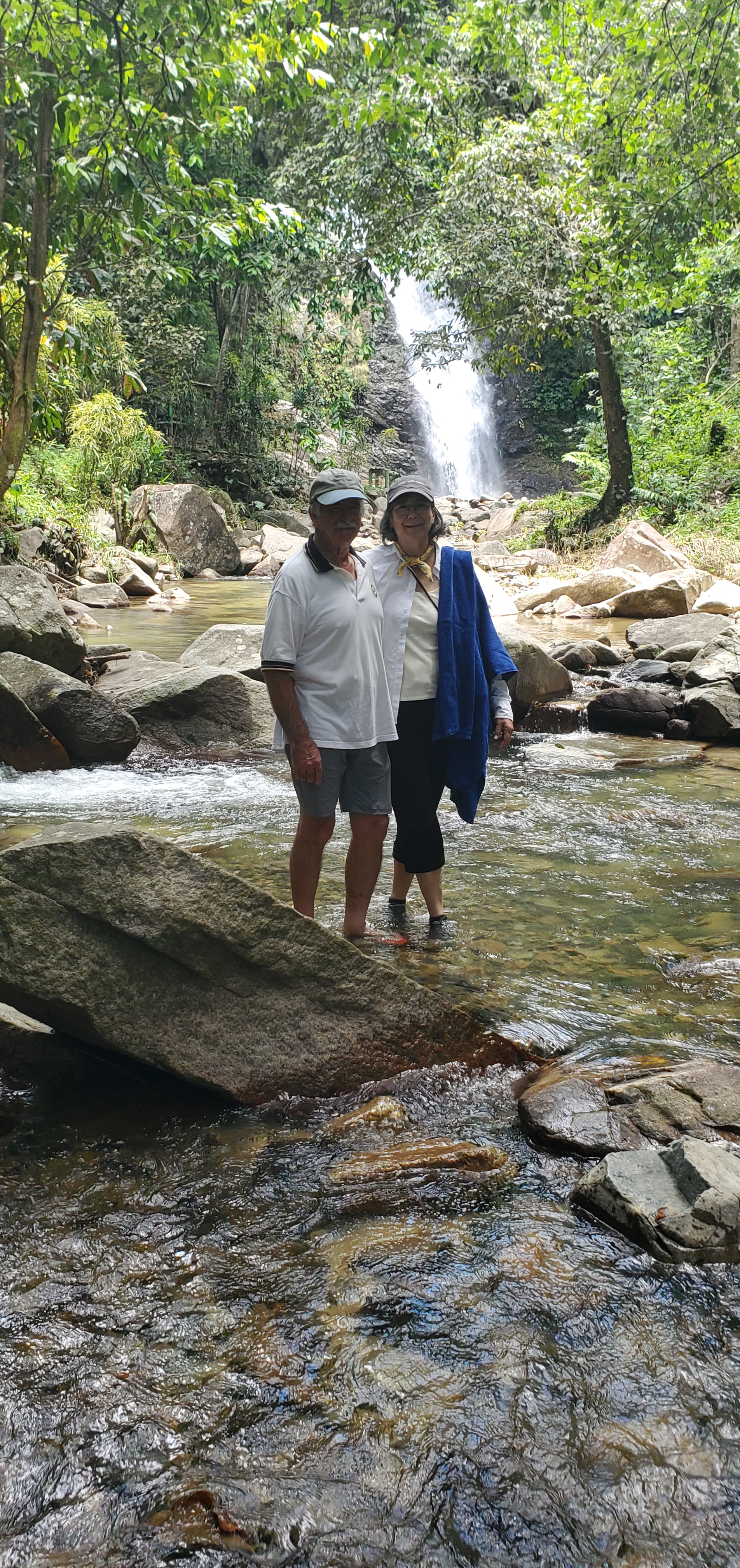
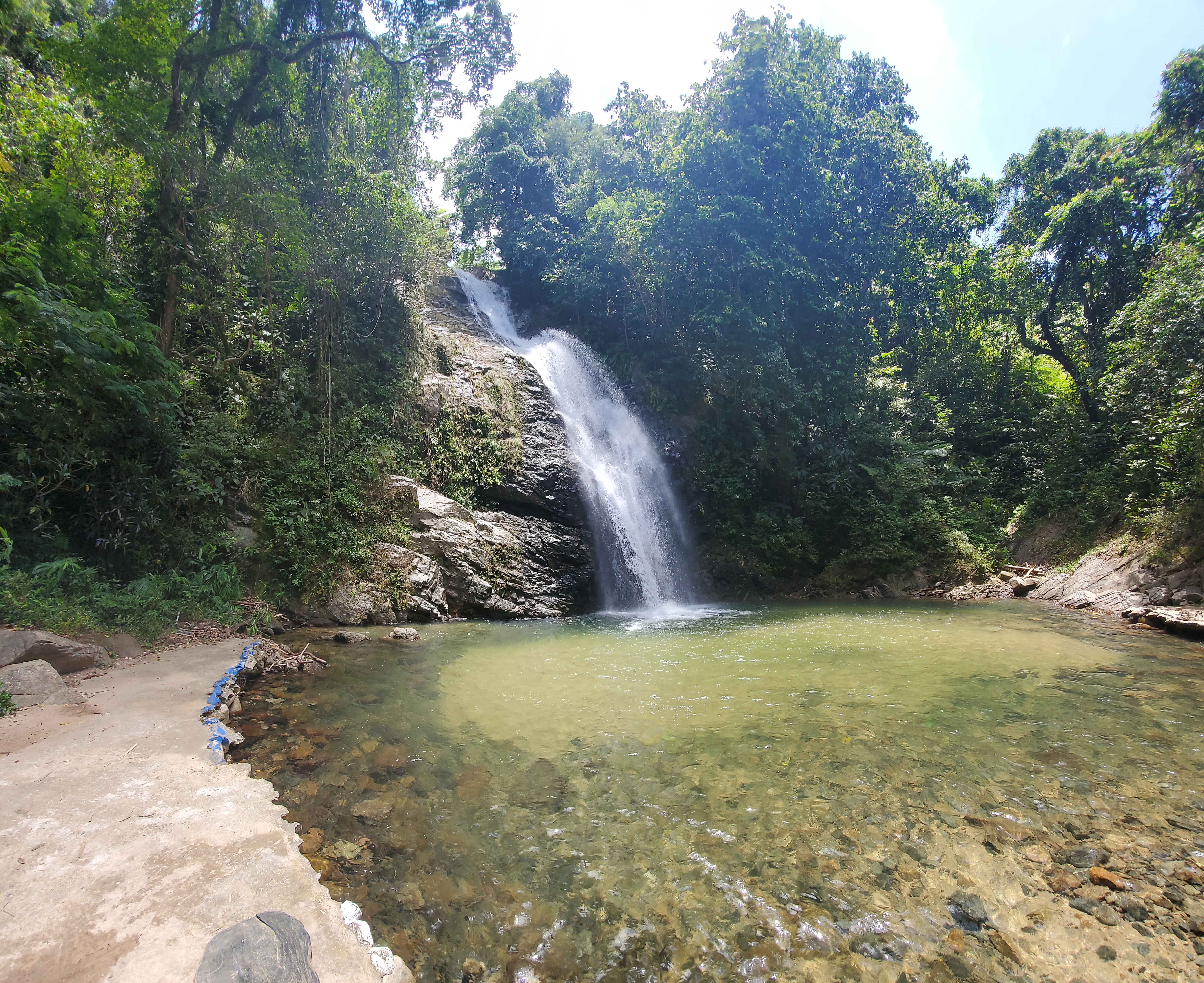
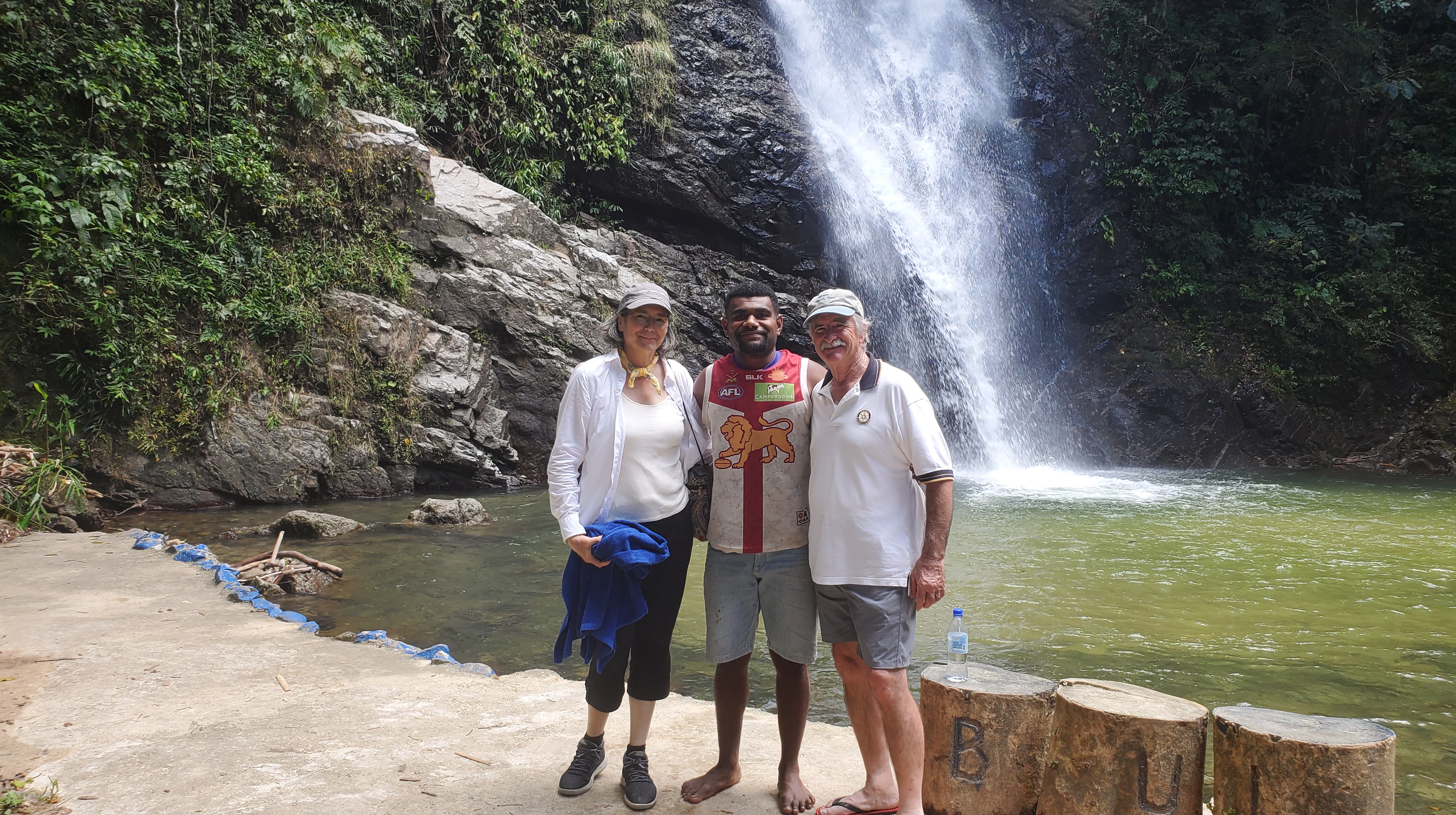
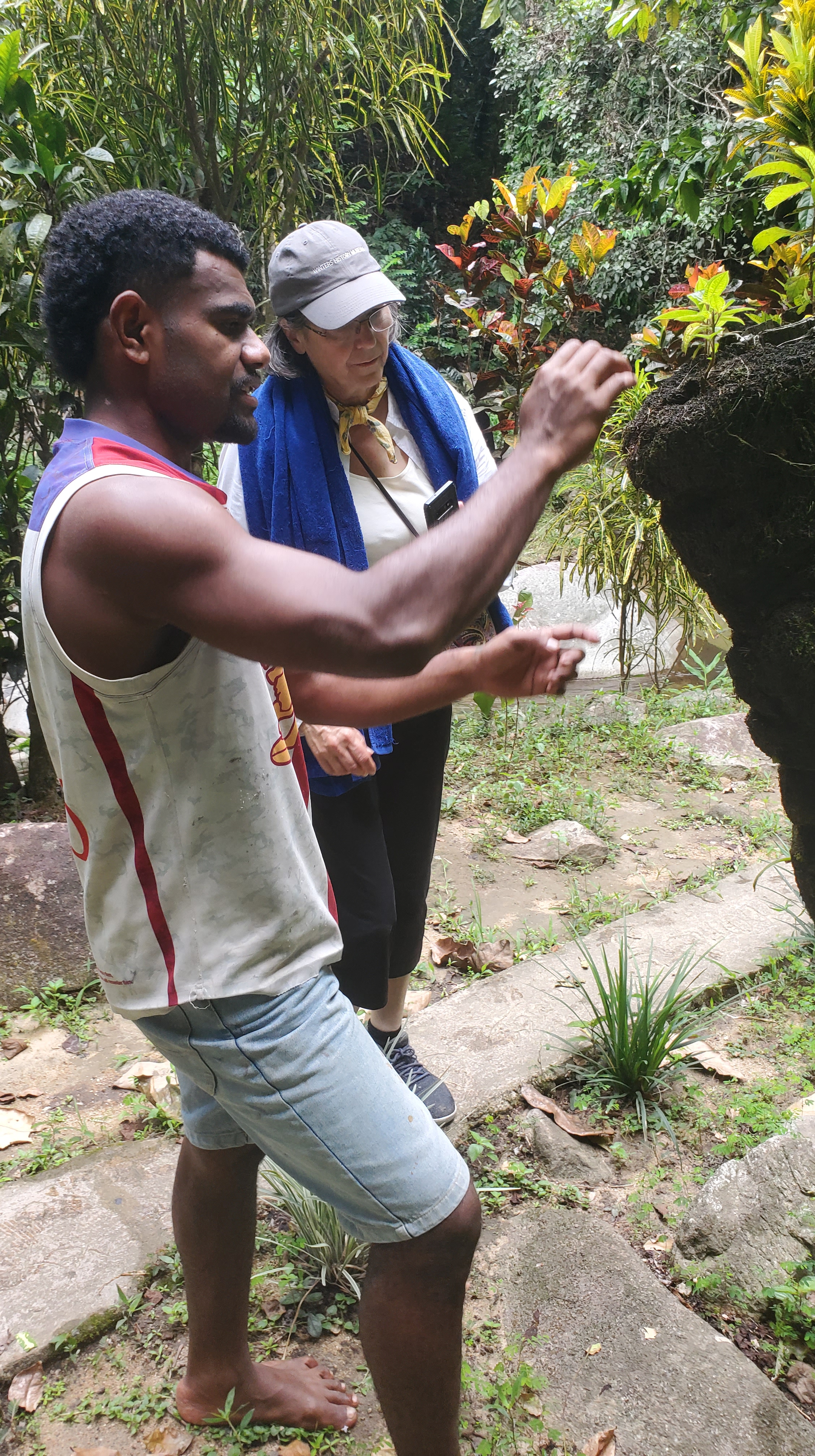
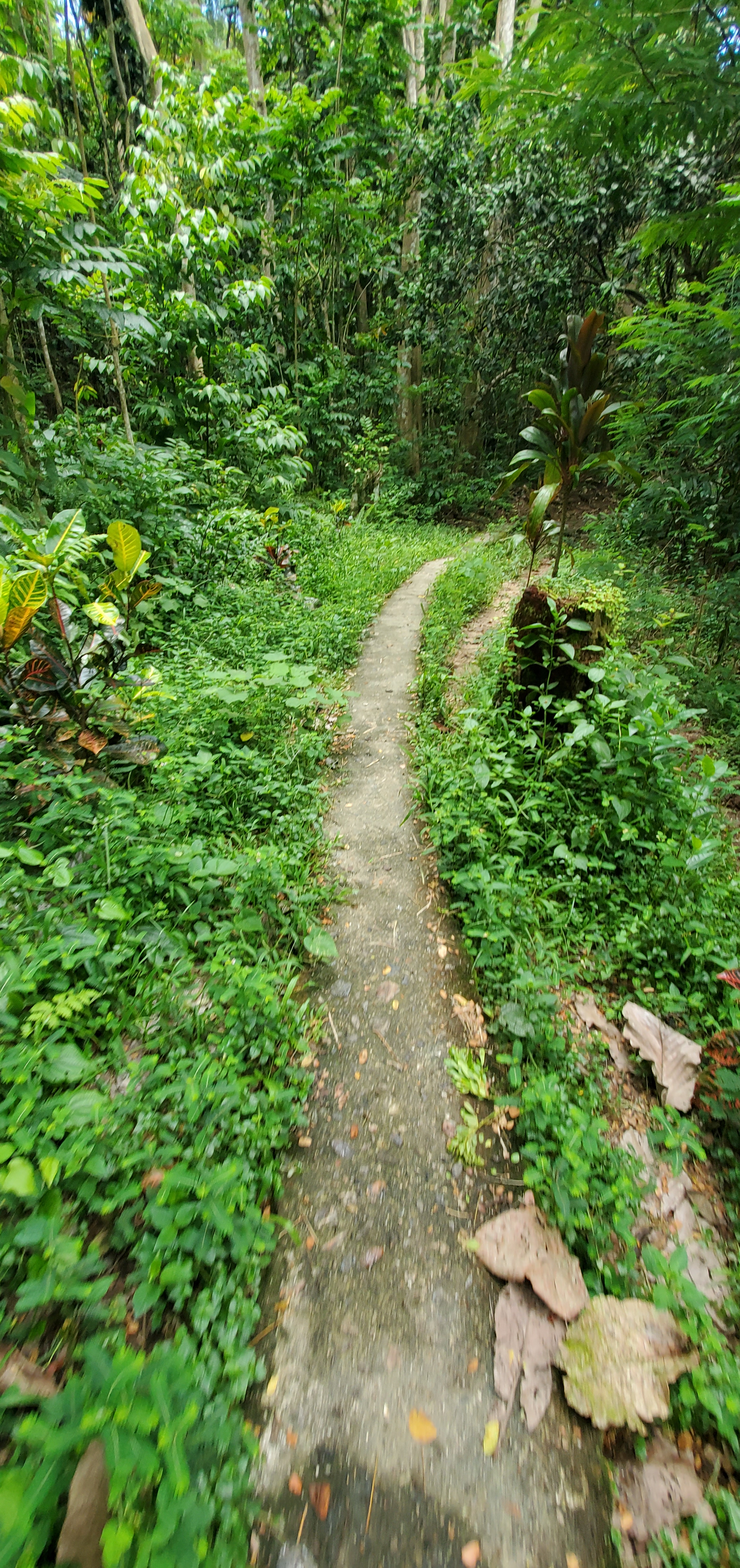
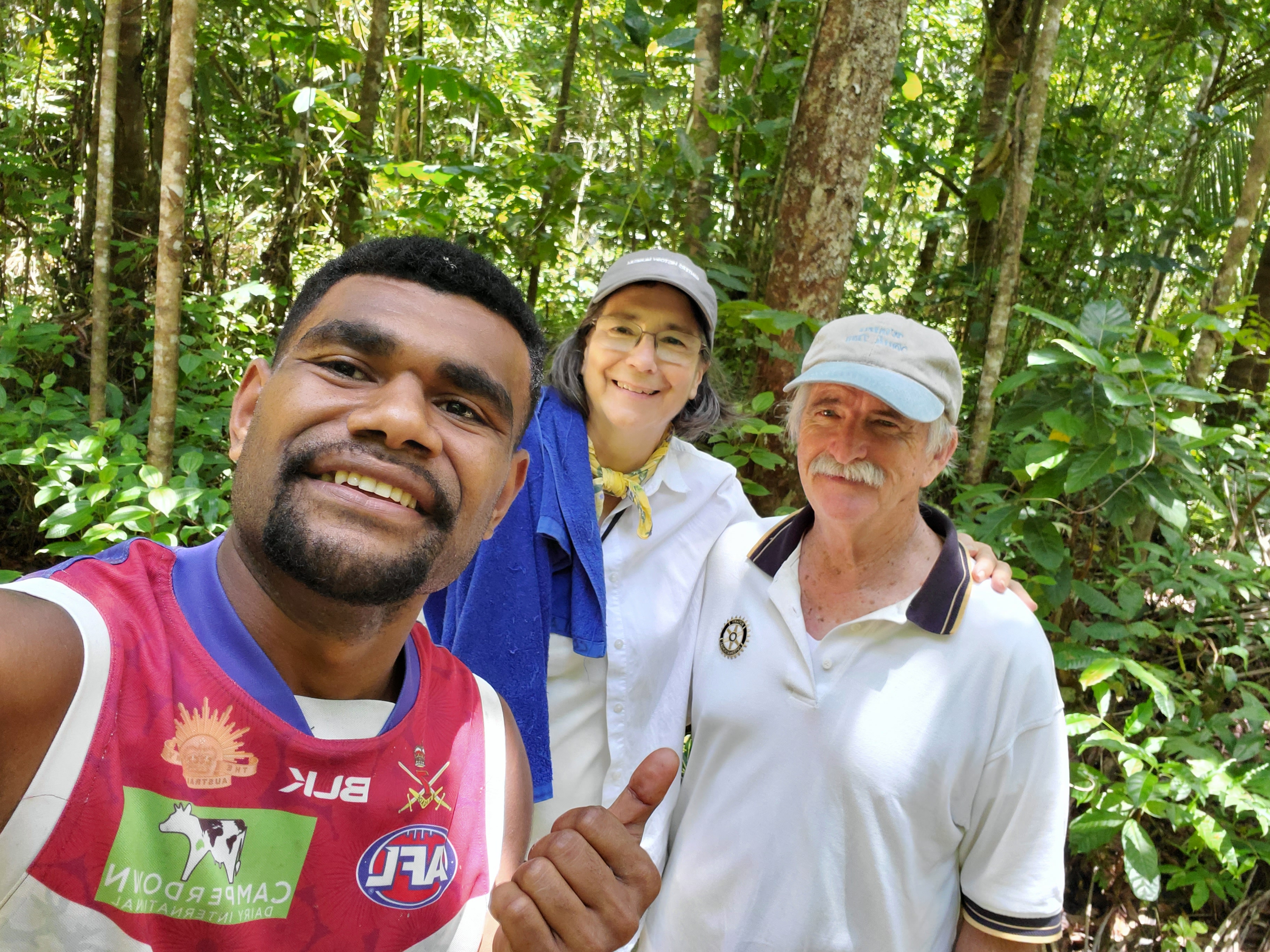
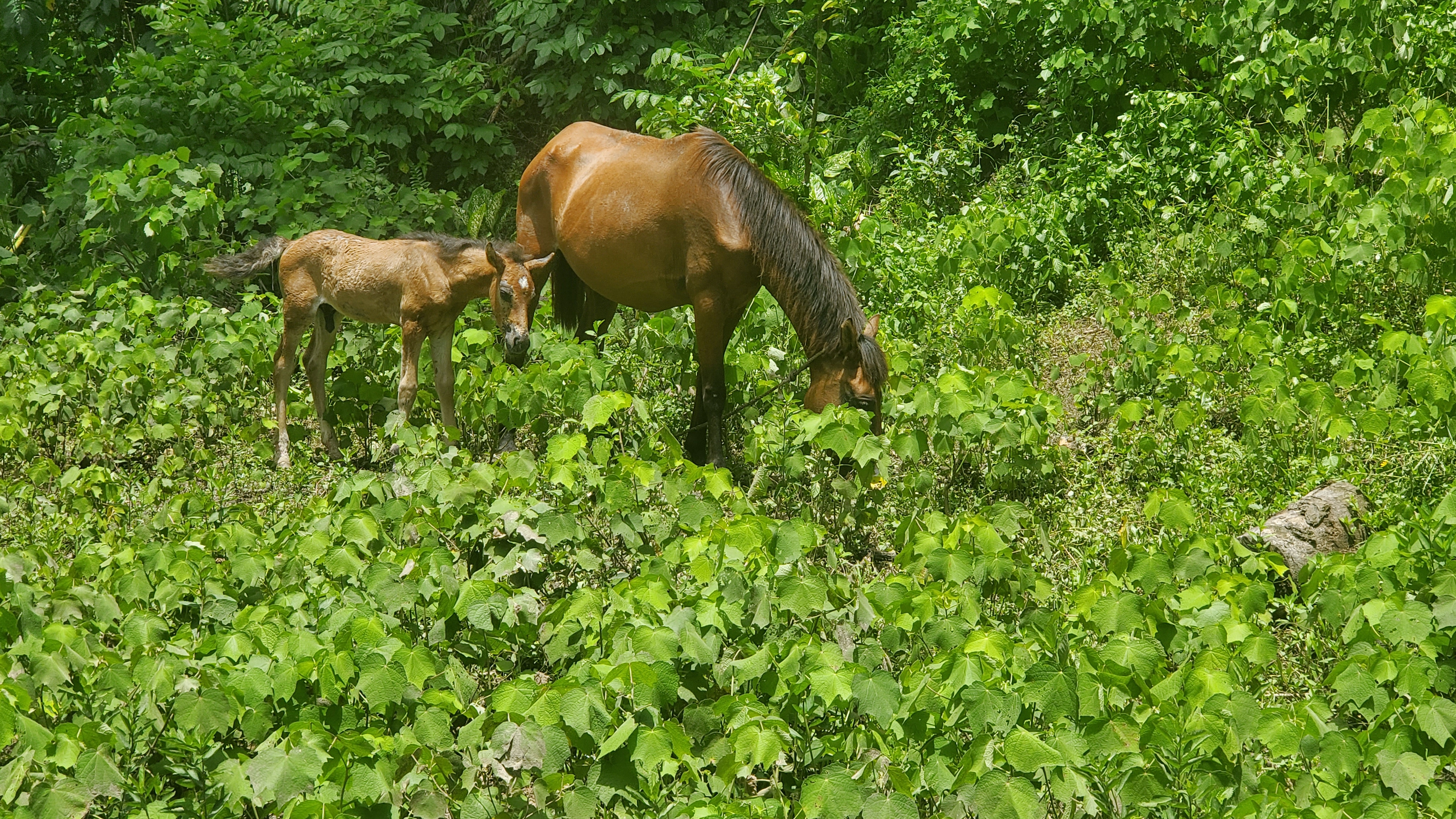
Sam drove us to a small village called Lawai, (similar but slightly different from our home address of Liwai). The purpose was to show a typical Fijian life and demonstration of ancient pottery making from over 3000 years ago.
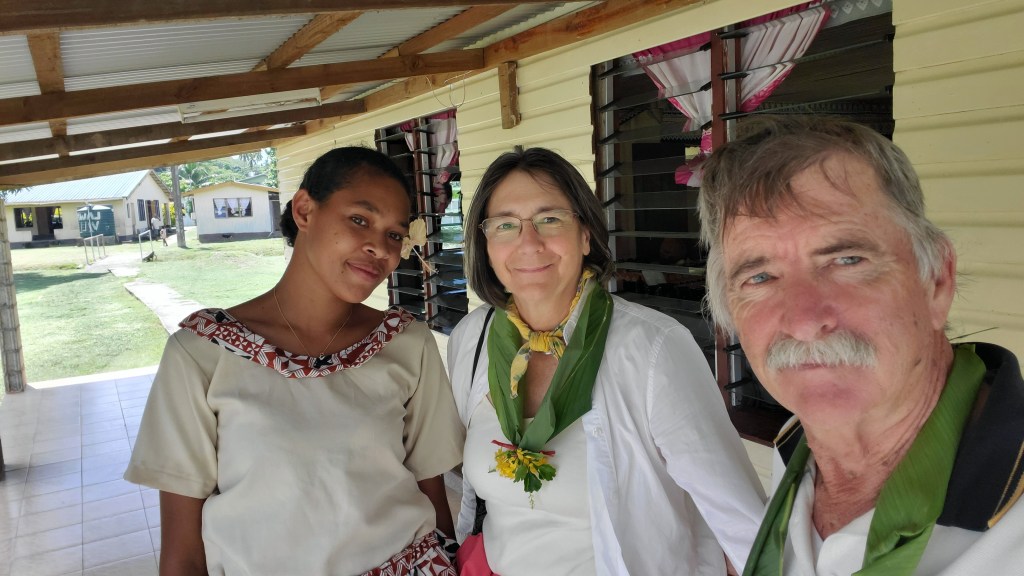
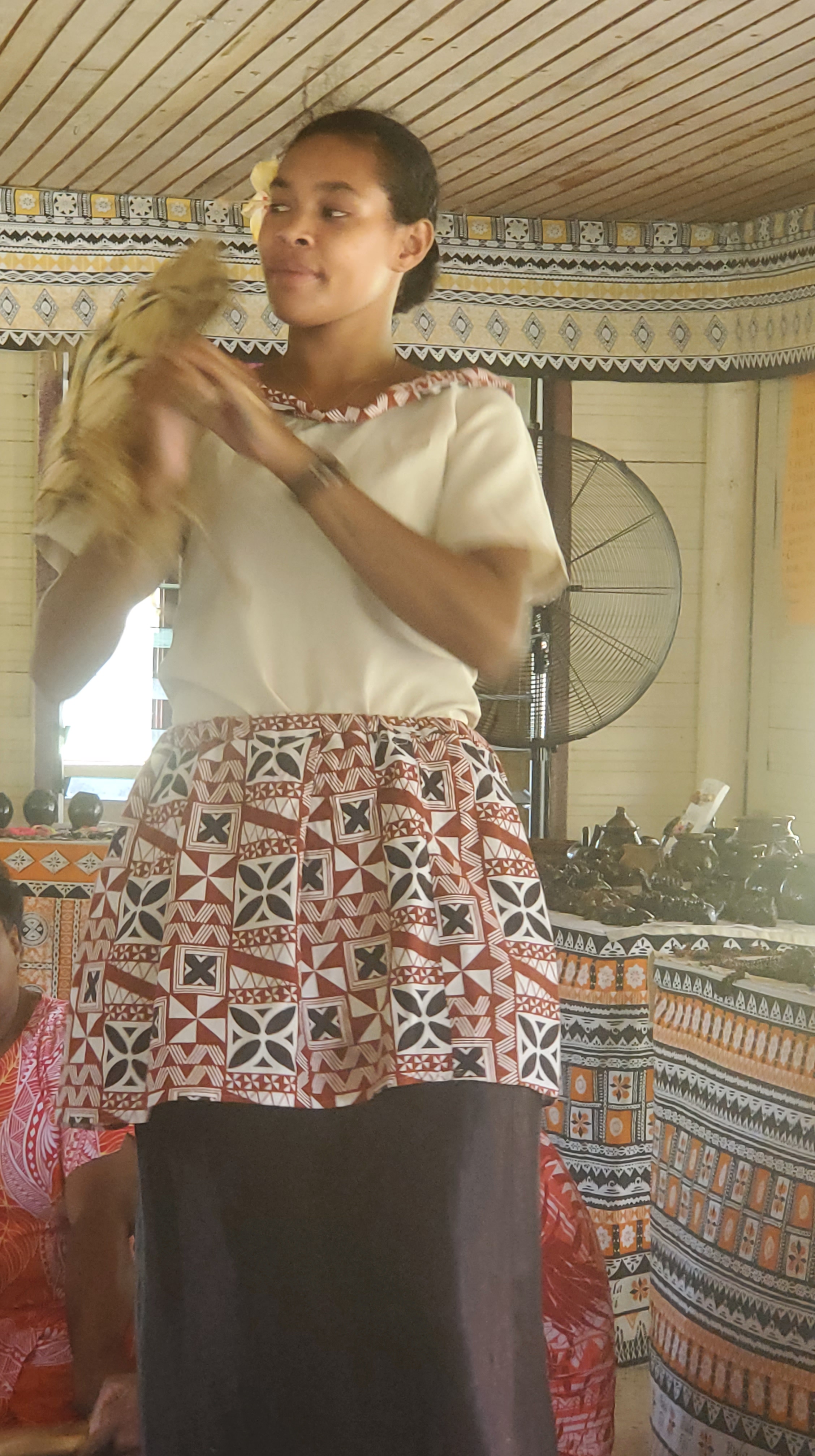
We were met by a young woman and given leis and asked to remove our shoes. They told the story of how they used the clay here to make pottery for over 3000 years. One woman demonstrated how they would use their feet to knead the clay while another one formed the clay into a bowl. The unique technique of the Fijian pottery is they heat the clay up in a fire, then they use a sort of tree sap to seal the hot pottery.
This ceremony was much like the one we had received at the waterfall entrance, but this time, they had elaborate music and singing that preceded the offering of kava. They even got all of us up to dance with them. These folks seemed more upbeat and genuine. Again, after the ceremony, they offered us to look at their handcrafts. We struggled to make them realize that we just were not interested in buying any souvenirs, but we made a donation to their community fund.

A Surprise Rotary Connection
I had written to the Rotary Club of Lautoka website in the off-chance that someone might see it, and maybe we could meet for coffee, hear about the Rotary clubs in the area. I got a lovely reply from Teresa Ali who is the Area Governor of all the clubs on Western Fiji, inviting us to dinner that night. We gratefully accepted, and made our way into Lautoka that evening, after a short stop at Pricilla’s. The place was in a bit hard-to-find area just beyond the business district. The outside of the restaurant (named curiously Restaurant 168) it had floor to ceiling glass, but painted in white. It made me think of a liquor store, painted so you couldn’t see the goods within. When we got up it, we tried to open one of the many doors to enter, and it seemed locked. We were a bit early, maybe the restaurant didn’t open until later. We tried another set of doors. Still locked. Someone heard us rattling the doors and came to let us in. Apparently, the main entrance is from the back and they don’t use these doors that open onto the front.
A woman who looked like she was waiting for others was there, so we asked if she was from the Rotary Club. She said, yes, she was and introduced herself as Gayatri Den. She told us she was a retired teacher and a new Rotarian. Soon another younger woman joined us, she really looked just out of high school. Her name was Sonali Naicker, and she was an IT person for a local company. I was really glad to see that the Rotary clubs here were making women welcome. Three other women joined us before the only man in the club showed up… Teresa, the Area Governor, Margaret Round, and Filise Nata arrived, and then the President of the club, Karanesh Naidu. We were amazed that so many of the small club had agreed on a moment’s notice to show up to greet strangers!
I sat next to Margaret Round, and learned that she was a retired HR manager, but she had taken on their club’s biggest project, an entire town devoted to homeless. This is a project “for the poorest of the poor,” she told us. A lot of the former sugar cane workers have become jobless and homeless and also unaware of modern cultural expectations or rules. A very difficult issue for towns in Fiji. It started as a mega-Rotary International grant, using a grant from New Zealand and Fiji community development to build a “Model City” project that houses 291 families, of course you opt for the project. Later It has expanded now to include many sustaining organizations. It was designed to serve the poorest of the poor. But the Rotary Club of Lautoka continues to manage help build onto the “Model City” named Koroipita, named after Peter Drysdale when he started the project in 1985. The project was also called “Rotahomes,” recognizing Rotary’s major role in supporting the project.
They invited us to take a tour of the project the next day. We had been planning to use our last day on the island to take a cruise to a smaller island to see the allure of the swank tourist destination, but when you have a choice of doing the tourist thing and getting to see what locals are doing for their own to help the poor, of course you go for the project! It would be a big day the next day for us to watch Elizianna and Cristian go off for their first day of school, and for us to go visit the Model City in another part of town.
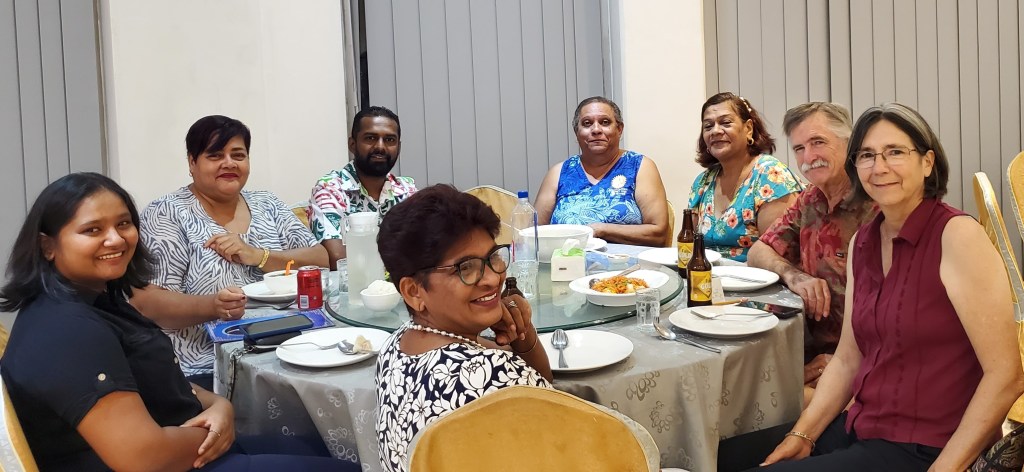
The Rotarians from the Club in Lautoka as spontaneous meeting that night. “We all just enjoy an excuse to go out, Margaret told us.” From center front, around clockwise,
First Day of School
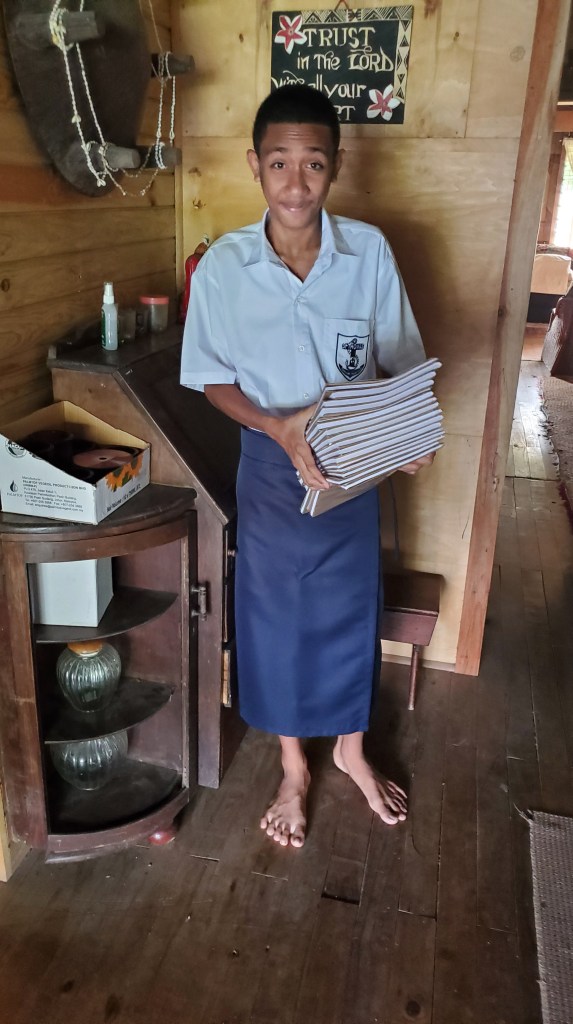
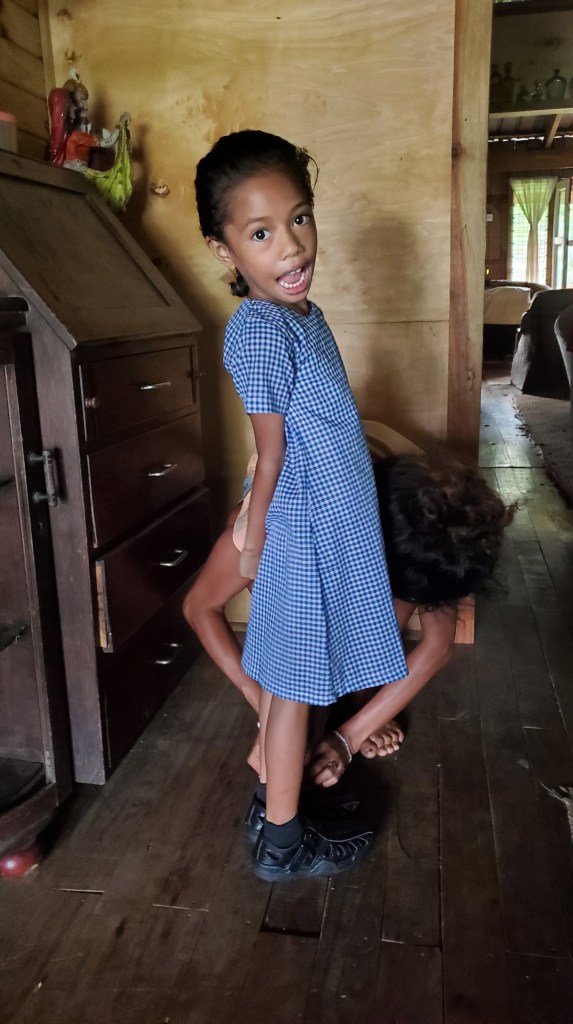
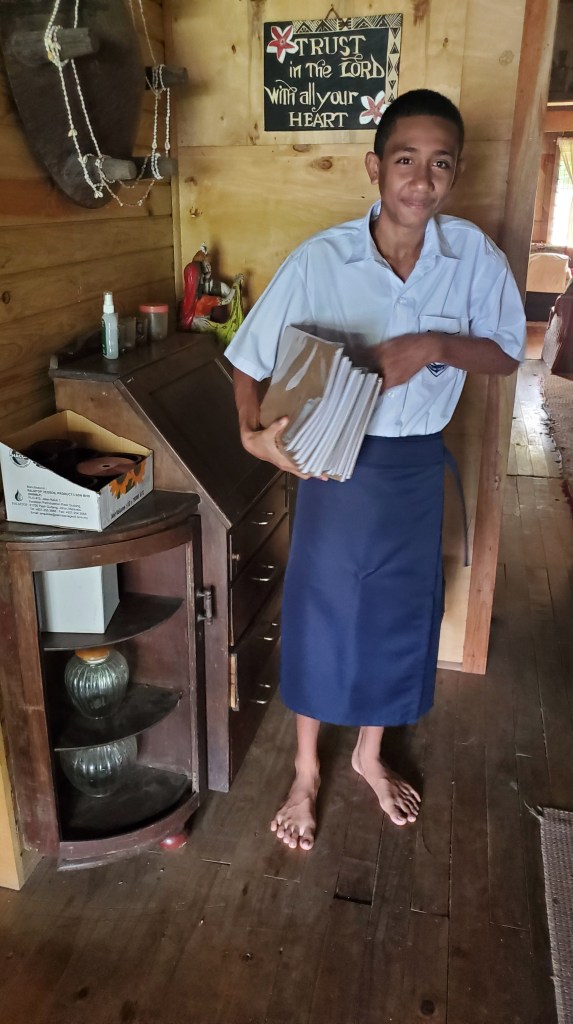
The next morning, Pricilla’s place was all abuzz with both Cristian (13) and Eliziana (5) getting ready for school the next day. We felt honored to be able to witness their special day. They were making sure their uniforms fit and were clean and neat, ready for school the next morning. Cristian had a new shirt and warrior’s skirt. Eliziana had a new dress and Barbie backpack. We could tell she was a little trepidatious but full of excitement for what she has heard school will be.


Model City–“Rotahomes”
Soon after the kids left for their school, we took the bus into town to see the Rotary project that runs the Model City, Rotahomes. First, we arrived at the offices where they take applicaitons for entry into the city.
Inside the office, we were met by the CBO and Margeret who volunteers to run the HR department. ”You know, all the problems you have in running any city, we have all those here, too,” she told us. Often they have people waiting inside the entryway of the office waiting to apply for entry into the project.
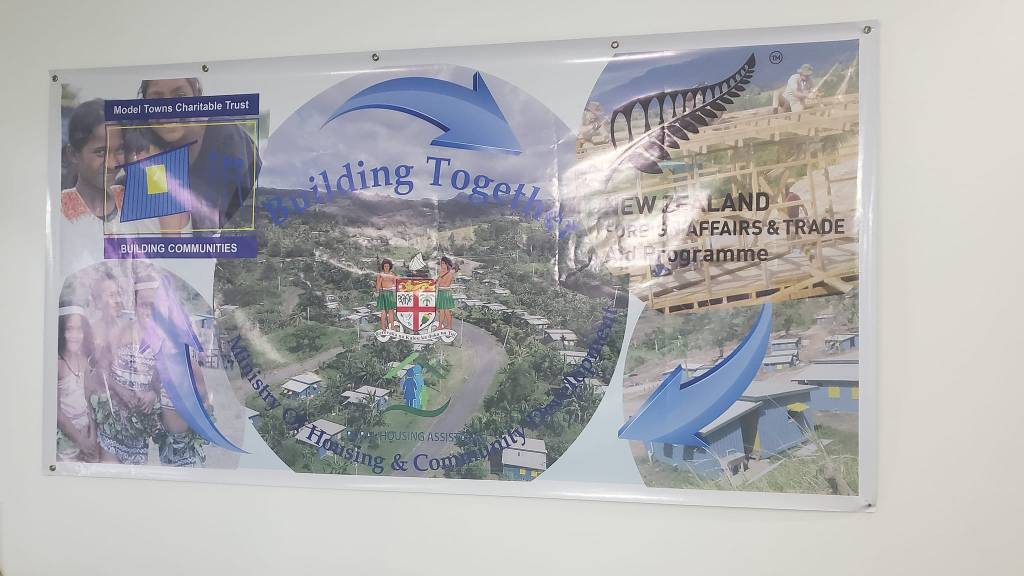

Margaret took us in a four-wheel-drive pickup out to the project. It was about two miles outside the city in an under-developed, rural area. “The land here was more affordable,” she told us. We have a sewer system, water delivery system, streets and walkways, utility systems, a community development department, schools for the younger grades, and new building department. They also have an employment development department to help residents of the town become productive and employable.
Rotarians from all over the world come in for a half work and half play project. A team of ten people can work for a week and build one of our houses, then they sometimes go spend a week on one of the vacation islands and make it a “work and play” project.
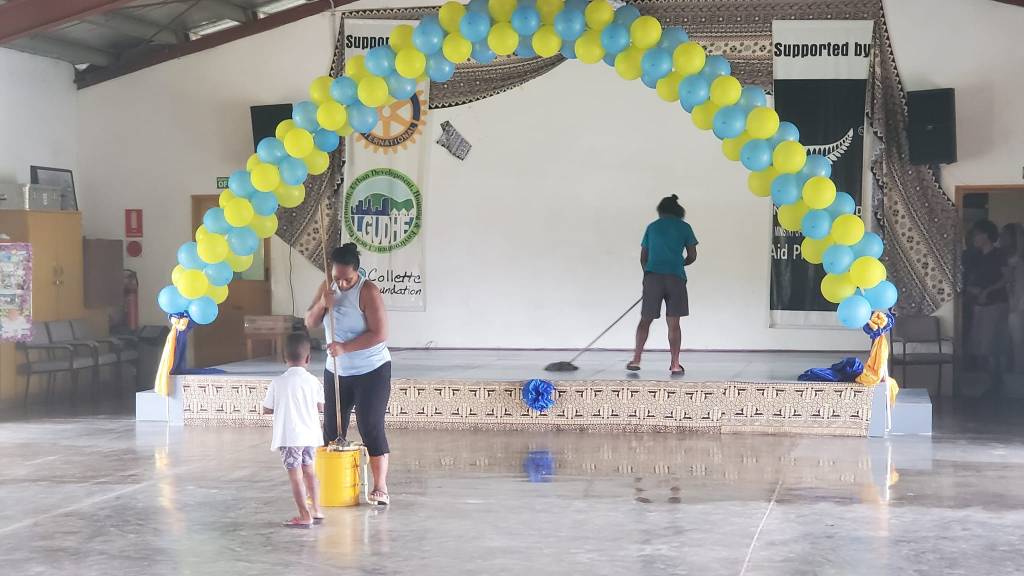
She first showed us the community center. They were preparing for a big assembly that evening at which they planned to honor several students who had done well in school. This mom was letting her child help with the work.
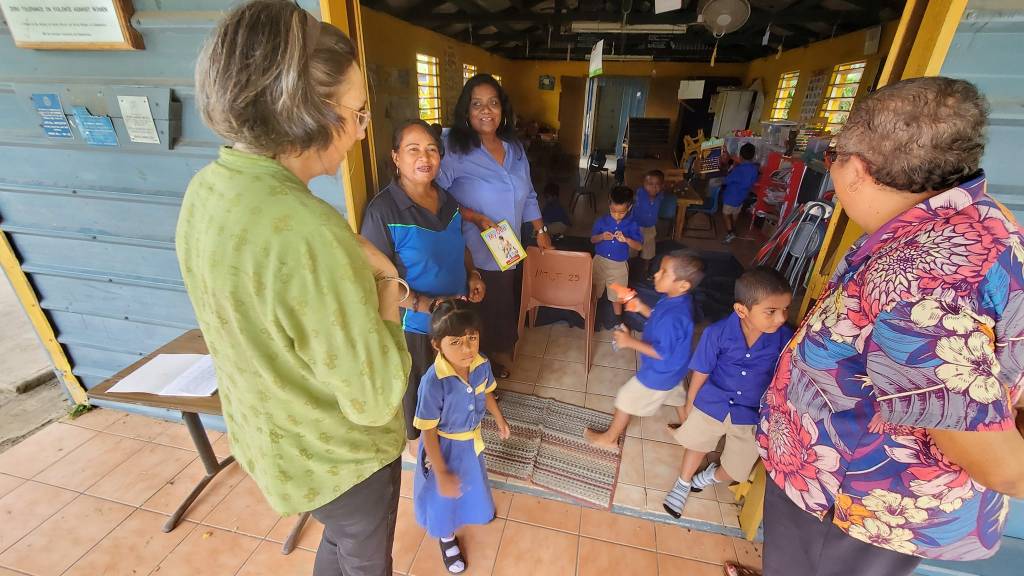
At the project kindergarten, Rebecca shakes hands with some of the newly minted kindergarteners. They were all very proud to wear their new uniforms. The teachers were kind, but I imagine they were a bit put off their stride, trying to reign kids on the first day of school. We thought of Eliziana doing the same thing just now in regular school in Lautoka.
Residents work with employees to build trusses for the next set of materials that will be assembled by Rotary teams soon. Often residents become employees of the town management program.
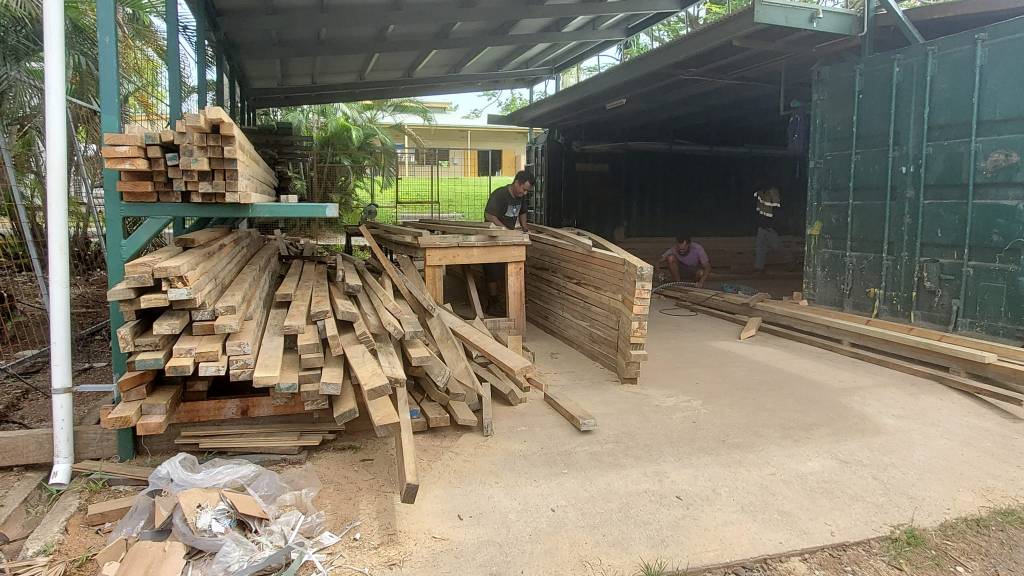
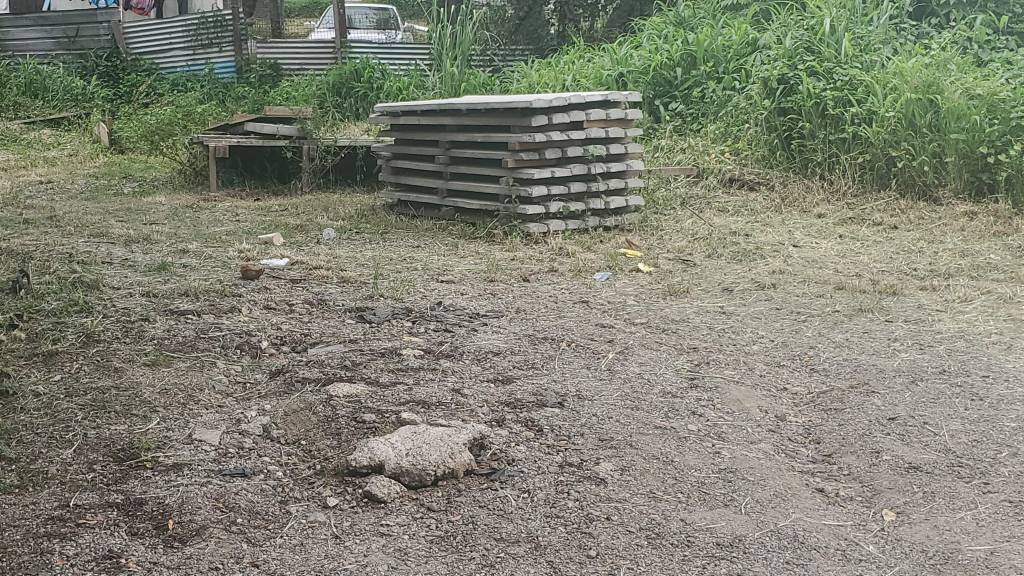
Here’s the “cement factory” where they pour elements for housing construction. These are beams for stabilizing the gound when they terrace off the building lots. Residents often get jobs in helping expand the project.
Residents grow orchids or raise bees for honey to sell at the local market. Anything they can do to become more productive and prosperous, it makes it possible to move up and out of this low cost housing.
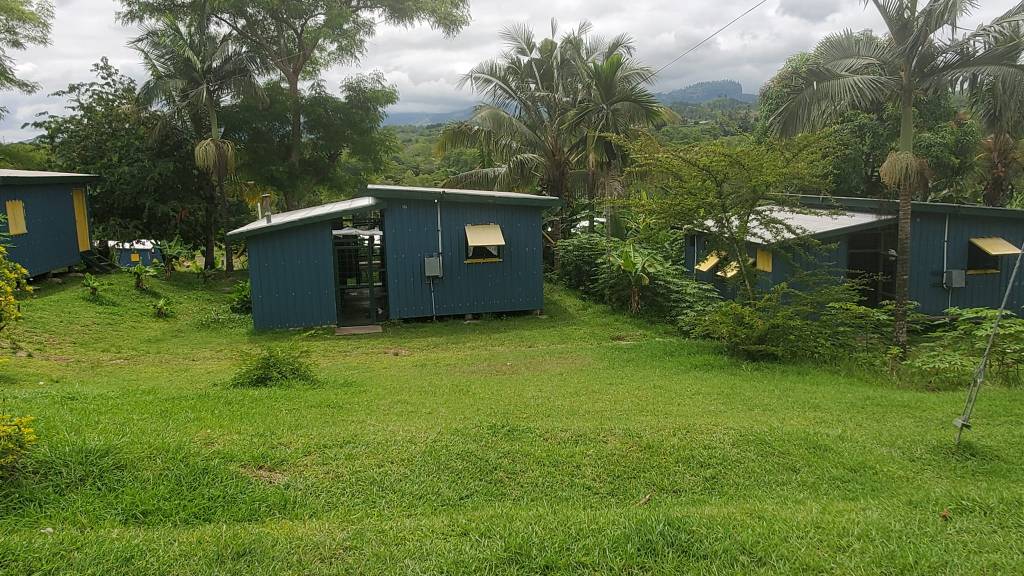
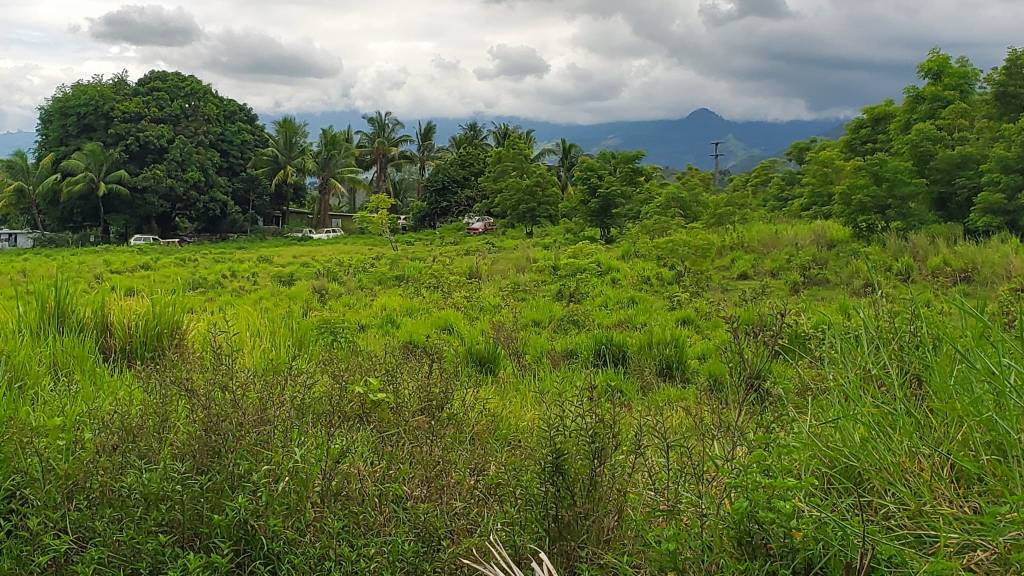
In this area, they program is getting ready for a Phase II. The program has about 20 new houses, and a selection committee has to choose who, out of 2,000 applicants will be the next to join Koroipita, the Model City.
The program has tons of problems, and Margaret will be the first to admit that. They have drug and alcohol abusers. They have those who don’t pay the minimum of $9 a month for “City fees.” They have many youth that get into trouble. But for many, this is the first time they have ever lived in a house or in a community with rules. The scope of the project goes way beyond just providing housing, it delves into every human need imaginable, including the need for mental and health care. But these Rotary members are taking these issues head on, and really making a difference, despite the very complex issues in front of them. Many come to see this “Model City” to see its value and challenges with an eye to replicate or improve on their first steps with the worldwide problem of homelessness and the “poorest of the poor.”
We were very blessed to get a glimpse into the issues that Fijians are dealing with. It was not the lighthearted, sunbaked, tropical tourist visit we had envisioned! Thank you Lautoka Rotarians for letting us get a peek at what you are doing for the “poorest of the poor.”
Learn more about Model Home Koroipita here: https://modeltowns.org/koroipita-model-town/
Last Supper
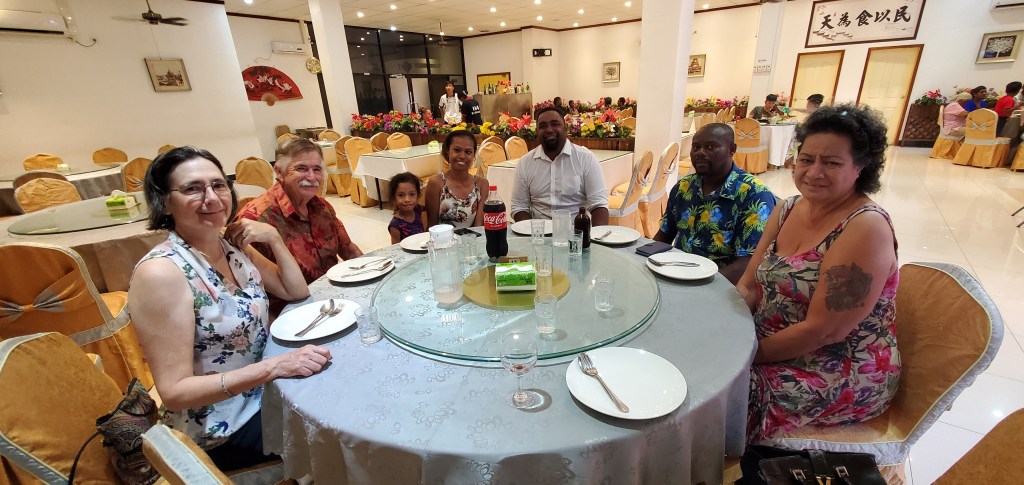
That evening, we had invited Pricilla’s family out to dinner, to the same beautiful place where the Rotarians had treated us. Karechi took us in his taxi, and Germaine drove their second car with Isibel Eliziana–Cristian said he had homework already, but Germaine told us that he was just shy and did not feel comfortable going out to dinner.
We wanted some way to say thank you to the family. At dinner, we toasted to new friends, to Eliziana’s first day at school, to future success, and the hope that we will see each other soon.
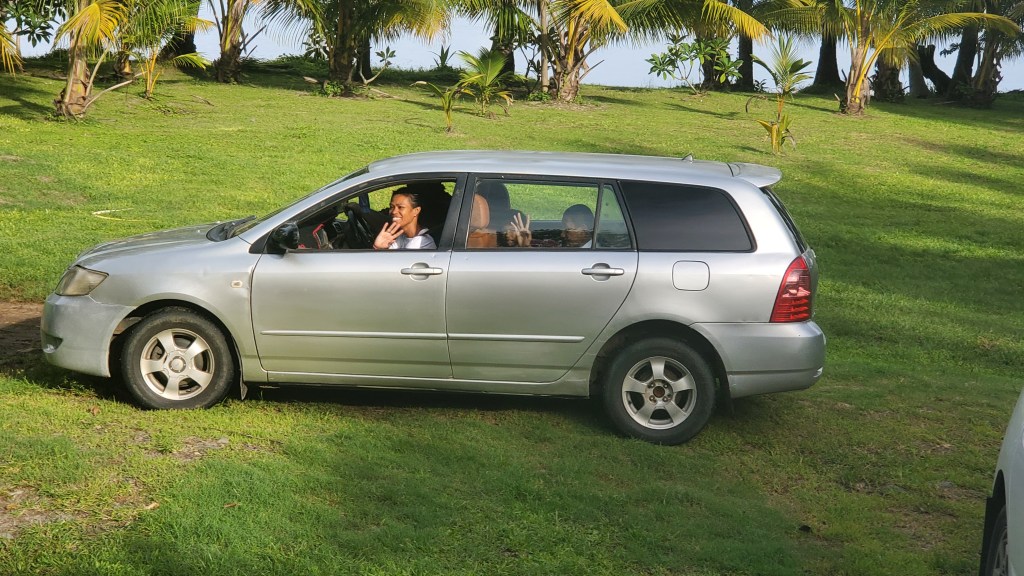
The next morning at 4am, Kalechi took us to the airport to make our 7am flight. We said our final goodbye to him just as we had five days ago in the dawn sunlight at the Nadi International Airport.
Originally, we just saw Fiji as a stopover. We thought, “why not?” Why not stop for a few days in Fiji just to see what it’s like. “But First a Stop in Fiji,” the working subtitle we initially gave this first chapter, indicates that we treated it as an adjunct trip, a little add-on. Little did we know that we would fall in love with the people and learn so much!
Our stay had ended all too soon. We saw an amazing slice of life through Pricilla’s family and through her story. We seemed to pack in a lifetime in just a few days! Fijian’s have had so many challenges and have a many to come. But they face them nowadays with perseverance and love. Looking back it does not seem like a stopover, an interlude, or just a curiosity. We came to see that it is a place with layers of history, rich diversity, and unique, strong, and beautiful people. It occupies prominent place in our hearts now. What we thought of as an opportunity to relax in the sun to get ready for our big adventure in New Zealand and Australia may be the most important stop on our journey. And now it is with reluctance that we leave Fiji. Goodbye Priscilla and Kelechi and family. Until we meet again!

 Fridaes' Adventures
Enjoying your new travel post – thank you for including us!
Linn and Paul
LikeLike
Good to have you along! We often think, “We’d like to share this with Linn and Paul.”
LikeLike
Woody and Rebecca,
What a fascinating story, great photos too. Thank you for an intimate portrait of life in Fiji.
Susan von Geldern
LikeLike
We’re glad you took the time to read it! It got rather lengthy!
LikeLike
Thanks for reading! This one got a bit long!
LikeLike
Beautiful stories and I am glad you enjoyed your stay in Fiji. Thank you for the kind words about Rotary Club of Lautoka. We are always happy to host Rotarians from around the world. Enjoy the rest of your vacation and safe travels home
Teresa
Rotary Club of Lautoka, Fiji
LikeLike
It was a magical experience for us! Thank you for arranging our meeting there. We will come back!
LikeLike
You and your club are abazing, and doind important things! Thsnk you for letting me see it!
LikeLike
AMAZING!
DOING great things…
LikeLike
Thank you Woody and Rebecca for the great write-up.
It was indeed a pleasure to meet you and host you for your Fiji stay.
All the best for your future travels.
Regards from all of us.Cocovillafiji.
LikeLike
Priscilla, our time with you was a treasure! We pray that we will be able to return someday soon! Please extend our best wishes to you and your entire family!
LikeLike
wow!! 95New Zealand and Australia Part 4
LikeLike