Our first look at New Zealand
(Special thanks to Peter Dyer and Kevin Haunui for editing and Māori spelling and vocabulary.)
For readers new to our blog, click here…
For those of you that are reading one of our blogs for the first time, the blog is called “Fridaes’ Adventures,” obvious enough, but we added an explanatory subtitle of “People First.” This calls out our tendency to be more interested in the people we meet than the places we go. We try to get to know the people first and let them teach us about the landmarks, the food, and the culture. The magic is hardly ever planned, but for us it unfolds usually when we find something or meet someone unexpected: serendipity. A great day is one in which we had nothing planned, or when we abandon a plan because somebody tells us about a more interesting place to see or an activity to do, and it often turns out better than anything we could have planned.
We travel primarily using Airbnb. One reason is that there is a simple tool you can use on the website to communicate with your hosts before you make an arrangement to stay. (Some people might call this a “hack,” but it’s just a friendly way to talk with your potential hosts before you agree to rent.) We often tell our hosts that we keep a blog and would like to get to know them as a part of our stay. Some hosts are very willing but some tell us that they’re busy, don’t have the time, or maybe that it’s just a business and that they don’t even live onsite. That is fine for us if we’re not interested in writing about that town or place. But often, we want to investigate a place, and they’re is no better place to start learning than with a willing host. And when a host is interested in us, and willing to open up, that makes for a brilliant start! In this blog, we met a couple of hosts who were very willing to share generously! And we reconnected with some old friends who used to live in our hometown of Winters.
Rebecca’s writing is entered in italics and mine is in normal text like this. She usually does the hard work of remembering people and place names, and she often records the food we eat. For my part, I often try to research the place a bit and throw in some history and analysis. We record them this way so you get a bit of our unique voices. Also, our trips are recorded here newest at the top. So if you’re following longer, multi-part story, you might need to scroll down to find the beginning of it. Happy reading. We love to hear from our readers in the comment section below. Tell us if any of this is interesting or if you’ve had similar experiences. And please subscribe and share on social media. If you subscribe you’ll receive an email when we post a new blog, and that’s only a few times a year, at best. Thanks for coming along!
Some Historical Background
A brief history of New Zealand shows that, unlike many Polynesian cultures, the first settlers populated these islands much more recently than Fiji or Samoa, (fewer than 750 years ago) and since then, the Māori have been very stable. Māori and other Polynesian cultures are related linguistically (Captain Cook had a Tahitian aboard who could communicate with the Māori when he first landed; –the languages having been separated by only four hundred years or so.) The cultures also have many similarities. As with the rest of Polynesia, Māori culture has strong traditional folklore, dance, and music ceremonies, and is steeped in mythology.
But unlike other Polynesian cultures, the Māori developed agricultural skills related to a cooler temperate climate, far different from the tropical islands from which they migrated. The Māori still, to this day, have traditions that include wood carving, tattooing, and weaving. The Māori hold food, friends, and family in the highest regard. Māori have a keen sense of right or moral action called “tikanga” or the right way of doing things. Much of their sense of stability in the world is expressed through their weaving and carving. A marae (/muh RAI/ (meeting house) can be found in most communities but you can’t just show up to see one, it is by invitation only.
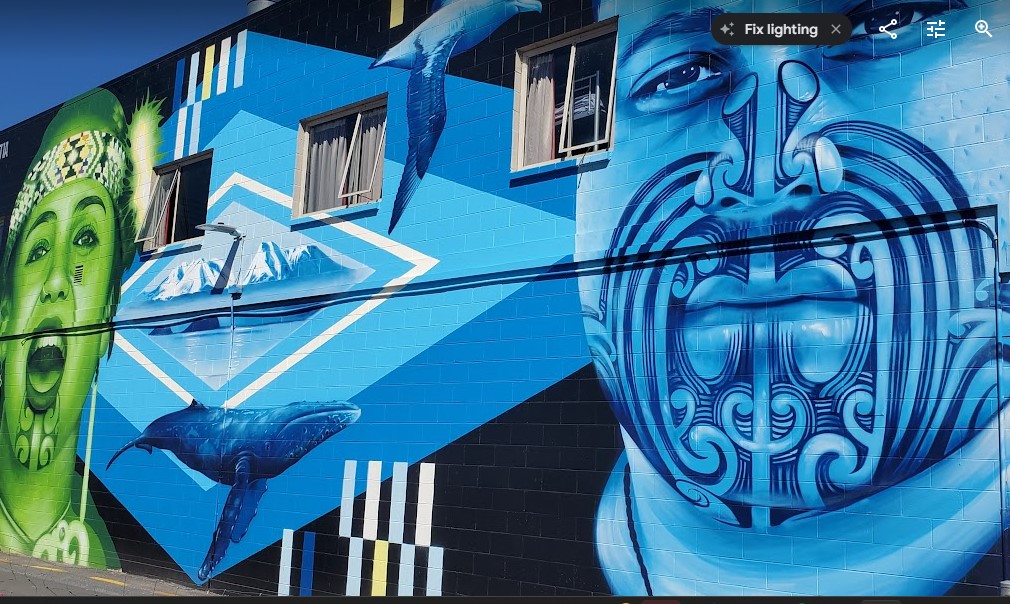
While the Māori had become comparatively more stable than other Polynesian islanders because of their isolated location, it is certainly not a single collectivized culture. Individualized groups or tribes (iwi) developed regional customs and practices, but they shared and developed the Māori language (Te Reo) and trade practices.
In 1840, the Treaty of Waitangi was signed between the various leaders of the Māori and the British Government. The Treaty was simple. It said that the British would protect the Māori culture and allow the Māori to continue to live as Māori. It also gave the right to govern and represent all the people of Aotearoa (to be renamed by the British as New Zealand) to the British Government. The words were simple, but the translation into the different languages ended up being quite different, and those differences about the meaning developed and grew.
Soon after the Treaty of Waitangi was signed and agreed to, conflicts arose. In 1860 the British made an offer to purchase land at Waitara from leader Wiremu Kīngi Te Rangitāke. His refusal to give up their land led to the outbreak of the Taranaki War, and a breakdown of trust in the Treaty While still revered as the establishing document that set the New Zealand government in motion in much the same way as the Constitution is for the United States, those that support Māori rights fear that this document is being whittled away. Waitangi Day is an annual celebration that celebrates Māori culture. It is also a day in recent years when political protests occur bringing up breaches in that Treaty.
Arriving in New Zealand
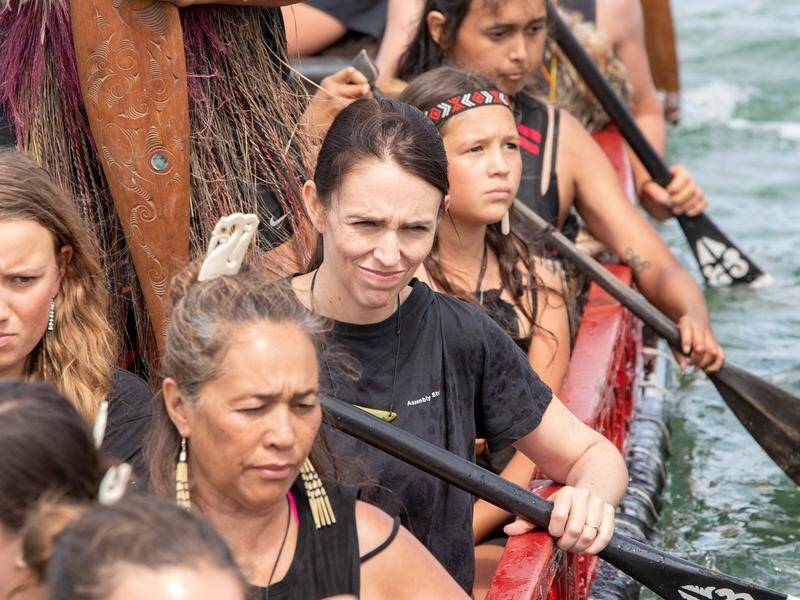
We had been very impressed with New Zealand’s progressive government in recent years. They had, under Jacinda Ardern’s leadership, avoided deaths during the pandemic with a forceful but compassionate approach to combating the spread of Covid. As an island, they were able to keep the incidence of Covid to a minimum and protect its citizens. When an attack on a mosque happened in 2021 taking the lives of 50 people, Ardern responded in a way that brought the Muslim and non-Muslim communities together. We were looking forward to experiencing this country where they seem to get so many things right.
Wellington is the national capital, and it is a relatively small city of a little over 200,000. By comparison, Auckland, the nation’s largest city is approaching two million.) This would be a good place to start our car rental experience, I thought. Small is good!
We had a great experience with Ezu Car Rental, a very small rental business with a fleet of just 20 cars. We arrived before noon at Wellington Airport. Amber, the agent I had communicated with by email, had told me that an early pickup would be fine. I called her number as soon as we landed. She was there waiting for us in a van and drove us to the rental agency. She put our luggage into a compact car as soon as we arrived and gave me the key. “Is that the car we’re renting?”
“Oh yes, you just need to come in to sign papers,” she said in her pleasant Chinese accent. Later we learned that Wellington is a very multicultural city. Asians comprise over 10% of it and most of them seem to be under 30. Five minutes later, we were driving down the left side of the road, trying to figure out how to make it to get the GPS to work on our phones, and how to find our Airbnb place.
The drive to our Airbnb was scary for me. Maybe it was not for Woody, but driving on the other side is hard. Being in the passenger seat, I have no control over anything, so I feel helpless. Sometimes he’d drive too close to the parked cars on my left. I tried to stay calm because I knew Woody had to concentrate.
Driving in New Zealand took a bit of adjustment. I had gotten a high deductible policy when I booked the car, ($1000) but the sweet-sounding agent at the car rental told me that we could add a total coverage policy for the car for NZ$1000. (approximately $650 US) I decided to run the risk, a decision that Rebecca later told me I should have shared with her. I didn’t want to worry her any more than she was already.
As I was driving, I wasn’t sure which was more disconcerting, the busy city traffic, worrying about the clearance on the left side of the car, going around the roundabouts, making sure I ended up on the correct side of the street, the $1000 cost for just about any minor collision, or the damn windshield wipers that came on every time I tried to activate the turn signal. I finally decided it would be up to the other New Zealanders to just get used to the fact that when my wipers were in motion, I was changing lanes. I’m sure that people nearby were laughing at us.
Lately, every time we enter a new city by car, I feel that we explore it organically, much in the manner of the formation of a leaf. Going down the arterial highway, mentally we are forming the layout of the city, going down the main stem first, then branching out to the secondary branches, and then the neighborhoods, like the leafy material between. We often only begin to comprehend the structure of the city by the time we are leaving it.
When a Californian thinks of a beautiful, windy city by the bay with steep hills running up and down, with a beautiful mix of 19th century wooden Queen Anne style houses, and modern glass high-rises, of course, he or she will assume that we’re talking about San Francisco. But this description suits Wellington to a tee. Differences? It has less than half the population of San Francisco, Wellington is clean, has few unhoused people that we saw (although we were told that it is a problem), and it has an efficient, clean, and safe bus system serving the entire city and including the greater metropolitan area around Wellington. The weather is warmer than most summer days in San Francisco, but the constant breeze coming off the bay keeps it cool. What’s not to love?
Wellington was our first stop because it was the place where some old friends from Winters had moved to about 20 years ago, Peter and Cathy Dyer. They had invited us over for dinner that first night after we got settled, so our mission was to get to our Airbnb, drop off our luggage, and then walk to their place for dinner later that night.
Kevin and James
We found our place, a charming Victorian cottage built on a hill that must have had a lovely view of the harbor until the 80’s or so when a tall apartment building was built in front and now blocks the view.
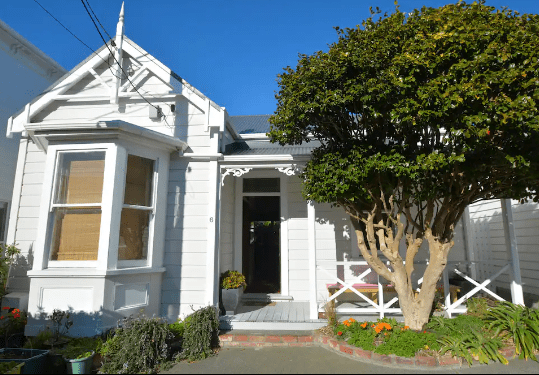
Kevin Haunui and James Harcourt are our hosts. Kevin is based at the University researching social and health issues involving Māori and James is an artist of some renown here. Their place is filled with amazing works of art.
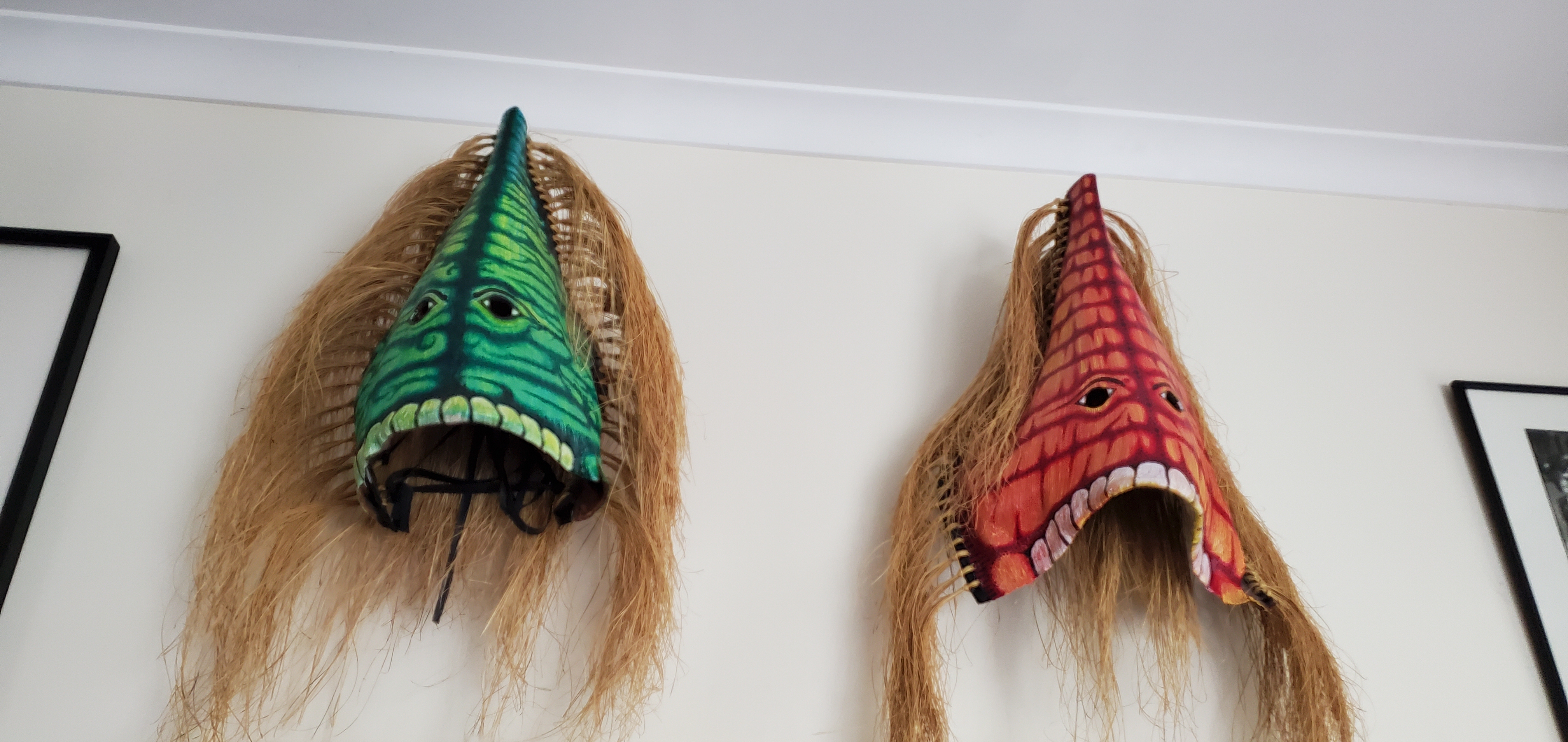
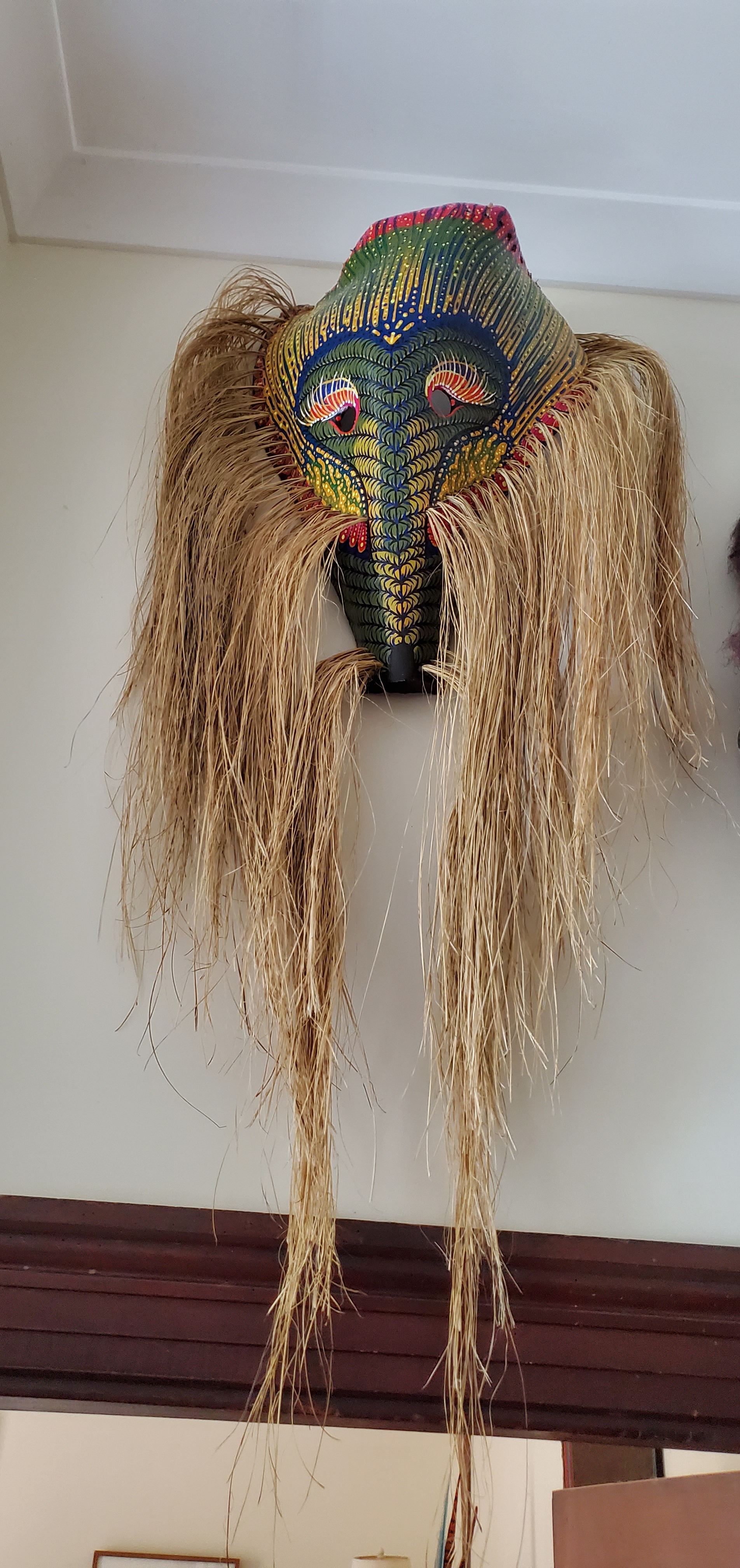
James has many large, whimsical, and colorful masks that he says is giving a face to nature; they’re bright, bold colored patterns and often embellished with dried grasses. He also has a couple of pieces he has done with bottle caps—flattened out so they look like flowers. They have welcomed us and made us feel at home. We are fortunate in our good luck.
We found James and Kevin’s place at the top of a very narrow lane, elevated above the surrounding vicinity. Kevin greeted us and showed us our room at the front of the house. The small Queen Anne Victorian looked a bit plain from the outside, but the inside it was transformed into a captivating gallery of artwork and curated decorations. Soon we began to become enveloped by their surroundings, trying to understand their story.
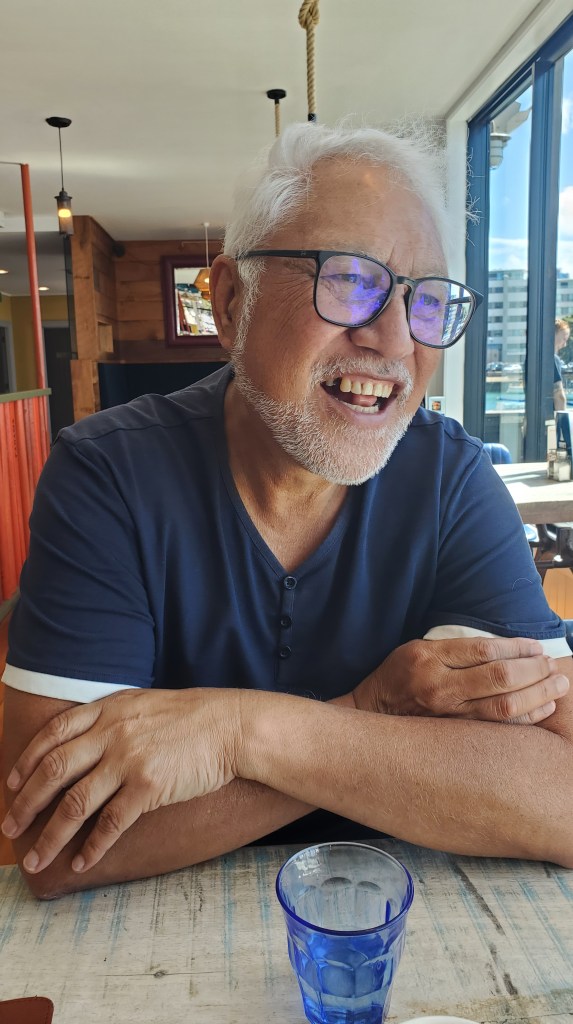
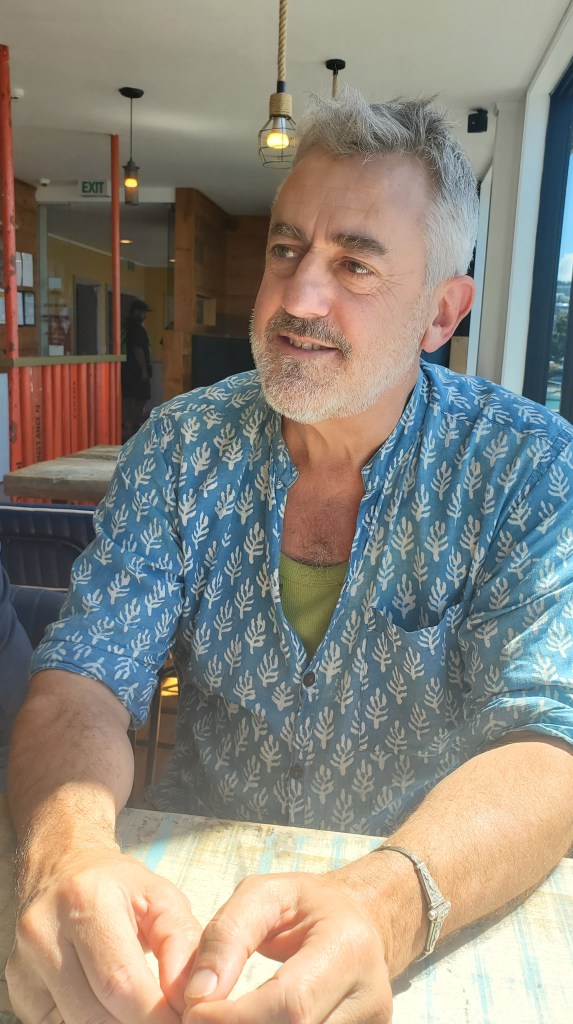
We instantly liked the warm, congenial company of Kevin, (left) and James (right). They told us about their city and their lives here in Wellington. We felt welcome to learn through their eyes, experience and talents.
James is an interesting artist that seeks to combine found and natural materials to create colorful art that causes one to question what is real and what is make believe, and where do nature and humans intersect.
He has a local gallery that we could see by special arrangement. It was only after our time in Wellington had run out that we realized that we would not be able to visit the gallery, much to our disappointment.
He seems to sell to a very specific clientele. He donates much of his profit to non-profits. He had a special promotion to help disadvantaged youth in Africa while we were there. I wish I had room in our luggage to buy a piece or two.
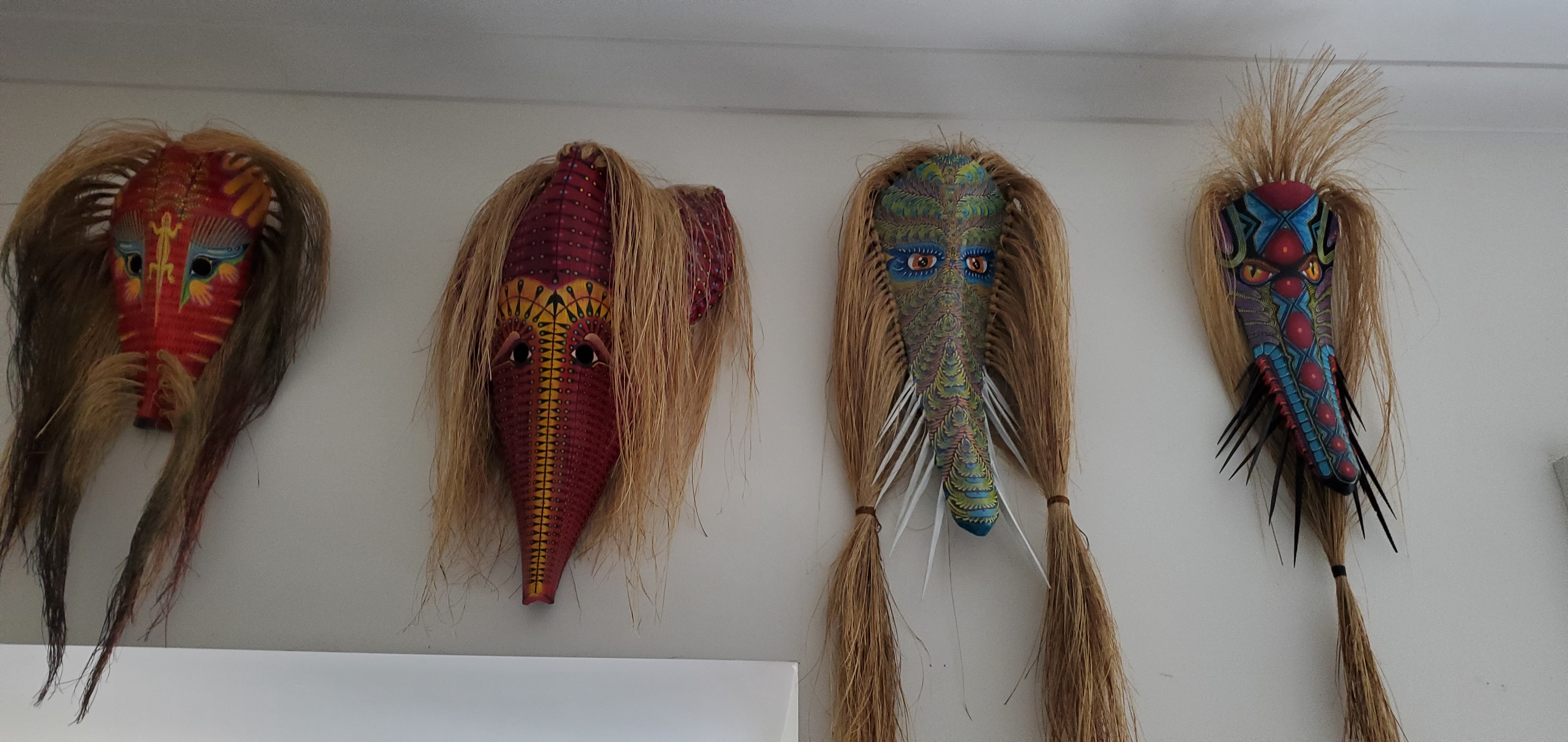
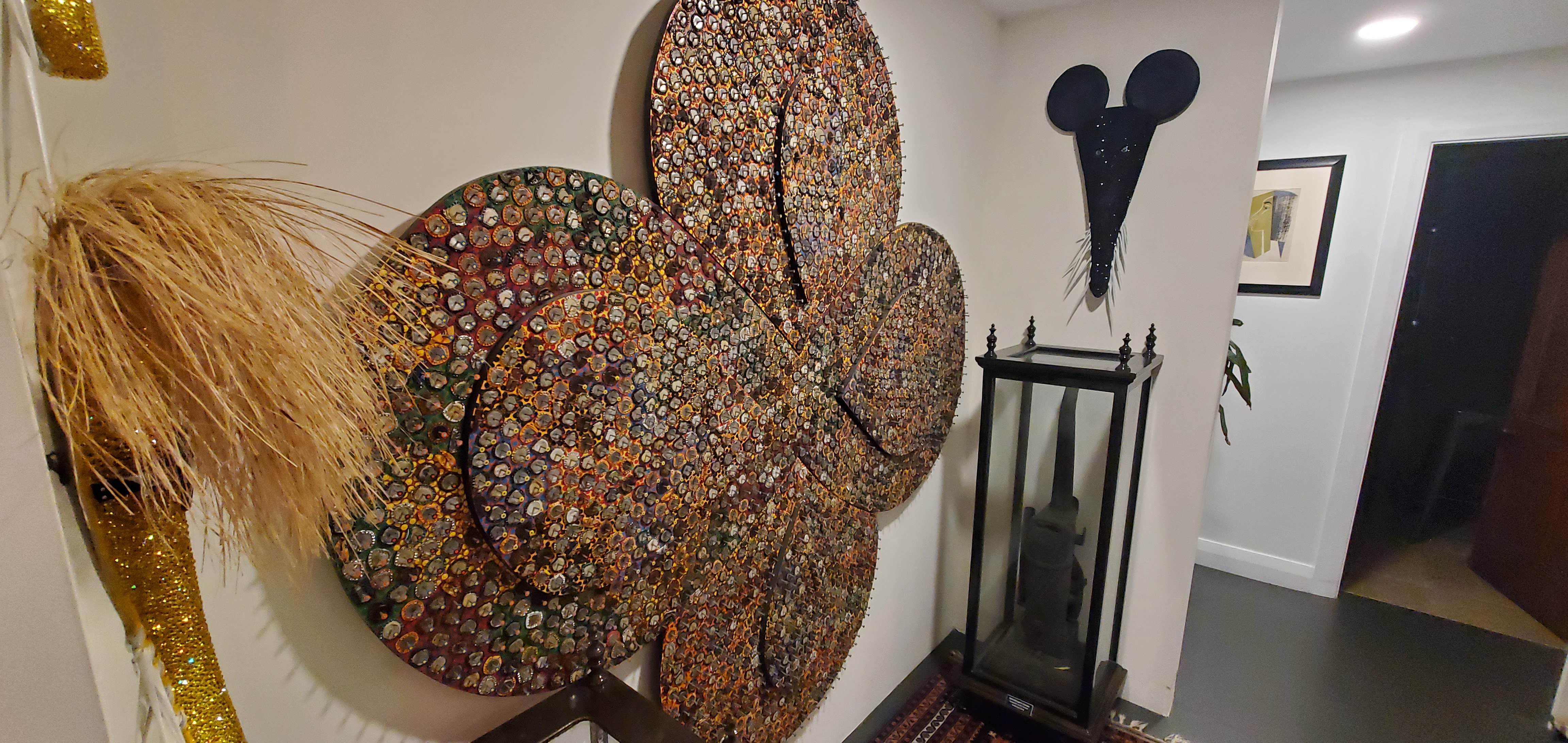
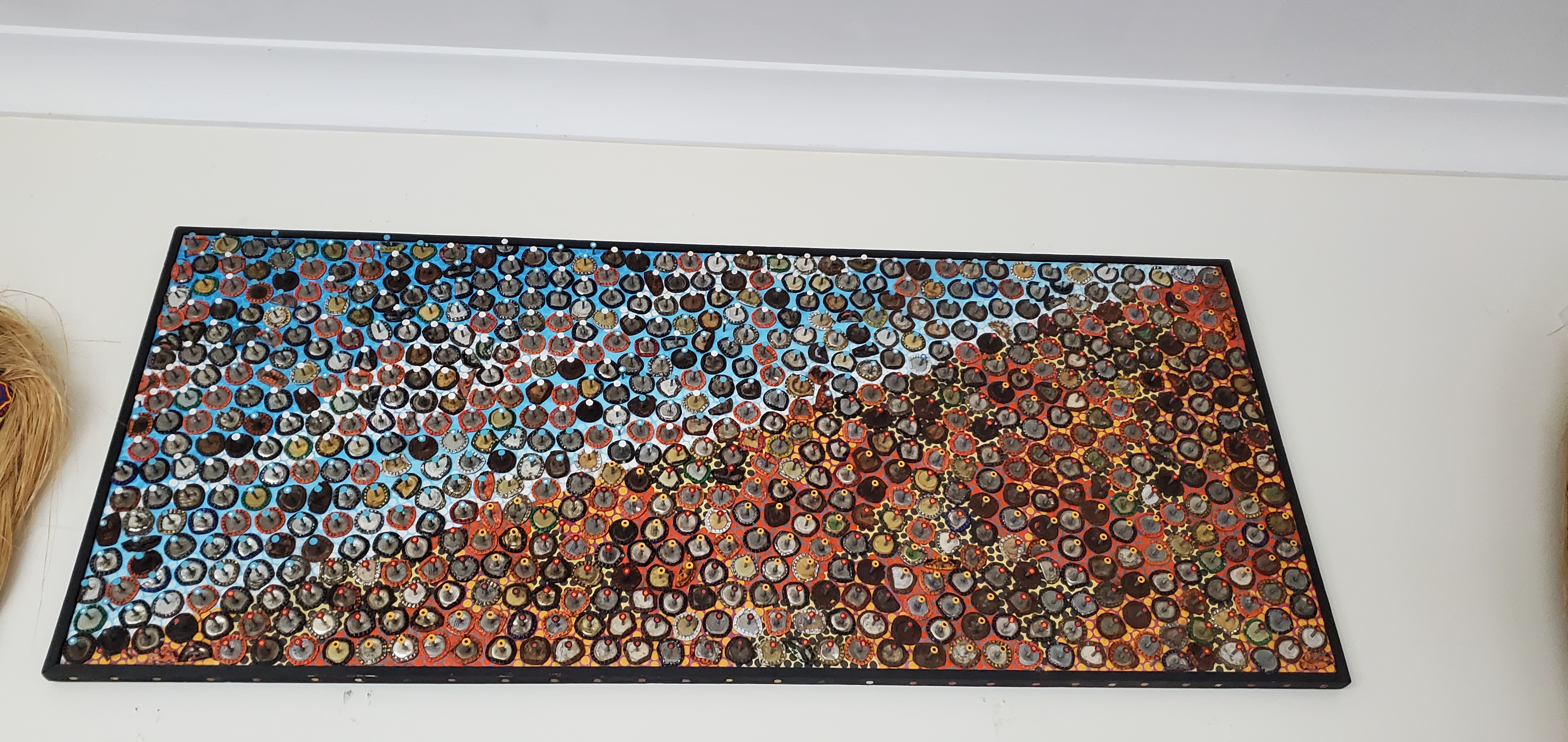
What an astonishing place we landed in! What may seem like luck in finding a cool Airbnb host is partially due to the research we do before booking. We look for people who respond positively to our inquiries. When hosts say something like “It’s just a business,” “We don’t actually live there,” or “This is just one of several rentals,” we usually don’t book with them. The ones who say, “Sure, we’d love to show you around,” or as in this host’s message: “Kia ora (Māori greeting) Woody and Rebecca. Thank you for your enquiry. We think Wellington is a cool little city and we can certainly share what we know with you,” we felt like they would be the ones to help us get to know Wellington and New Zealand.
Little did I know that they were going to be a key to unlock so much about the heart and soul of New Zealand.
Peter and Cathy
After settling in and taking a rest, we went out to explore. We walked up their street (Prince Street) and found a steep stairway down the hill to the main road that runs around the harbor. There was a restaurant ahead of us on the water and Woody suggested we go have a drink. It was called Coehne’s Bar—it was upstairs, and downstairs was the Yacht Club—started in 1880 or so.
We sat down at an outdoor table overlooking the harbor and ordered some wine. (It was Happy Hour.) I heard someone speaking American English and looked around to the next table and who should be sitting there, but the only people we know in Wellington, the people we were going to be joining for dinner in a couple hours, Cathy, and Peter Dyer!
We went to their table, and we all hugged and smiled in amazement.
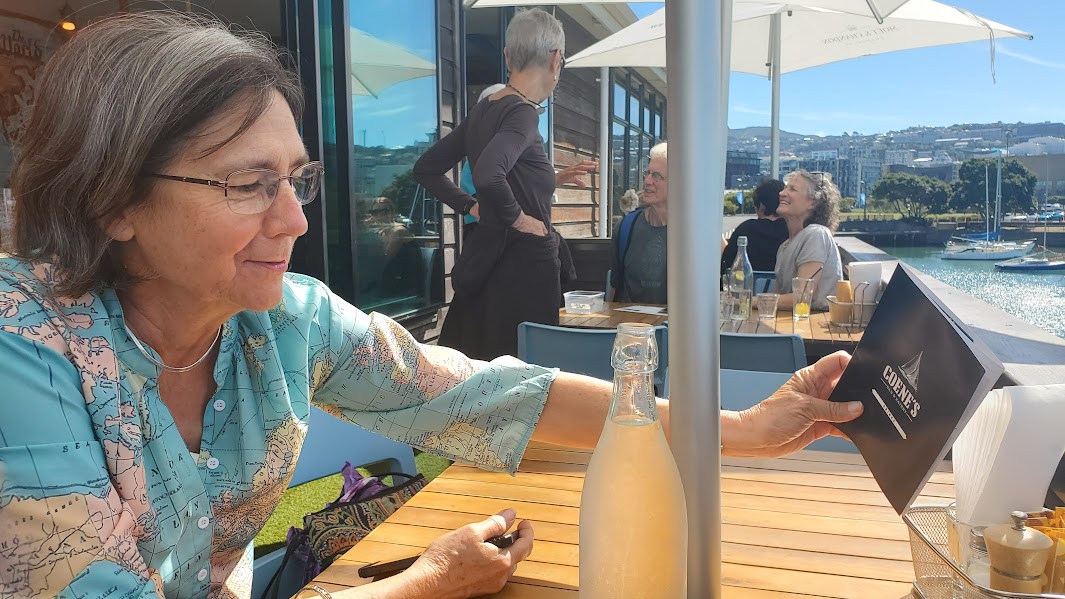
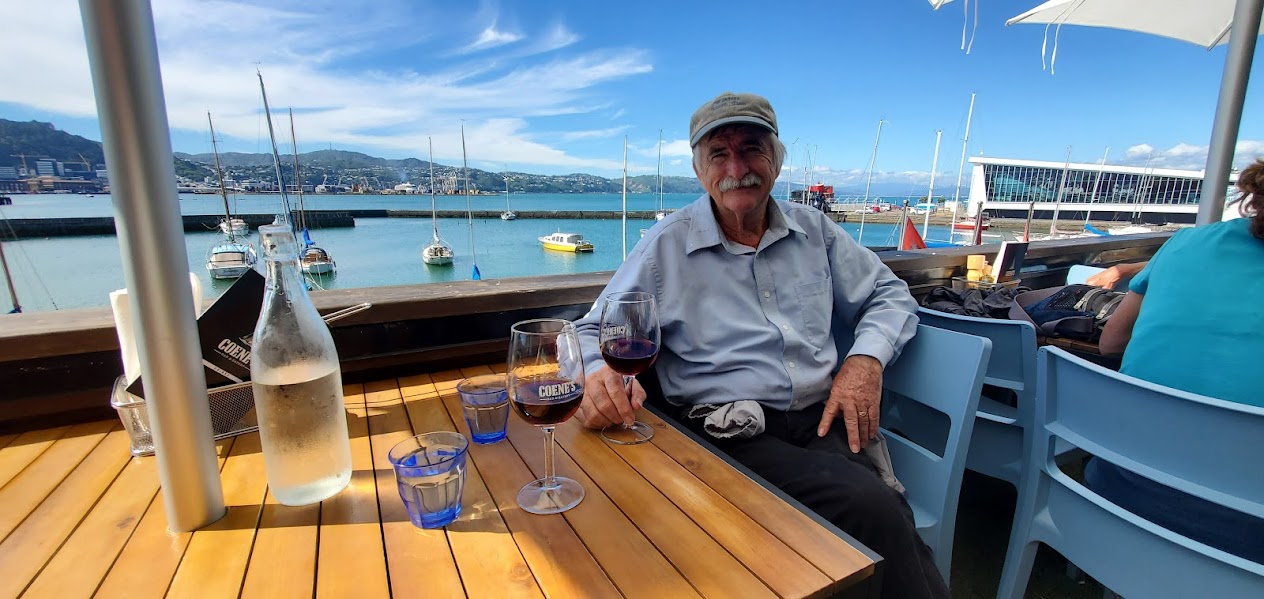
Rebecca and I took photos of each other at the Yacht Club that first afternoon. Later we discovered that Peter and Cathy are seen in the photo I had taken behind Rebecca. Later we overheard them and had a laugh at the improbability of it.
We didn’t know them very well. When they lived in Winters. they lived on rural Central Lane, worked at UC Davis, and had no kids.
Now they live on the 8th floor of a new apartment building near the harbor. It is a small but functional apartment, filled with their instruments hanging on the wall, some guitars that Peter plays, and an upright bass in a stand that Cathy plays.
Peter and Cathy lived in Palmerton North here in New Zealand before they moved to Wellington. Cathy was working as a university veterinarian but then she changed jobs and they moved to Wellington. There she worked as a researcher who organized the protocols about what couldn’t be brought into the country. So, she was the reason the beagle was sniffing my bag when we went through customs.
We went to dinner later that evening at their place. Peter and Cathy now live in a modern apartment, with their dog, Tiny, eight floors above the busy center of Wellington. They invited us over for dinner the first night and we got to meet Peter’s cousin, from Alexandria, Virginia, Debby who was also visiting.
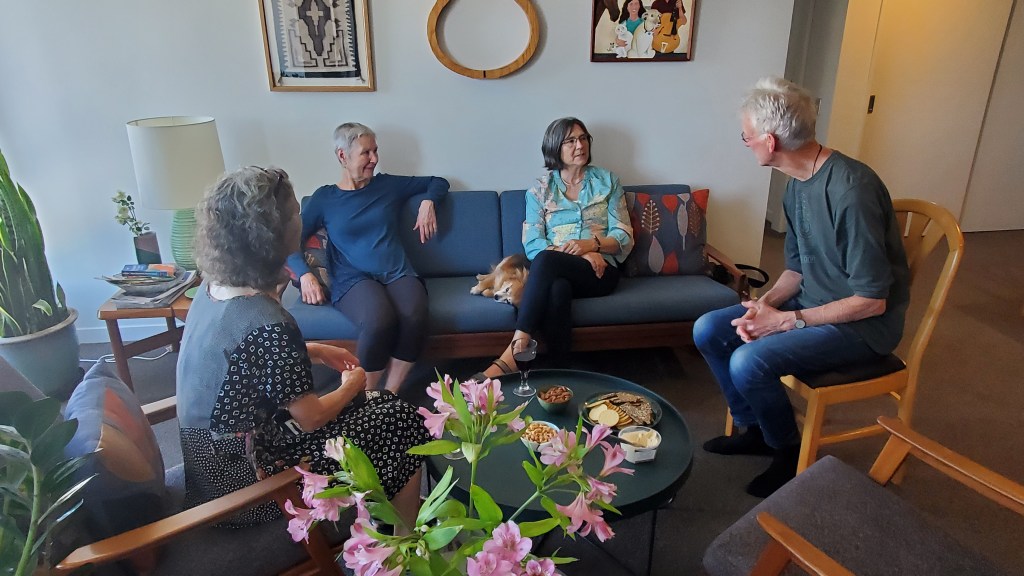
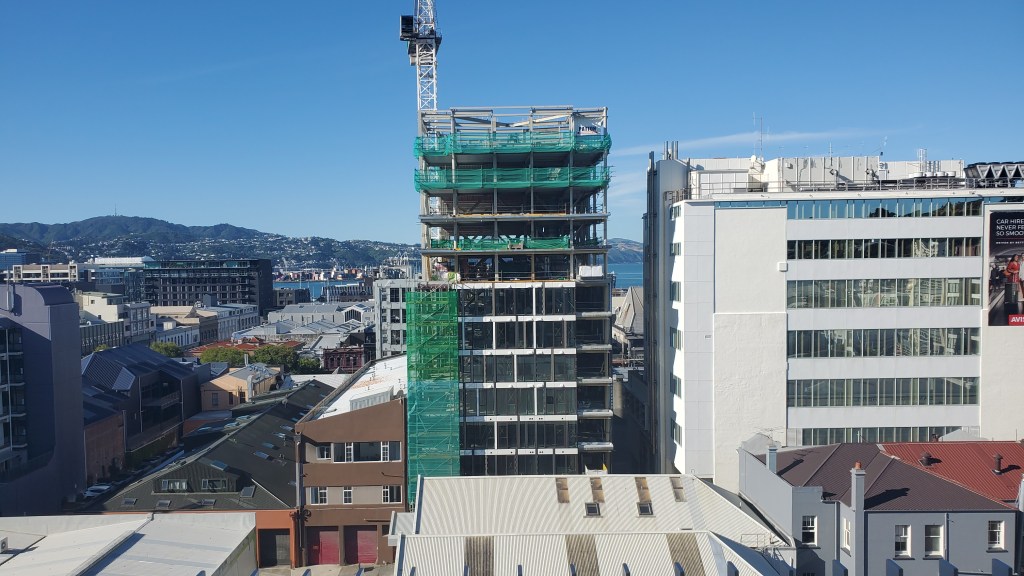
From their balcony, they used to have a great view of Lambton Harbor. But it is still a very nice view of the Central Business District. “Besides, whose view did our building obstruct when this building went up?” Peter asked.
To the right of the previous photo, we could pick out where James and Kevin’s house perched high up on the hill. It, too, has an obstructed view just below the pink building on the horizon.
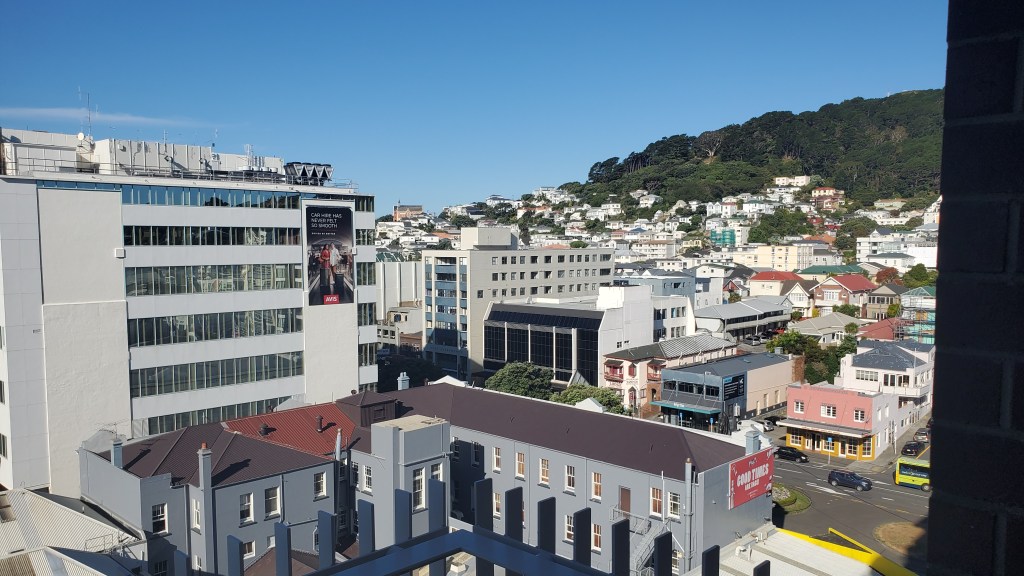
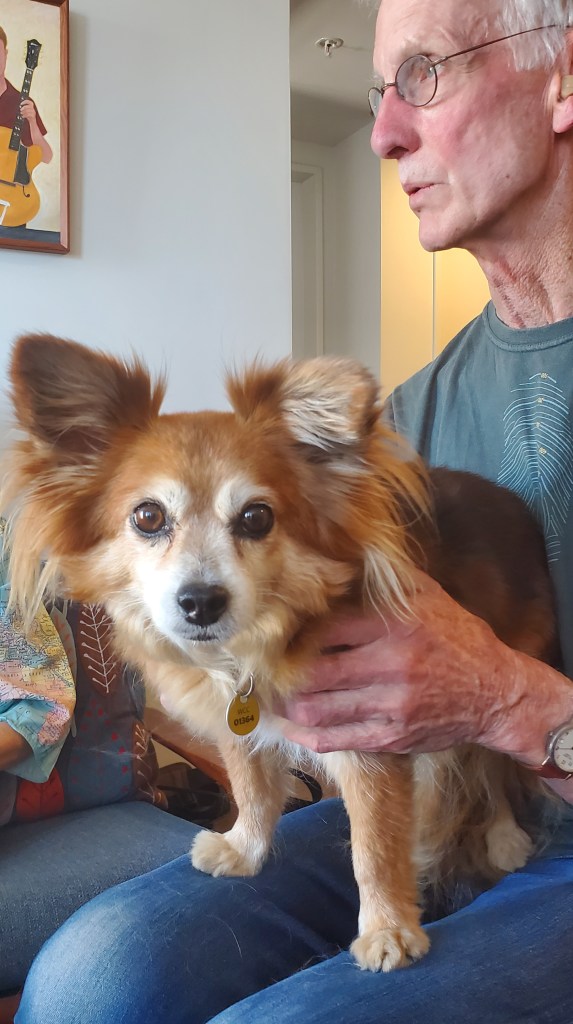
“Tiny” quickly became a favorite of ours. He is a quiet, loving rescue dog that Cathy tried to find a home for, but they ended up adopting. Here, Peter is holding him, but he visits all the guests as he warms up to them. He is maybe a mix of Pomeranian and Papillon. He’s the perfect pet for a small apartment. Taking him for three walks a day keeps Peter and Cathy busy.
Cathy and Peter posed for a photo with us in front of their musical instrument collection. They play as part of a few different musical groups in Wellington’s folk culture.
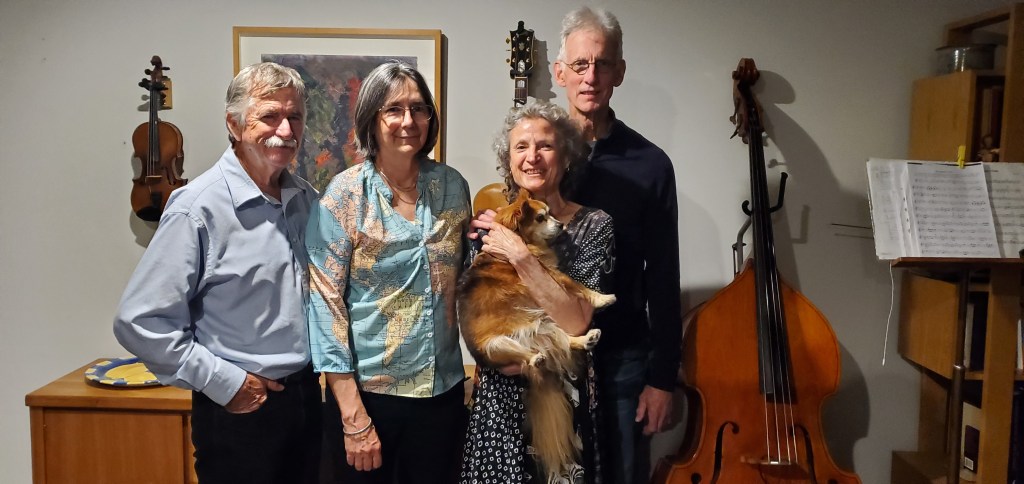
Peter worked as a machinist in Palmerston North. Later he turned to writing. He is the author of numerous articles for New Zealand publications as well as of a book: Rottenomics–the story of New Zealand’s Leaky Buildings Disaster.
Peter and Cathy had prepared a sumptuous meal of tortillas and salad, served after several toasts to friendship and old memories. I was especially enamored of Tiny, their small rescue Pekingese mix dog. Tiny came to sit on my lap for part of the evening. We enjoyed catching up with twenty years of being in different places. We told them about what Winters has been doing, and they told us of New Zealand life and times.
When we got back to James and Kevin’s place, we met James. He is an artist who does very interesting artwork using found and natural materials. James showed us some of the artwork in the house. Much of it is from previous shows he had done. There were several huge masks made from the base of palm fronds and painted in bright colors. The effect is a kind of natural-looking sculpture. He also had several large pieces made with bottle caps that formed amazing patterns and textures.
Zealandia
The next morning, we met Cathy and Peter, and Peter’s Debby and her niece, Carrie, and took a bus to Zealandia. It’s a very large nature preserve with miles of paths to explore. It houses many of the endangered birds of NZ. It also has a habitat area for the tuatara, a reptile cousin to the lizard family and the only surviving member of its order.
We stayed together walking for a while. Cathy knew a lot about the birds we saw. One bird, she said we were fortunate to see, was the takahe—it was thought to be extinct, but they had found a few survivors on an island. They have been in a captive breeding program and are doing better. There are about 250 now. They are about the size of a chicken and have blue-black iridescent feathers, bright orange feet and beaks.

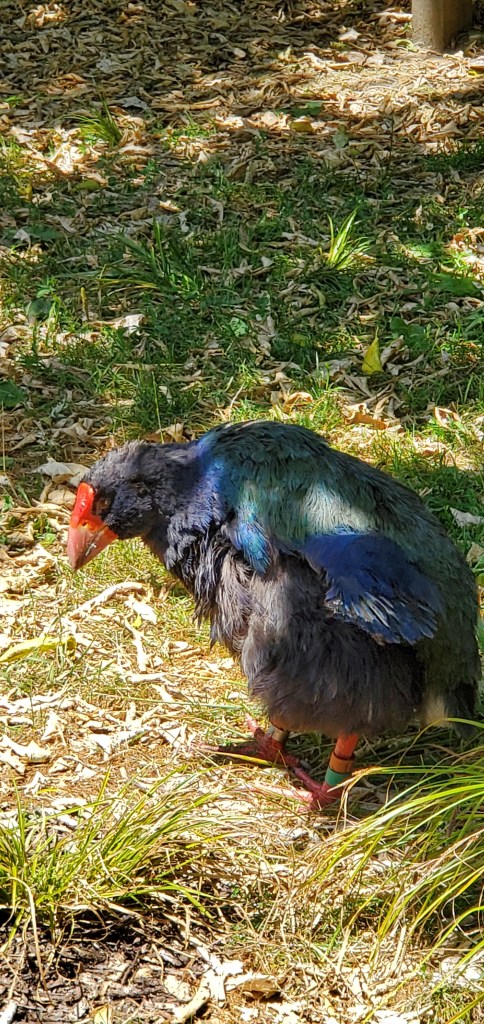
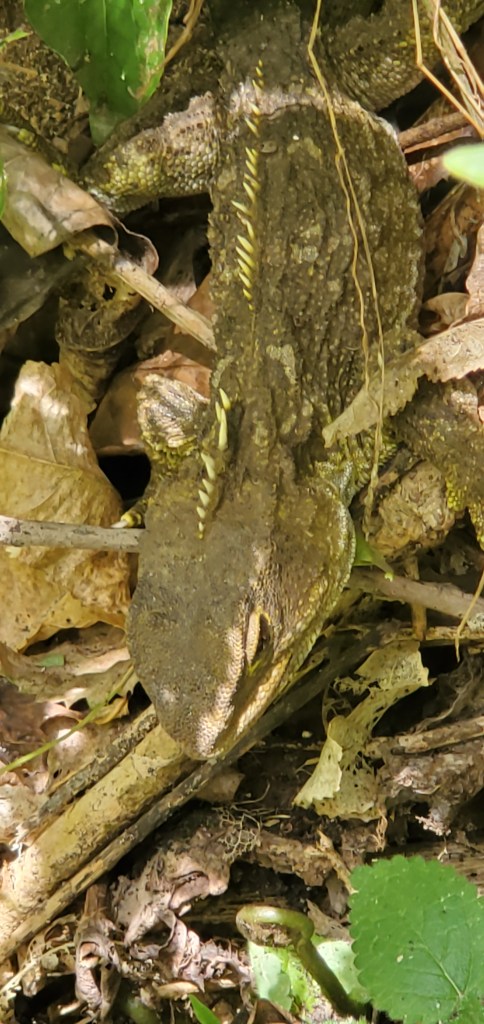
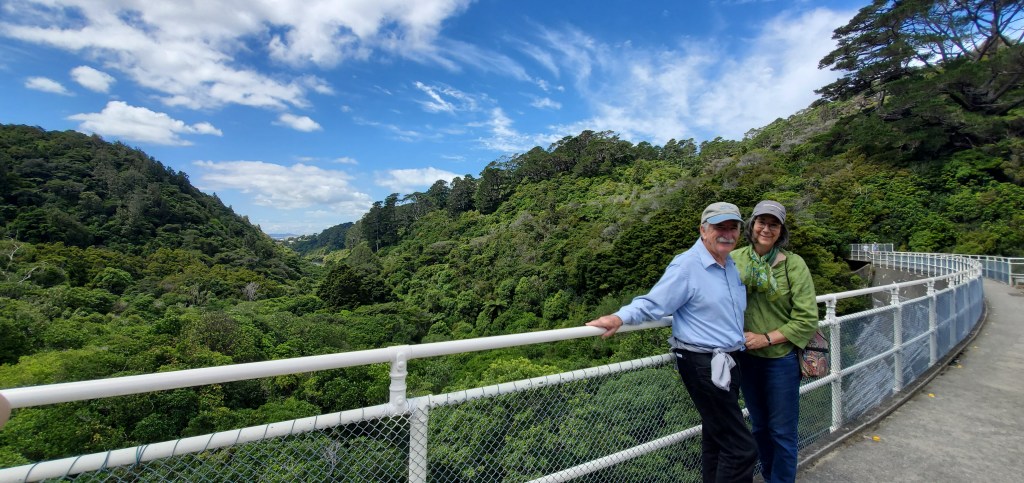
Zealandia is different from other zoological preserves. Rather than putting endangered animals in a zoo-like cage, this preserve has natural habitats that are suited to the species that are endangered and we walk on paths that don’t impact their habitat. The animals and supporting food sources are appropriately placed together. While paths are created through the different areas, the animals may or may not be out when you walk through, but they are plentiful. Many reserves prop up the endangered species. But here, when a certain species is placed, they are on their own. They must survive on their own, so it is a small step to move these individuals from this preserve back into an unprotected habitat. The main control is to keep the invasive predators out of the park with high fences. Stoats, rats, feral cats, and Australian possums have all been introduced here and play havoc with native species. There were many traps set around the park to catch them.
Visiting a Māori Marae
That night we bought Chinese takeaway on our way home. James and Kevin were there, James had been working in the backyard. He has created a lovely space there—though tiny, he has some herbs, peppers, and a few tomatoes growing along the back fence. He also has quite a collection of cacti.
We enjoy their company. They are smart, witty, and are doing good things. Kevin invited us to join him tomorrow to see one of his projects. He is Māori and helps support a Māori community center in a small rural town about an hour away—he used to live there. They are getting ready for a festival this coming Tuesday and he is helping organize it. So, we will get to see a marae—a center where Māori culture and customs are the main focus. James said he would go with us too.
I wasn’t sure exactly what the plan was. We had talked about arranging a walking tour of Wellington through the “free walking tour” system that we have enjoyed in many cities in our travels. But when Kevin invited us, we thought this was something that ordinary tourists might not ever see.
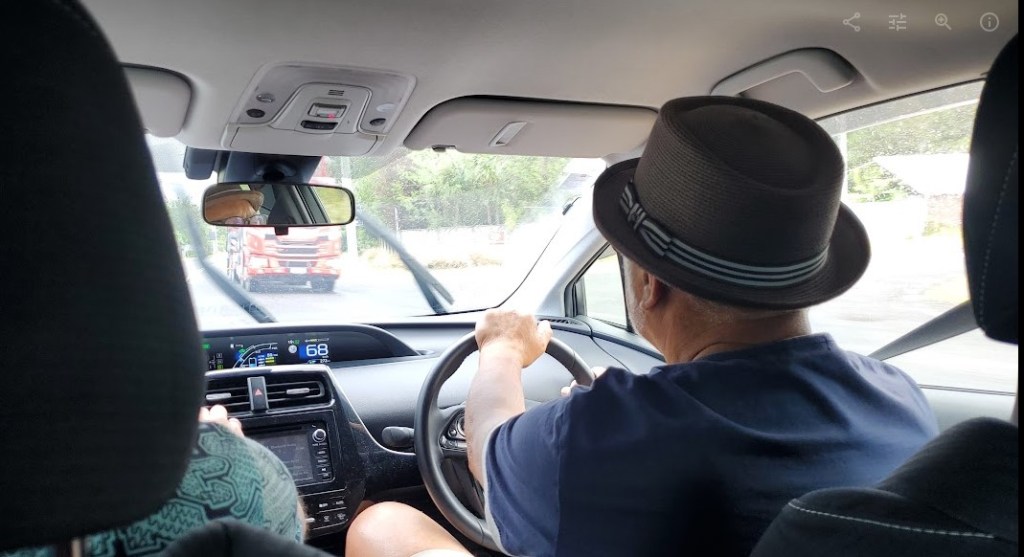
In the morning, we rode with Kevin and James out of the busy Wellington traffic, through the rain on the winding, soggy highway northeast through the small town of Featherston. From there, we headed on the flat farmland to Martinborough. The village square was getting ready for a big fair there the next day. Then we drove a couple blocks from the town square to see the marae. There was a large kitchen and dining room to one side (the Whare kai), a large, open lawn (the marae), and then an A frame-shaped building (the Whare nui) with red carved facia rafters, and at the top of the main ridgepole, a carved figure.
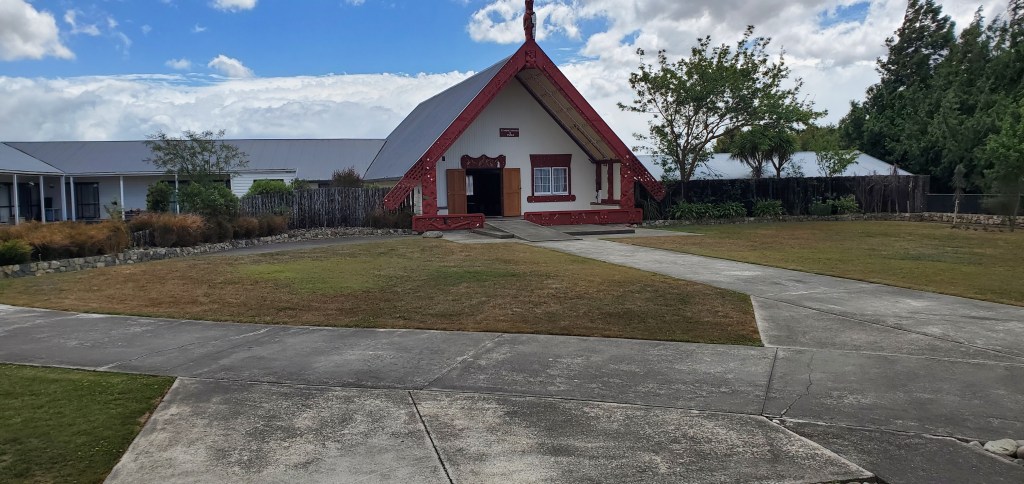
Kevin told us that the carved figure (called a tekoteko) represents the ancestor after whom the Whare nui is named. The Whare nui or meeting house and the marae are most important for the Māori community as this is the site where visitors are formally welcomed, acknowledged and where truly important occasions are held. The Whare nui and marae present the pride of the community.
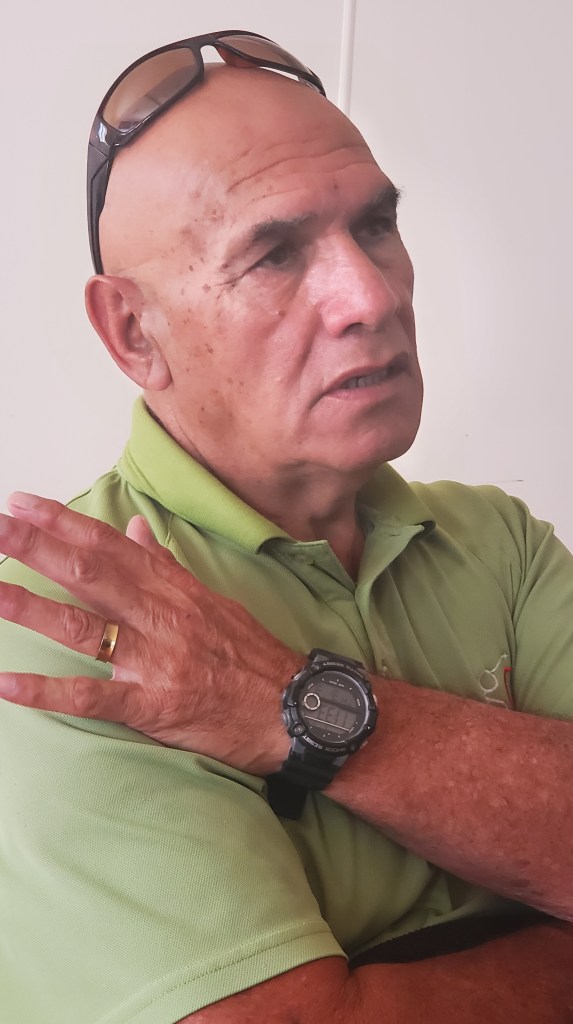
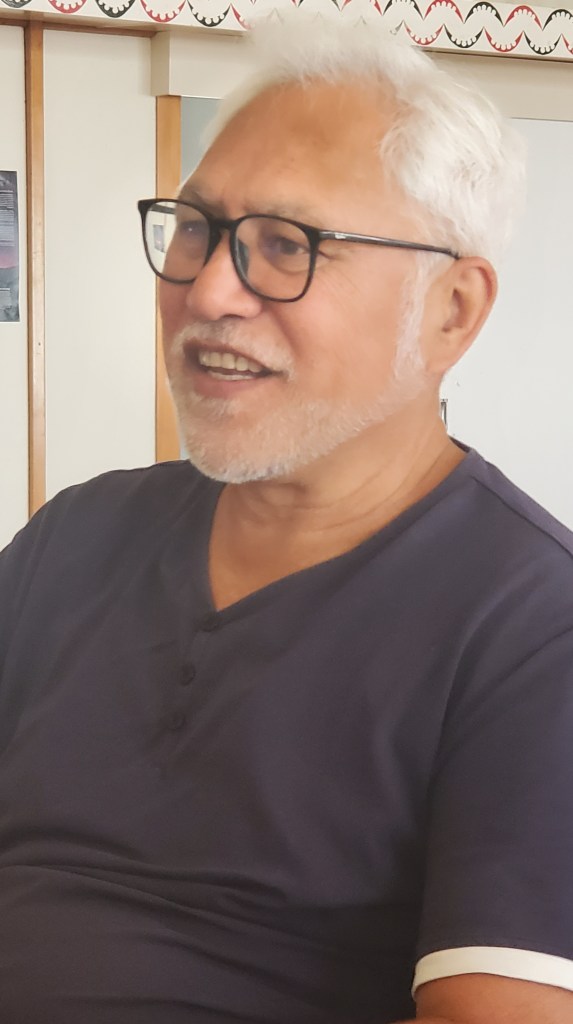
Kevin (right) is the Chairman of the Trustees of this Marae. He met with Wiremu Dawson (left), the kaumatua of the hau ariki marae (the elder of the center of Mauri identity and activities for this community.)
I asked if we would be able to see the marae, Kevin said that it is only open to guests that are invited by the Kaumatua of the marae. In the meantime, Kevin had to meet with a few people from the marae to plan for the Waitangi Day celebration coming up. (Waitangi is a commemoration of the signing of the Waitangi Treaty of 1840, and this local marae was going to put on a special celebration for the Martinborough community a few days later.)
Kevin told us that we could come in and listen to the planning meeting. When we came into the building, a gentleman of about 60 years old greeted us, his name was Wiremu Dawson. He is bald, with olive skin, stoutly built and had penetrating, dark eyes. He first greeted Kevin and James with the “hongi” a traditional gesture made by placing the foreheads and noses together. Then, he asked me if I would mind doing the same greeting. I was honored, but a bit uneasy, not knowing how to do it. He said, “Just look straight into my eyes.” He offered me his hand to shake, then pulled me closer, staring into my eyes, and we pressed foreheads and noses together. Then, he offered the same greeting to Rebecca. I felt we had been invited into a sort of inner circle.
I came to understand that Kevin was the Chairman of the Trustees of the marae, a position that holds legal responsibility for maintaining the property and administration of functions of the Māori community. I began to realize we were getting a rare peek at the inner workings of the first peoples of New Zealand in this community, something that was that sort of thing we always seek to see—something that a typical tourist might never have the opportunity to experience.
I don’t remember the exact business they discussed, but it was simply a discussion of who would be in charge of which parts of the event, food, tables, and setup. We even participated in the discussion a bit by making some comments about how the visitors could come in and out, get access to the refreshments without blocking the entrance. What did we know? I think they were very kind to put up with us.
Although James does not have Māori blood, he seems to have a certain important position in this marae. As Kevin’s partner, he is known and accepted as a part of the community. He was involved in some maintenance, and it seems that he has contributed some of his artistry to some of the carved pieces on the marae.
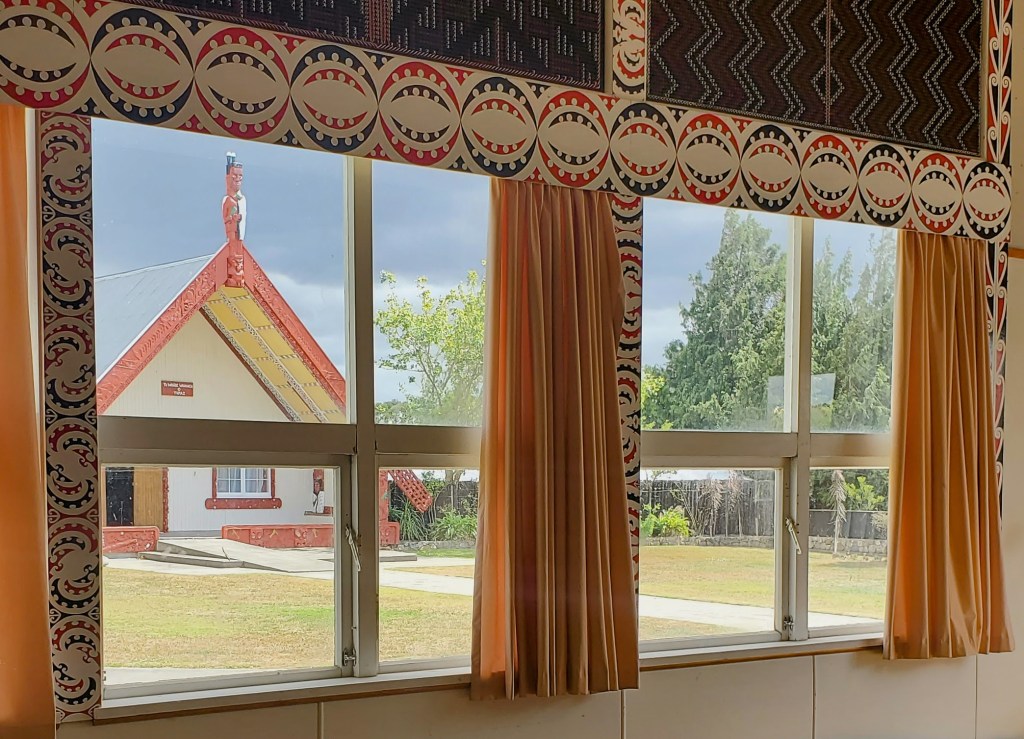
I asked them if it would be ok to take photos during this meeting, and they agreed, but I detected some reluctance. They said that here, it is ok, but not in the Whare nui. So, I guessed at some point we would be invited in to see it.
Later, we went outside, and Kevin instructed us on how we would be invited in. When Wiremu comes to the entrance of the Meeting House, he will invite us in for a formal welcome. Our instructions included before entering the Whare nui, we are to take off our shoes. Once iInside the Whare nui, seating would be arranged opposite where Wiremu would sit, these would be our seats, protocol also required men sit in front, and the women (in this case, just Rebecca) sit behind the men.
When Wiremu came to the entry way to invite us into the whare nui, he was in a nice, freshly ironed white shirt, and his demeanor changed from that of being a practical workman, head maintenance guy here, magically, to the stern, serious, and respected leader of the marae. We removed our shoes, the men entered first and Rebecca came in behind. The walls were adorned with upright carvings whakairo, tukutuku, woven panels and kowhaiwhai painted panels.
In the center, there were benches where we sat.
Wiremu began his welcome or whakatau with a karakia (a blessing) followed by oratory whaikorero, and a welcome song waiata. Kevin responded for us in the same way. They asked us if we wanted to say anything. I said that this seemed really to be a living place because it is only occupied when the descendants of the original builders had invited us inside, so it seemed to be a very special experience.
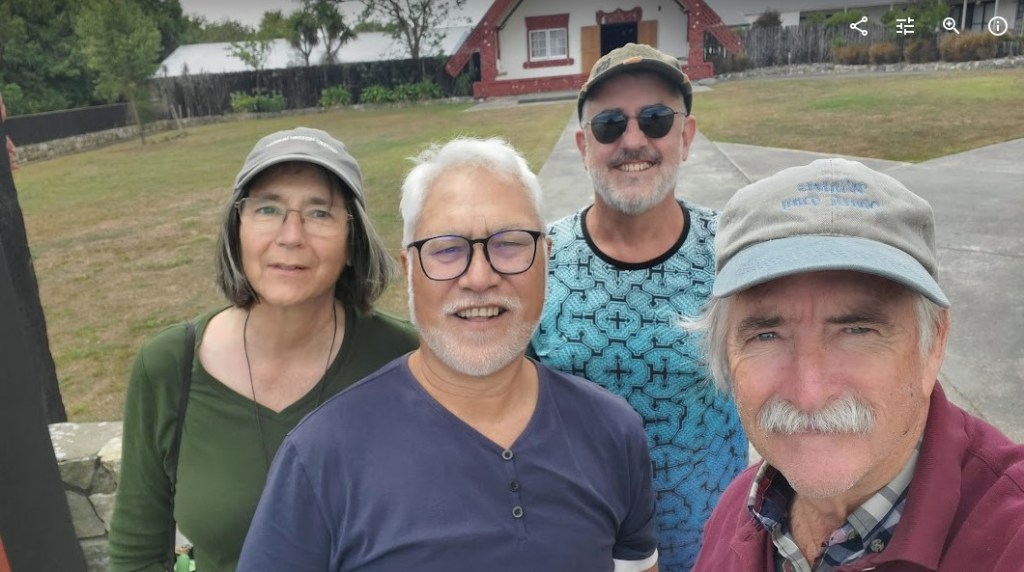
After a while, we went back into the dining hall. A member of the Māori community came and began to set up some tables. I thought it was for some other meeting. Soon, however, they invited us to be seated, and they served us light sandwiches, fruit, and coffee or tea. I don’t think it set in until just then what an honor we had been presented. We could not have landed in a better situation to get a glimpse of both the modern life and the historic roots of New Zealand.
Last Night in Wellington
Back at the apartment we had invited Peter and Cathy and Peter’s cousins to go out to dinner with us and Kevin and James. After we returned from our drive, I walked to the market and bought some hors d’ oeuvres and set them up out on the kitchen counter. Peter and Cathy and his cousin arrived at 6 pm, all clad in dripping rain gear. They were all duly impressed with James’s artwork. They seemed to enjoy talking with one another. We left for the restaurant about 7:15. We were eating at Coehne’s again where Woody and I had had drinks that first day. It’s a noisy restaurant, but we all enjoyed the food and company. We talked for a long while. No one had dessert. We were all too full.
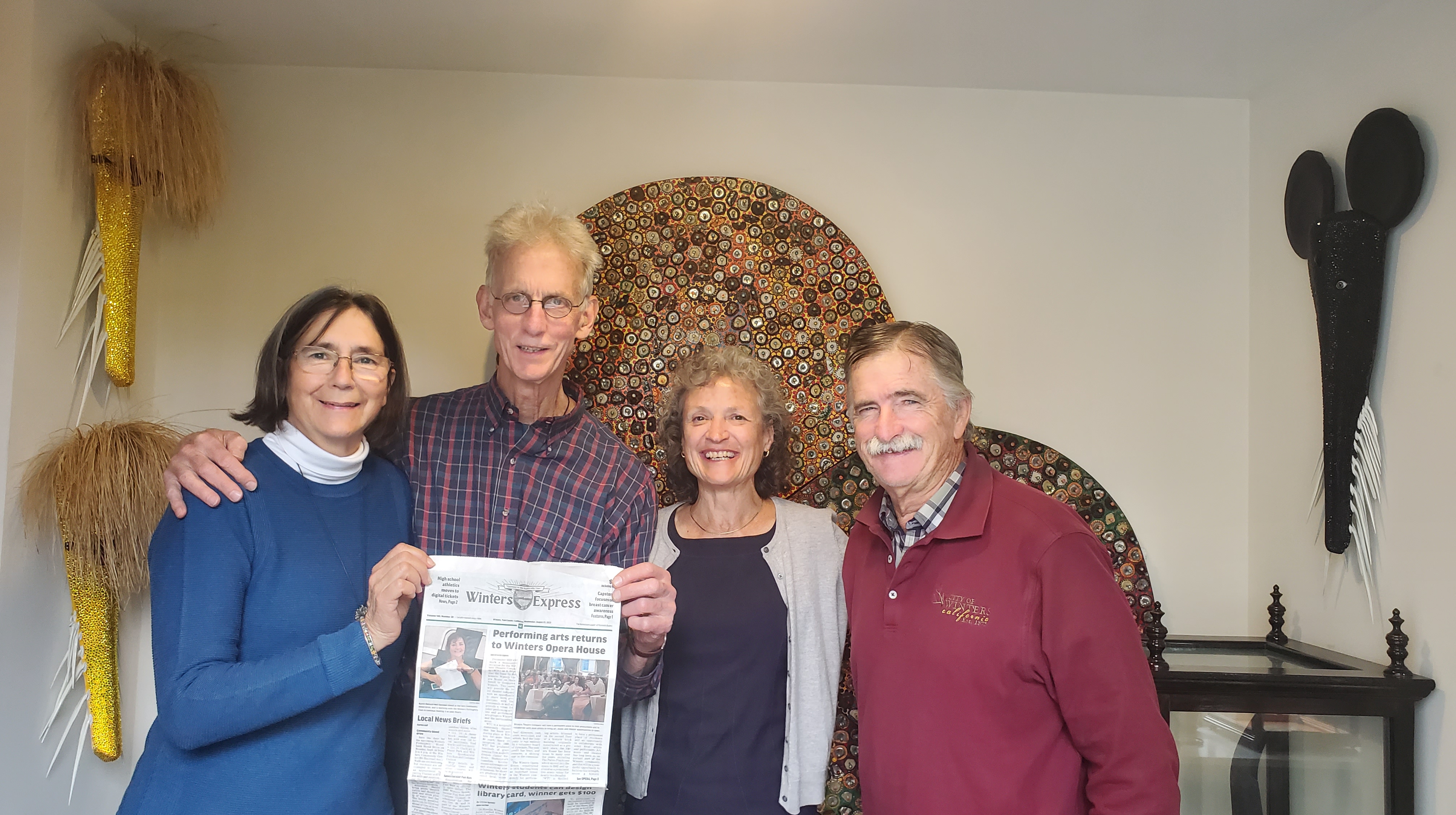
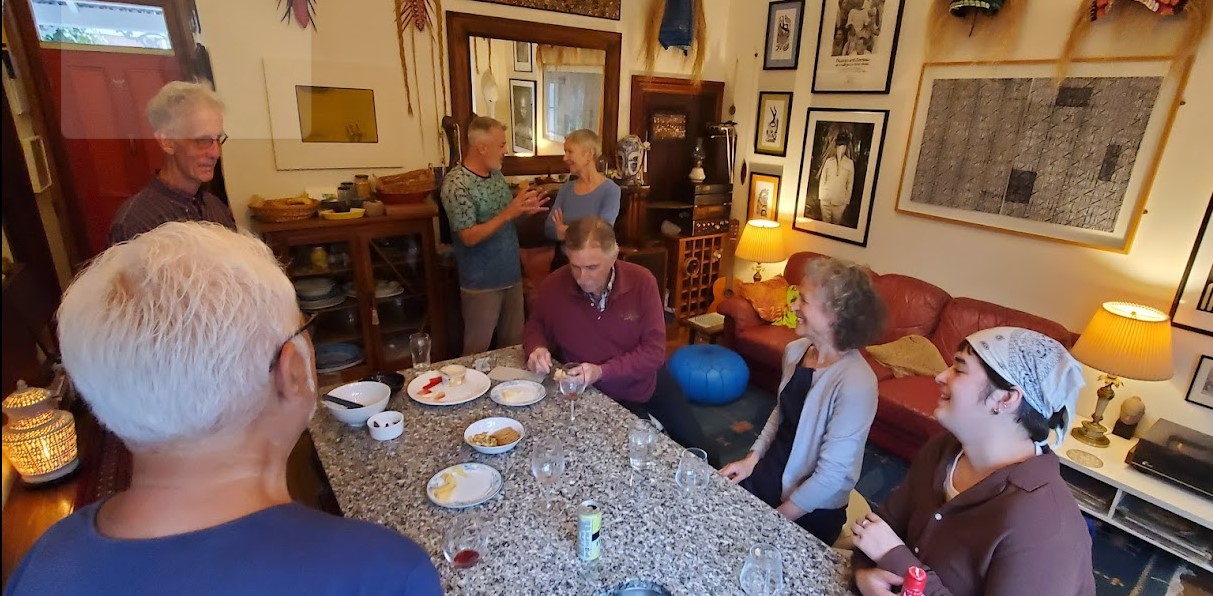
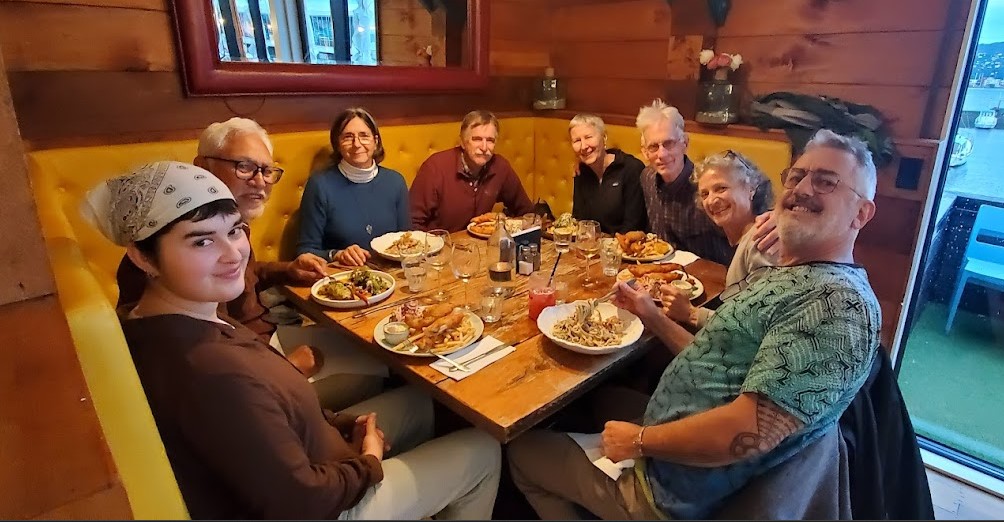
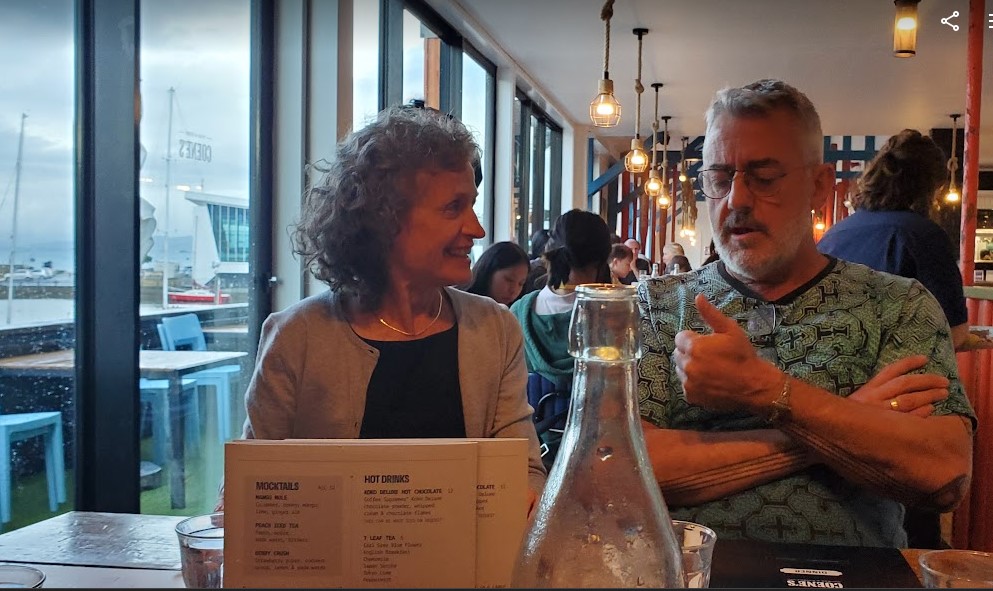
The two groups had a chance to meet each other at dinner. Cathy and Peter and cousin, Debby, and Debby’s niece, Carrie, all came to see the amazing artwork at the apartment, and Rebecca and I posed for a photo with the Winters Express, an old custom. We met at the Yacht Club once again.
We all hugged goodbye. Tomorrow Woody and I will head north.
The start to our New Zealand trip was amazing, but not what we expected. The renewed friendship and sharing Zealandia’s amazing nature preserve with Peter and Cathy; the artwork we enjoyed of James throughout this apartment; and of course, Kevin’s introduction to the true New Zealand, Aotearoa, it was all such an abundant experience.
One of the things I read about the way of looking at life through Māori eyes was this: At the heart of Māori philosophy is this: ” All of life is inter-connected. When we recognize this, we accept the limitations of human domination of the environment.” I thought of this as we went to sleep that last evening. I thought about how we all struggle to find our place in the world and part of this struggle is how to be respectful and content with our limitations. If we are to ever have a world where peace rules the planet, it would look a lot like the experience we’ve had here in Wellington. Peter and Cathy, and James and Kevin, friends new and old, they have shown us a glimpse of that world! We are full!

 Fridaes' Adventures
I love the way you make friends everywhere you go.
LikeLike
Thanks. We work at it a bit. Some are casual acquaintances and some I expect to visit us in California! We expect to see Cathy and Peter later this year as they already have a trip back to N. California in the late summer. Kevin and James are considering coming sometime.
LikeLike